

5 Preparation of the Catalysts
207
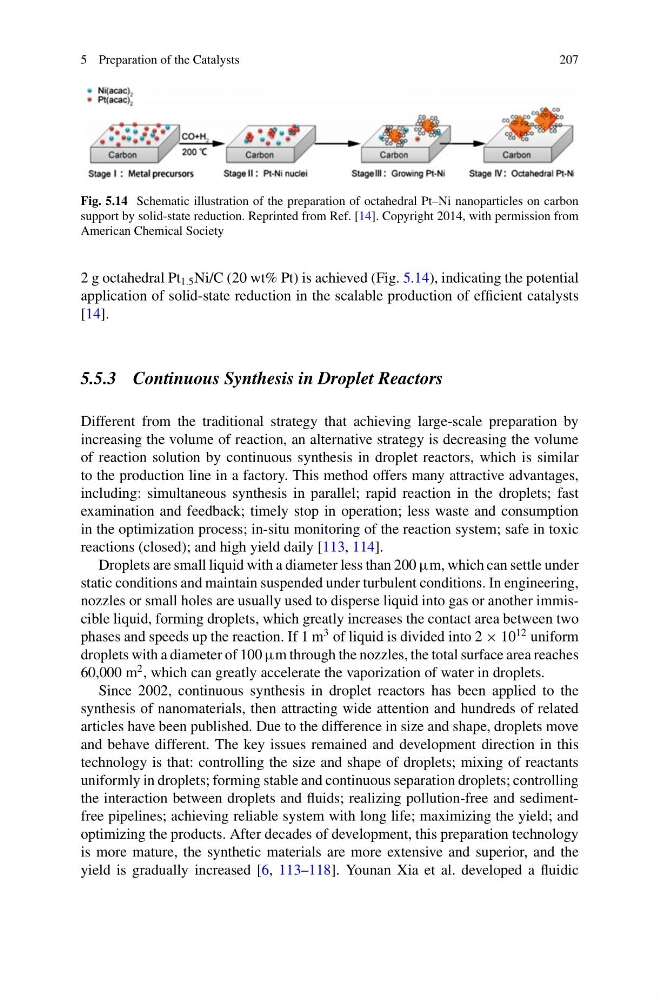
Fig. 5.14 Schematic illustration of the preparation of octahedral Pt–Ni nanoparticles on carbon
support by solid-state reduction. Reprinted from Ref. [14]. Copyright 2014, with permission from
American Chemical Society
2 g octahedral Pt 1.5 Ni/C (20 wt% Pt) is achieved (Fig. 5.14), indicating the potential
application of solid-state reduction in the scalable production of efficient catalysts
[14].
5.5.3 Continuous Synthesis in Droplet Reactors
Different from the traditional strategy that achieving large-scale preparation by
increasing the volume of reaction, an alternative strategy is decreasing the volume
of reaction solution by continuous synthesis in droplet reactors, which is similar
to the production line in a factory. This method offers many attractive advantages,
including: simultaneous synthesis in parallel; rapid reaction in the droplets; fast
examination and feedback; timely stop in operation; less waste and consumption
in the optimization process; in-situ monitoring of the reaction system; safe in toxic
reactions (closed); and high yield daily [113, 114].
Droplets are small liquid with a diameter less than 200 µm, which can settle under
static conditions and maintain suspended under turbulent conditions. In engineering,
nozzles or small holes are usually used to disperse liquid into gas or another immiscible liquid, forming droplets, which greatly increases the contact area between two
phases and speeds up the reaction. If 1 m
3 of liquid is divided into 2 × 10
12 uniform
droplets with a diameter of 100 µm through the nozzles, the total surface area reaches
60,000 m
2 , which can greatly accelerate the vaporization of water in droplets.
Since 2002, continuous synthesis in droplet reactors has been applied to the
synthesis of nanomaterials, then attracting wide attention and hundreds of related
articles have been published. Due to the difference in size and shape, droplets move
and behave different. The key issues remained and development direction in this
technology is that: controlling the size and shape of droplets; mixing of reactants
uniformly in droplets; forming stable and continuous separation droplets; controlling
the interaction between droplets and fluids; realizing pollution-free and sedimentfree pipelines; achieving reliable system with long life; maximizing the yield; and
optimizing the products. After decades of development, this preparation technology
is more mature, the synthetic materials are more extensive and superior, and the
yield is gradually increased [6, 113–118]. Younan Xia et al. developed a fluidic
207
Fig. 5.14 Schematic illustration of the preparation of octahedral Pt–Ni nanoparticles on carbon
support by solid-state reduction. Reprinted from Ref. [14]. Copyright 2014, with permission from
American Chemical Society
2 g octahedral Pt 1.5 Ni/C (20 wt% Pt) is achieved (Fig. 5.14), indicating the potential
application of solid-state reduction in the scalable production of efficient catalysts
[14].
5.5.3 Continuous Synthesis in Droplet Reactors
Different from the traditional strategy that achieving large-scale preparation by
increasing the volume of reaction, an alternative strategy is decreasing the volume
of reaction solution by continuous synthesis in droplet reactors, which is similar
to the production line in a factory. This method offers many attractive advantages,
including: simultaneous synthesis in parallel; rapid reaction in the droplets; fast
examination and feedback; timely stop in operation; less waste and consumption
in the optimization process; in-situ monitoring of the reaction system; safe in toxic
reactions (closed); and high yield daily [113, 114].
Droplets are small liquid with a diameter less than 200 µm, which can settle under
static conditions and maintain suspended under turbulent conditions. In engineering,
nozzles or small holes are usually used to disperse liquid into gas or another immiscible liquid, forming droplets, which greatly increases the contact area between two
phases and speeds up the reaction. If 1 m
3 of liquid is divided into 2 × 10
12 uniform
droplets with a diameter of 100 µm through the nozzles, the total surface area reaches
60,000 m
2 , which can greatly accelerate the vaporization of water in droplets.
Since 2002, continuous synthesis in droplet reactors has been applied to the
synthesis of nanomaterials, then attracting wide attention and hundreds of related
articles have been published. Due to the difference in size and shape, droplets move
and behave different. The key issues remained and development direction in this
technology is that: controlling the size and shape of droplets; mixing of reactants
uniformly in droplets; forming stable and continuous separation droplets; controlling
the interaction between droplets and fluids; realizing pollution-free and sedimentfree pipelines; achieving reliable system with long life; maximizing the yield; and
optimizing the products. After decades of development, this preparation technology
is more mature, the synthetic materials are more extensive and superior, and the
yield is gradually increased [6, 113–118]. Younan Xia et al. developed a fluidic