

206
S. Luo et al.
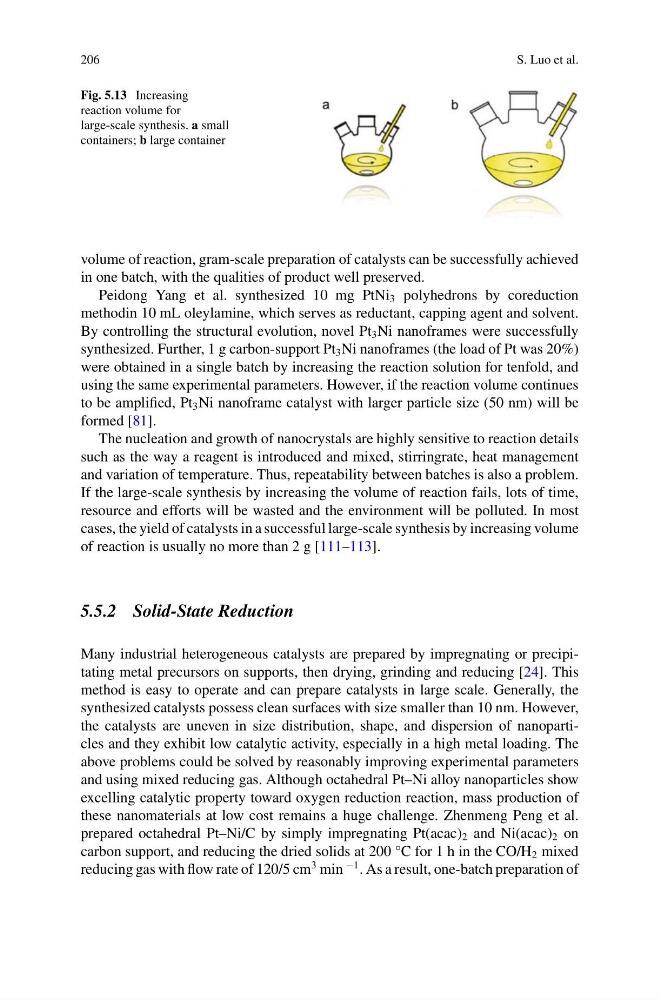
Fig. 5.13 Increasing
reaction volume for
large-scale synthesis. a small
containers; b large container
volume of reaction, gram-scale preparation of catalysts can be successfully achieved
in one batch, with the qualities of product well preserved.
Peidong Yang et al. synthesized 10 mg PtNi 3 polyhedrons by coreduction
methodin 10 mL oleylamine, which serves as reductant, capping agent and solvent.
By controlling the structural evolution, novel Pt 3 Ni nanoframes were successfully
synthesized. Further, 1 g carbon-support Pt 3 Ni nanoframes (the load of Pt was 20%)
were obtained in a single batch by increasing the reaction solution for tenfold, and
using the same experimental parameters. However, if the reaction volume continues
to be amplified, Pt 3 Ni nanoframe catalyst with larger particle size (50 nm) will be
formed [81].
The nucleation and growth of nanocrystals are highly sensitive to reaction details
such as the way a reagent is introduced and mixed, stirringrate, heat management
and variation of temperature. Thus, repeatability between batches is also a problem.
If the large-scale synthesis by increasing the volume of reaction fails, lots of time,
resource and efforts will be wasted and the environment will be polluted. In most
cases, the yield of catalysts in a successful large-scale synthesis by increasing volume
of reaction is usually no more than 2 g [111–113].
5.5.2 Solid-State Reduction
Many industrial heterogeneous catalysts are prepared by impregnating or precipitating metal precursors on supports, then drying, grinding and reducing [24]. This
method is easy to operate and can prepare catalysts in large scale. Generally, the
synthesized catalysts possess clean surfaces with size smaller than 10 nm. However,
the catalysts are uneven in size distribution, shape, and dispersion of nanoparticles and they exhibit low catalytic activity, especially in a high metal loading. The
above problems could be solved by reasonably improving experimental parameters
and using mixed reducing gas. Although octahedral Pt–Ni alloy nanoparticles show
excelling catalytic property toward oxygen reduction reaction, mass production of
these nanomaterials at low cost remains a huge challenge. Zhenmeng Peng et al.
prepared octahedral Pt–Ni/C by simply impregnating Pt(acac) 2 and Ni(acac) 2 on
carbon support, and reducing the dried solids at 200 °C for 1 h in the CO/H 2 mixed
reducing gas with flow rate of 120/5 cm
3 min
−1 . As a result, one-batch preparation of
S. Luo et al.
Fig. 5.13 Increasing
reaction volume for
large-scale synthesis. a small
containers; b large container
volume of reaction, gram-scale preparation of catalysts can be successfully achieved
in one batch, with the qualities of product well preserved.
Peidong Yang et al. synthesized 10 mg PtNi 3 polyhedrons by coreduction
methodin 10 mL oleylamine, which serves as reductant, capping agent and solvent.
By controlling the structural evolution, novel Pt 3 Ni nanoframes were successfully
synthesized. Further, 1 g carbon-support Pt 3 Ni nanoframes (the load of Pt was 20%)
were obtained in a single batch by increasing the reaction solution for tenfold, and
using the same experimental parameters. However, if the reaction volume continues
to be amplified, Pt 3 Ni nanoframe catalyst with larger particle size (50 nm) will be
formed [81].
The nucleation and growth of nanocrystals are highly sensitive to reaction details
such as the way a reagent is introduced and mixed, stirringrate, heat management
and variation of temperature. Thus, repeatability between batches is also a problem.
If the large-scale synthesis by increasing the volume of reaction fails, lots of time,
resource and efforts will be wasted and the environment will be polluted. In most
cases, the yield of catalysts in a successful large-scale synthesis by increasing volume
of reaction is usually no more than 2 g [111–113].
5.5.2 Solid-State Reduction
Many industrial heterogeneous catalysts are prepared by impregnating or precipitating metal precursors on supports, then drying, grinding and reducing [24]. This
method is easy to operate and can prepare catalysts in large scale. Generally, the
synthesized catalysts possess clean surfaces with size smaller than 10 nm. However,
the catalysts are uneven in size distribution, shape, and dispersion of nanoparticles and they exhibit low catalytic activity, especially in a high metal loading. The
above problems could be solved by reasonably improving experimental parameters
and using mixed reducing gas. Although octahedral Pt–Ni alloy nanoparticles show
excelling catalytic property toward oxygen reduction reaction, mass production of
these nanomaterials at low cost remains a huge challenge. Zhenmeng Peng et al.
prepared octahedral Pt–Ni/C by simply impregnating Pt(acac) 2 and Ni(acac) 2 on
carbon support, and reducing the dried solids at 200 °C for 1 h in the CO/H 2 mixed
reducing gas with flow rate of 120/5 cm
3 min
−1 . As a result, one-batch preparation of