

154
Y. Li et al.
4.6.4 Nitrogen-Doped Graphene
4.6.4.1 Oxygen Reduction Properties of Nitrogen-Doped Graphene
In 2010, Qu et al. [377] found that nitrogen-doped graphene (N-graphene) has the
ORR performance similar to nitrogen-doped carbon nanotubes, which opened the
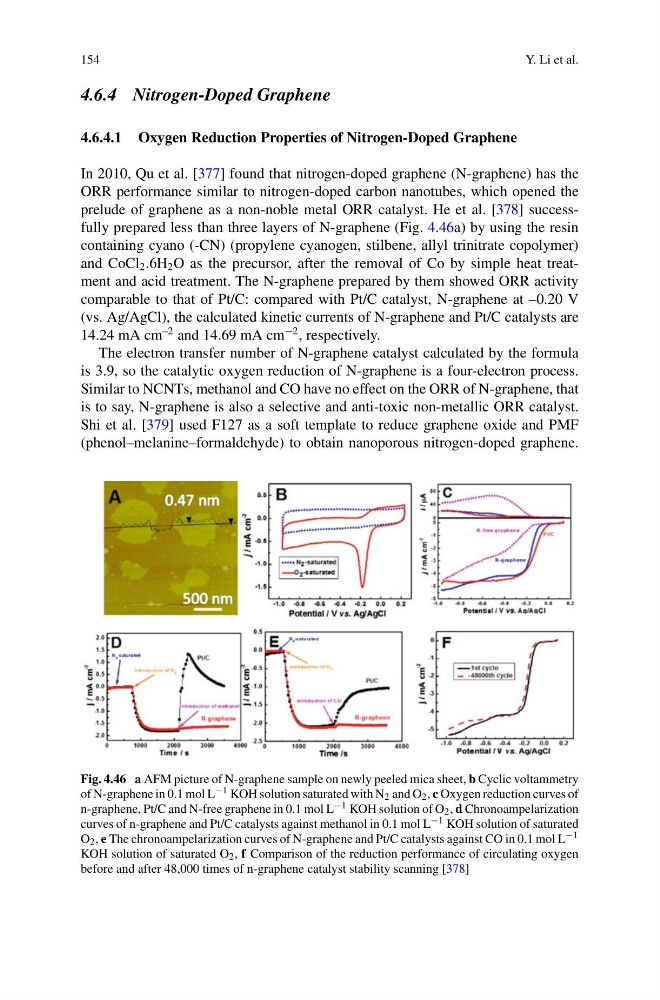
prelude of graphene as a non-noble metal ORR catalyst. He et al. [378] successfully prepared less than three layers of N-graphene (Fig. 4.46a) by using the resin
containing cyano (-CN) (propylene cyanogen, stilbene, allyl trinitrate copolymer)
and CoCl 2 .6H 2 O as the precursor, after the removal of Co by simple heat treatment and acid treatment. The N-graphene prepared by them showed ORR activity
comparable to that of Pt/C: compared with Pt/C catalyst, N-graphene at –0.20 V
(vs. Ag/AgCl), the calculated kinetic currents of N-graphene and Pt/C catalysts are
14.24 mA cm
–2 and 14.69 mA cm
−2 , respectively.
The electron transfer number of N-graphene catalyst calculated by the formula
is 3.9, so the catalytic oxygen reduction of N-graphene is a four-electron process.
Similar to NCNTs, methanol and CO have no effect on the ORR of N-graphene, that
is to say, N-graphene is also a selective and anti-toxic non-metallic ORR catalyst.
Shi et al. [379] used F127 as a soft template to reduce graphene oxide and PMF
(phenol–melanine–formaldehyde) to obtain nanoporous nitrogen-doped graphene.
Fig. 4.46 a AFM picture of N-graphene sample on newly peeled mica sheet, b Cyclic voltammetry
of N-graphene in 0.1 mol L −1 KOH solution saturated with N 2 and O 2 , c Oxygen reduction curves of
n-graphene, Pt/C and N-free graphene in 0.1 mol L −1 KOH solution of O 2 , d Chronoampelarization
curves of n-graphene and Pt/C catalysts against methanol in 0.1 mol L −1 KOH solution of saturated
O 2 , e The chronoampelarization curves of N-graphene and Pt/C catalysts against CO in 0.1 mol L −1
KOH solution of saturated O 2 , f Comparison of the reduction performance of circulating oxygen
before and after 48,000 times of n-graphene catalyst stability scanning [378]
Y. Li et al.
4.6.4 Nitrogen-Doped Graphene
4.6.4.1 Oxygen Reduction Properties of Nitrogen-Doped Graphene
In 2010, Qu et al. [377] found that nitrogen-doped graphene (N-graphene) has the
ORR performance similar to nitrogen-doped carbon nanotubes, which opened the
prelude of graphene as a non-noble metal ORR catalyst. He et al. [378] successfully prepared less than three layers of N-graphene (Fig. 4.46a) by using the resin
containing cyano (-CN) (propylene cyanogen, stilbene, allyl trinitrate copolymer)
and CoCl 2 .6H 2 O as the precursor, after the removal of Co by simple heat treatment and acid treatment. The N-graphene prepared by them showed ORR activity
comparable to that of Pt/C: compared with Pt/C catalyst, N-graphene at –0.20 V
(vs. Ag/AgCl), the calculated kinetic currents of N-graphene and Pt/C catalysts are
14.24 mA cm
–2 and 14.69 mA cm
−2 , respectively.
The electron transfer number of N-graphene catalyst calculated by the formula
is 3.9, so the catalytic oxygen reduction of N-graphene is a four-electron process.
Similar to NCNTs, methanol and CO have no effect on the ORR of N-graphene, that
is to say, N-graphene is also a selective and anti-toxic non-metallic ORR catalyst.
Shi et al. [379] used F127 as a soft template to reduce graphene oxide and PMF
(phenol–melanine–formaldehyde) to obtain nanoporous nitrogen-doped graphene.
Fig. 4.46 a AFM picture of N-graphene sample on newly peeled mica sheet, b Cyclic voltammetry
of N-graphene in 0.1 mol L −1 KOH solution saturated with N 2 and O 2 , c Oxygen reduction curves of
n-graphene, Pt/C and N-free graphene in 0.1 mol L −1 KOH solution of O 2 , d Chronoampelarization
curves of n-graphene and Pt/C catalysts against methanol in 0.1 mol L −1 KOH solution of saturated
O 2 , e The chronoampelarization curves of N-graphene and Pt/C catalysts against CO in 0.1 mol L −1
KOH solution of saturated O 2 , f Comparison of the reduction performance of circulating oxygen
before and after 48,000 times of n-graphene catalyst stability scanning [378]