

4 Catalyst Materials for Oxygen Reduction Reaction
155
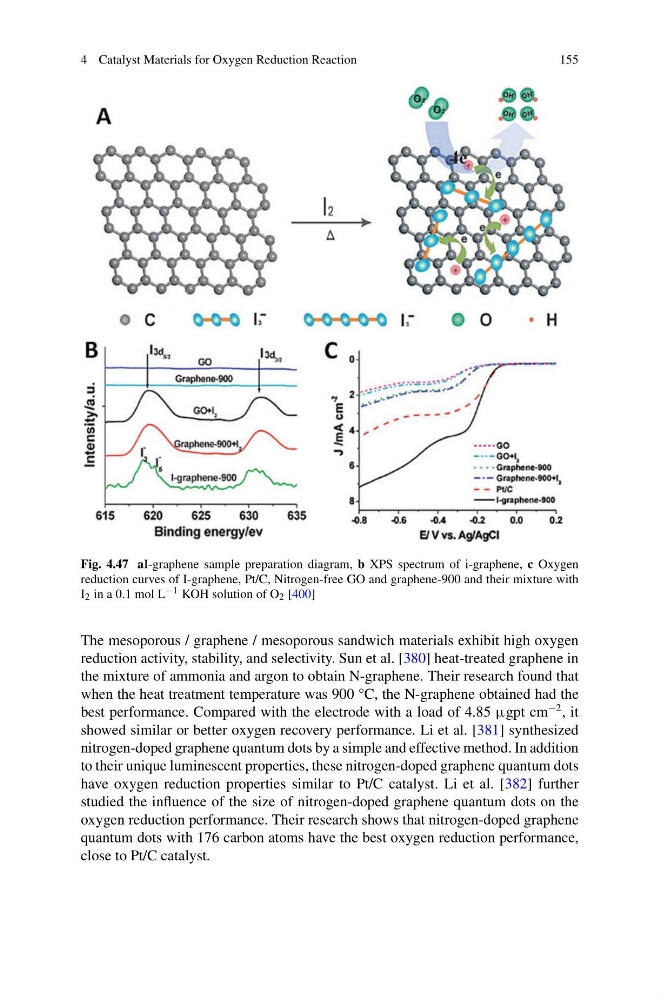
Fig. 4.47 aI-graphene sample preparation diagram, b XPS spectrum of i-graphene, c Oxygen
reduction curves of I-graphene, Pt/C, Nitrogen-free GO and graphene-900 and their mixture with
I 2 in a 0.1 mol L −1 KOH solution of O 2 [400]
The mesoporous / graphene / mesoporous sandwich materials exhibit high oxygen
reduction activity, stability, and selectivity. Sun et al. [380] heat-treated graphene in
the mixture of ammonia and argon to obtain N-graphene. Their research found that
when the heat treatment temperature was 900 °C, the N-graphene obtained had the
best performance. Compared with the electrode with a load of 4.85 μgpt cm
−2 , it
showed similar or better oxygen recovery performance. Li et al. [381] synthesized
nitrogen-doped graphene quantum dots by a simple and effective method. In addition
to their unique luminescent properties, these nitrogen-doped graphene quantum dots
have oxygen reduction properties similar to Pt/C catalyst. Li et al. [382] further
studied the influence of the size of nitrogen-doped graphene quantum dots on the
oxygen reduction performance. Their research shows that nitrogen-doped graphene
quantum dots with 176 carbon atoms have the best oxygen reduction performance,
close to Pt/C catalyst.
155
Fig. 4.47 aI-graphene sample preparation diagram, b XPS spectrum of i-graphene, c Oxygen
reduction curves of I-graphene, Pt/C, Nitrogen-free GO and graphene-900 and their mixture with
I 2 in a 0.1 mol L −1 KOH solution of O 2 [400]
The mesoporous / graphene / mesoporous sandwich materials exhibit high oxygen
reduction activity, stability, and selectivity. Sun et al. [380] heat-treated graphene in
the mixture of ammonia and argon to obtain N-graphene. Their research found that
when the heat treatment temperature was 900 °C, the N-graphene obtained had the
best performance. Compared with the electrode with a load of 4.85 μgpt cm
−2 , it
showed similar or better oxygen recovery performance. Li et al. [381] synthesized
nitrogen-doped graphene quantum dots by a simple and effective method. In addition
to their unique luminescent properties, these nitrogen-doped graphene quantum dots
have oxygen reduction properties similar to Pt/C catalyst. Li et al. [382] further
studied the influence of the size of nitrogen-doped graphene quantum dots on the
oxygen reduction performance. Their research shows that nitrogen-doped graphene
quantum dots with 176 carbon atoms have the best oxygen reduction performance,
close to Pt/C catalyst.