

4 Catalyst Materials for Oxygen Reduction Reaction
153
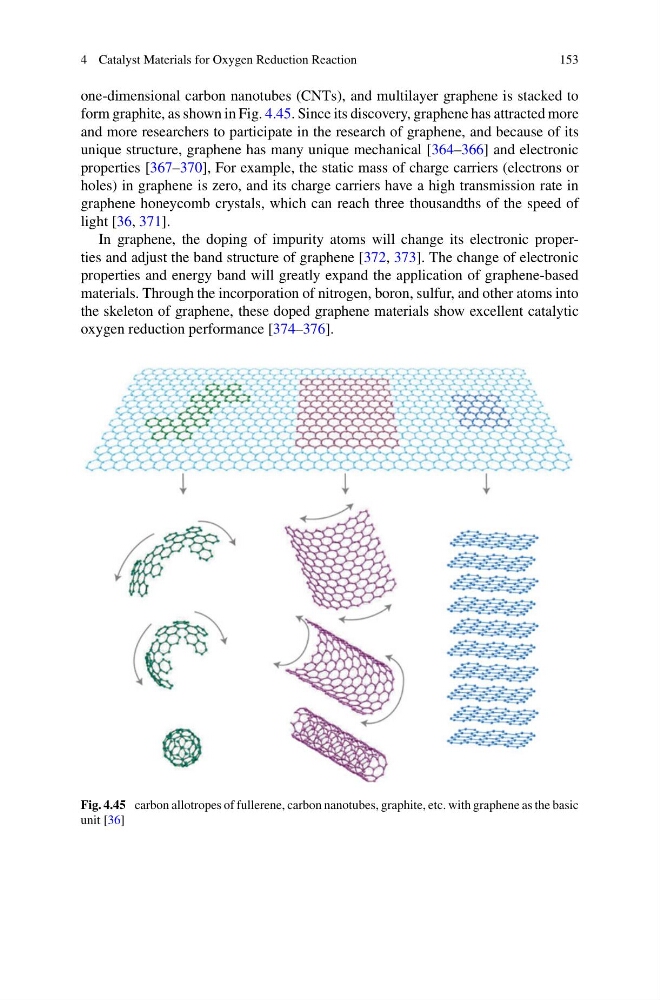
one-dimensional carbon nanotubes (CNTs), and multilayer graphene is stacked to
form graphite, as shown in Fig. 4.45. Since its discovery, graphene has attracted more
and more researchers to participate in the research of graphene, and because of its
unique structure, graphene has many unique mechanical [364–366] and electronic
properties [367–370], For example, the static mass of charge carriers (electrons or
holes) in graphene is zero, and its charge carriers have a high transmission rate in
graphene honeycomb crystals, which can reach three thousandths of the speed of
light [36, 371].
In graphene, the doping of impurity atoms will change its electronic properties and adjust the band structure of graphene [372, 373]. The change of electronic
properties and energy band will greatly expand the application of graphene-based
materials. Through the incorporation of nitrogen, boron, sulfur, and other atoms into
the skeleton of graphene, these doped graphene materials show excellent catalytic
oxygen reduction performance [374–376].
Fig. 4.45 carbon allotropes of fullerene, carbon nanotubes, graphite, etc. with graphene as the basic
unit [36]
153
one-dimensional carbon nanotubes (CNTs), and multilayer graphene is stacked to
form graphite, as shown in Fig. 4.45. Since its discovery, graphene has attracted more
and more researchers to participate in the research of graphene, and because of its
unique structure, graphene has many unique mechanical [364–366] and electronic
properties [367–370], For example, the static mass of charge carriers (electrons or
holes) in graphene is zero, and its charge carriers have a high transmission rate in
graphene honeycomb crystals, which can reach three thousandths of the speed of
light [36, 371].
In graphene, the doping of impurity atoms will change its electronic properties and adjust the band structure of graphene [372, 373]. The change of electronic
properties and energy band will greatly expand the application of graphene-based
materials. Through the incorporation of nitrogen, boron, sulfur, and other atoms into
the skeleton of graphene, these doped graphene materials show excellent catalytic
oxygen reduction performance [374–376].
Fig. 4.45 carbon allotropes of fullerene, carbon nanotubes, graphite, etc. with graphene as the basic
unit [36]