

4 Catalyst Materials for Oxygen Reduction Reaction
145
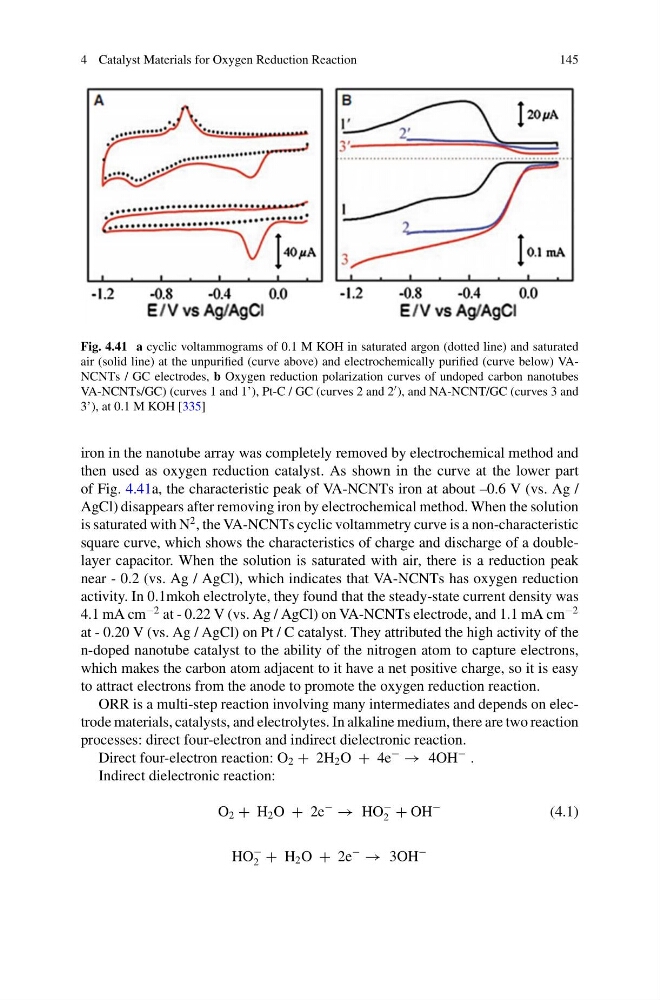
Fig. 4.41 a cyclic voltammograms of 0.1 M KOH in saturated argon (dotted line) and saturated
air (solid line) at the unpurified (curve above) and electrochemically purified (curve below) VANCNTs / GC electrodes, b Oxygen reduction polarization curves of undoped carbon nanotubes
VA-NCNTs/GC) (curves 1 and 1’), Pt-C / GC (curves 2 and 2 ), and NA-NCNT/GC (curves 3 and
3’), at 0.1 M KOH [335]
iron in the nanotube array was completely removed by electrochemical method and
then used as oxygen reduction catalyst. As shown in the curve at the lower part
of Fig. 4.41a, the characteristic peak of VA-NCNTs iron at about –0.6 V (vs. Ag /
AgCl) disappears after removing iron by electrochemical method. When the solution
is saturated with N
2 , the VA-NCNTs cyclic voltammetry curve is a non-characteristic
square curve, which shows the characteristics of charge and discharge of a doublelayer capacitor. When the solution is saturated with air, there is a reduction peak
near - 0.2 (vs. Ag / AgCl), which indicates that VA-NCNTs has oxygen reduction
activity. In 0.1mkoh electrolyte, they found that the steady-state current density was
4.1 mA cm
−2 at - 0.22 V (vs. Ag / AgCl) on VA-NCNTs electrode, and 1.1 mA cm
−2
at - 0.20 V (vs. Ag / AgCl) on Pt / C catalyst. They attributed the high activity of the
n-doped nanotube catalyst to the ability of the nitrogen atom to capture electrons,
which makes the carbon atom adjacent to it have a net positive charge, so it is easy
to attract electrons from the anode to promote the oxygen reduction reaction.
ORR is a multi-step reaction involving many intermediates and depends on electrode materials, catalysts, and electrolytes. In alkaline medium, there are two reaction
processes: direct four-electron and indirect dielectronic reaction.
Direct four-electron reaction: O 2 + 2H 2 O + 4e
−
→ 4OH
− .
Indirect dielectronic reaction:
O 2 + H 2 O + 2e
−
→ HO
−
2 + OH
−
(4.1)
HO
−
2 + H 2 O + 2e
−
→ 3OH
−
145
Fig. 4.41 a cyclic voltammograms of 0.1 M KOH in saturated argon (dotted line) and saturated
air (solid line) at the unpurified (curve above) and electrochemically purified (curve below) VANCNTs / GC electrodes, b Oxygen reduction polarization curves of undoped carbon nanotubes
VA-NCNTs/GC) (curves 1 and 1’), Pt-C / GC (curves 2 and 2 ), and NA-NCNT/GC (curves 3 and
3’), at 0.1 M KOH [335]
iron in the nanotube array was completely removed by electrochemical method and
then used as oxygen reduction catalyst. As shown in the curve at the lower part
of Fig. 4.41a, the characteristic peak of VA-NCNTs iron at about –0.6 V (vs. Ag /
AgCl) disappears after removing iron by electrochemical method. When the solution
is saturated with N
2 , the VA-NCNTs cyclic voltammetry curve is a non-characteristic
square curve, which shows the characteristics of charge and discharge of a doublelayer capacitor. When the solution is saturated with air, there is a reduction peak
near - 0.2 (vs. Ag / AgCl), which indicates that VA-NCNTs has oxygen reduction
activity. In 0.1mkoh electrolyte, they found that the steady-state current density was
4.1 mA cm
−2 at - 0.22 V (vs. Ag / AgCl) on VA-NCNTs electrode, and 1.1 mA cm
−2
at - 0.20 V (vs. Ag / AgCl) on Pt / C catalyst. They attributed the high activity of the
n-doped nanotube catalyst to the ability of the nitrogen atom to capture electrons,
which makes the carbon atom adjacent to it have a net positive charge, so it is easy
to attract electrons from the anode to promote the oxygen reduction reaction.
ORR is a multi-step reaction involving many intermediates and depends on electrode materials, catalysts, and electrolytes. In alkaline medium, there are two reaction
processes: direct four-electron and indirect dielectronic reaction.
Direct four-electron reaction: O 2 + 2H 2 O + 4e
−
→ 4OH
− .
Indirect dielectronic reaction:
O 2 + H 2 O + 2e
−
→ HO
−
2 + OH
−
(4.1)
HO
−
2 + H 2 O + 2e
−
→ 3OH
−