

144
Y. Li et al.
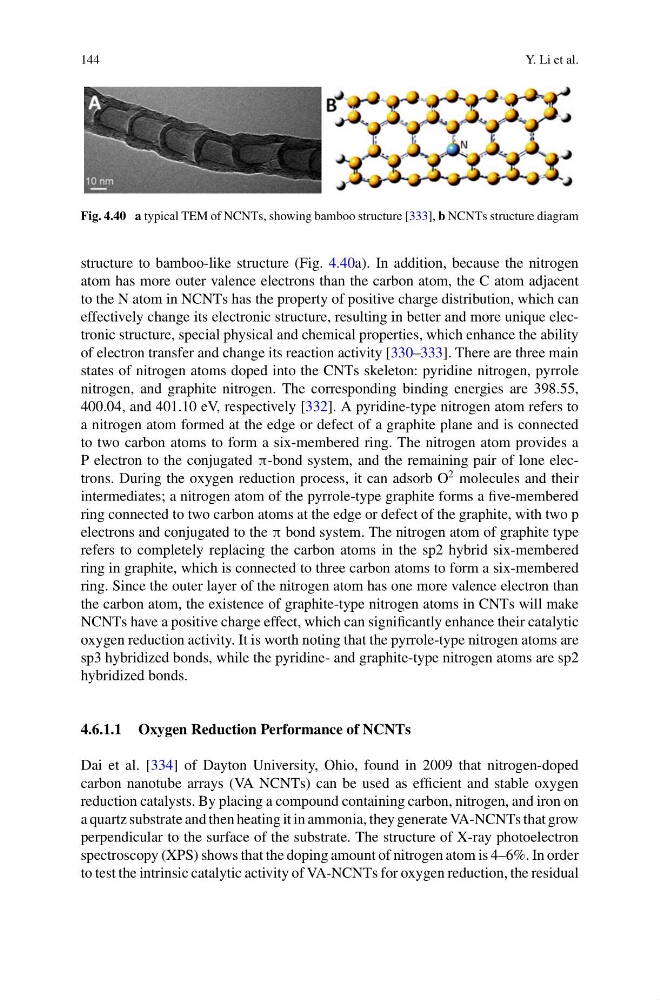
Fig. 4.40 a typical TEM of NCNTs, showing bamboo structure [333], b NCNTs structure diagram
structure to bamboo-like structure (Fig. 4.40a). In addition, because the nitrogen
atom has more outer valence electrons than the carbon atom, the C atom adjacent
to the N atom in NCNTs has the property of positive charge distribution, which can
effectively change its electronic structure, resulting in better and more unique electronic structure, special physical and chemical properties, which enhance the ability
of electron transfer and change its reaction activity [330–333]. There are three main
states of nitrogen atoms doped into the CNTs skeleton: pyridine nitrogen, pyrrole
nitrogen, and graphite nitrogen. The corresponding binding energies are 398.55,
400.04, and 401.10 eV, respectively [332]. A pyridine-type nitrogen atom refers to
a nitrogen atom formed at the edge or defect of a graphite plane and is connected
to two carbon atoms to form a six-membered ring. The nitrogen atom provides a
P electron to the conjugated π-bond system, and the remaining pair of lone electrons. During the oxygen reduction process, it can adsorb O
2 molecules and their
intermediates; a nitrogen atom of the pyrrole-type graphite forms a five-membered
ring connected to two carbon atoms at the edge or defect of the graphite, with two p
electrons and conjugated to the π bond system. The nitrogen atom of graphite type
refers to completely replacing the carbon atoms in the sp2 hybrid six-membered
ring in graphite, which is connected to three carbon atoms to form a six-membered
ring. Since the outer layer of the nitrogen atom has one more valence electron than
the carbon atom, the existence of graphite-type nitrogen atoms in CNTs will make
NCNTs have a positive charge effect, which can significantly enhance their catalytic
oxygen reduction activity. It is worth noting that the pyrrole-type nitrogen atoms are
sp3 hybridized bonds, while the pyridine- and graphite-type nitrogen atoms are sp2
hybridized bonds.
4.6.1.1 Oxygen Reduction Performance of NCNTs
Dai et al. [334] of Dayton University, Ohio, found in 2009 that nitrogen-doped
carbon nanotube arrays (VA NCNTs) can be used as efficient and stable oxygen
reduction catalysts. By placing a compound containing carbon, nitrogen, and iron on
a quartz substrate and then heating it in ammonia, they generate VA-NCNTs that grow
perpendicular to the surface of the substrate. The structure of X-ray photoelectron
spectroscopy (XPS) shows that the doping amount of nitrogen atom is 4–6%. In order
to test the intrinsic catalytic activity of VA-NCNTs for oxygen reduction, the residual
Y. Li et al.
Fig. 4.40 a typical TEM of NCNTs, showing bamboo structure [333], b NCNTs structure diagram
structure to bamboo-like structure (Fig. 4.40a). In addition, because the nitrogen
atom has more outer valence electrons than the carbon atom, the C atom adjacent
to the N atom in NCNTs has the property of positive charge distribution, which can
effectively change its electronic structure, resulting in better and more unique electronic structure, special physical and chemical properties, which enhance the ability
of electron transfer and change its reaction activity [330–333]. There are three main
states of nitrogen atoms doped into the CNTs skeleton: pyridine nitrogen, pyrrole
nitrogen, and graphite nitrogen. The corresponding binding energies are 398.55,
400.04, and 401.10 eV, respectively [332]. A pyridine-type nitrogen atom refers to
a nitrogen atom formed at the edge or defect of a graphite plane and is connected
to two carbon atoms to form a six-membered ring. The nitrogen atom provides a
P electron to the conjugated π-bond system, and the remaining pair of lone electrons. During the oxygen reduction process, it can adsorb O
2 molecules and their
intermediates; a nitrogen atom of the pyrrole-type graphite forms a five-membered
ring connected to two carbon atoms at the edge or defect of the graphite, with two p
electrons and conjugated to the π bond system. The nitrogen atom of graphite type
refers to completely replacing the carbon atoms in the sp2 hybrid six-membered
ring in graphite, which is connected to three carbon atoms to form a six-membered
ring. Since the outer layer of the nitrogen atom has one more valence electron than
the carbon atom, the existence of graphite-type nitrogen atoms in CNTs will make
NCNTs have a positive charge effect, which can significantly enhance their catalytic
oxygen reduction activity. It is worth noting that the pyrrole-type nitrogen atoms are
sp3 hybridized bonds, while the pyridine- and graphite-type nitrogen atoms are sp2
hybridized bonds.
4.6.1.1 Oxygen Reduction Performance of NCNTs
Dai et al. [334] of Dayton University, Ohio, found in 2009 that nitrogen-doped
carbon nanotube arrays (VA NCNTs) can be used as efficient and stable oxygen
reduction catalysts. By placing a compound containing carbon, nitrogen, and iron on
a quartz substrate and then heating it in ammonia, they generate VA-NCNTs that grow
perpendicular to the surface of the substrate. The structure of X-ray photoelectron
spectroscopy (XPS) shows that the doping amount of nitrogen atom is 4–6%. In order
to test the intrinsic catalytic activity of VA-NCNTs for oxygen reduction, the residual