

146
Y. Li et al.
The direct four-electron reaction has low overpotential and high conversion efficiency, However, the over potential of indirect dielectronic process is high and the
conversion efficiency is low, and the hydrogen peroxide ion (HO
2− ) will cause serious
corrosion to the proton exchange membrane in the membrane electrode assembly
(MEA), which makes the performance of MEA decline rapidly. The number of electronic reactions (n) of each oxygen molecule reduced by oxygen can be calculated
by the following formula [336]:
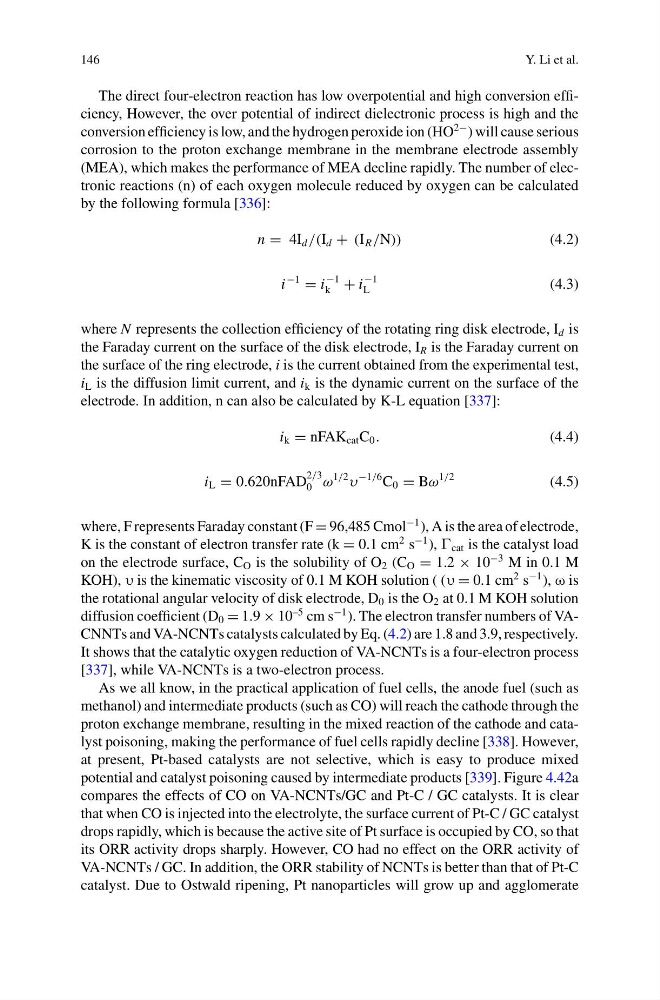
n = 4I d /(I d + (I R /N))
(4.2)
i
−1
= i
−1
k + i
−1
L
(4.3)
where N represents the collection efficiency of the rotating ring disk electrode, I d is
the Faraday current on the surface of the disk electrode, I R is the Faraday current on
the surface of the ring electrode, i is the current obtained from the experimental test,
i L is the diffusion limit current, and i k is the dynamic current on the surface of the
electrode. In addition, n can also be calculated by K-L equation [337]:
i k = nFAK cat C 0 .
(4.4)
i L = 0.620nFAD
2/3
0 ω
1/2
υ
−1/6 C 0 = Bω
1/2
(4.5)
where, F represents Faraday constant (F = 96,485 Cmol
−1 ), A is the area of electrode,
K is the constant of electron transfer rate (k = 0.1 cm
2 s
−1 ), G cat is the catalyst load
on the electrode surface, C O is the solubility of O 2 (C O = 1.2 × 10
−3 M in 0.1 M
KOH), υ is the kinematic viscosity of 0.1 M KOH solution ( (υ = 0.1 cm
2 s
−1 ), ω is
the rotational angular velocity of disk electrode, D 0 is the O 2 at 0.1 M KOH solution
diffusion coefficient (D 0 = 1.9 × 10
–5 cm s
−1 ). The electron transfer numbers of VACNNTs and VA-NCNTs catalysts calculated by Eq. (4.2) are 1.8 and 3.9, respectively.
It shows that the catalytic oxygen reduction of VA-NCNTs is a four-electron process
[337], while VA-NCNTs is a two-electron process.
As we all know, in the practical application of fuel cells, the anode fuel (such as
methanol) and intermediate products (such as CO) will reach the cathode through the
proton exchange membrane, resulting in the mixed reaction of the cathode and catalyst poisoning, making the performance of fuel cells rapidly decline [338]. However,
at present, Pt-based catalysts are not selective, which is easy to produce mixed
potential and catalyst poisoning caused by intermediate products [339]. Figure 4.42a
compares the effects of CO on VA-NCNTs/GC and Pt-C / GC catalysts. It is clear
that when CO is injected into the electrolyte, the surface current of Pt-C / GC catalyst
drops rapidly, which is because the active site of Pt surface is occupied by CO, so that
its ORR activity drops sharply. However, CO had no effect on the ORR activity of
VA-NCNTs / GC. In addition, the ORR stability of NCNTs is better than that of Pt-C
catalyst. Due to Ostwald ripening, Pt nanoparticles will grow up and agglomerate
Y. Li et al.
The direct four-electron reaction has low overpotential and high conversion efficiency, However, the over potential of indirect dielectronic process is high and the
conversion efficiency is low, and the hydrogen peroxide ion (HO
2− ) will cause serious
corrosion to the proton exchange membrane in the membrane electrode assembly
(MEA), which makes the performance of MEA decline rapidly. The number of electronic reactions (n) of each oxygen molecule reduced by oxygen can be calculated
by the following formula [336]:
n = 4I d /(I d + (I R /N))
(4.2)
i
−1
= i
−1
k + i
−1
L
(4.3)
where N represents the collection efficiency of the rotating ring disk electrode, I d is
the Faraday current on the surface of the disk electrode, I R is the Faraday current on
the surface of the ring electrode, i is the current obtained from the experimental test,
i L is the diffusion limit current, and i k is the dynamic current on the surface of the
electrode. In addition, n can also be calculated by K-L equation [337]:
i k = nFAK cat C 0 .
(4.4)
i L = 0.620nFAD
2/3
0 ω
1/2
υ
−1/6 C 0 = Bω
1/2
(4.5)
where, F represents Faraday constant (F = 96,485 Cmol
−1 ), A is the area of electrode,
K is the constant of electron transfer rate (k = 0.1 cm
2 s
−1 ), G cat is the catalyst load
on the electrode surface, C O is the solubility of O 2 (C O = 1.2 × 10
−3 M in 0.1 M
KOH), υ is the kinematic viscosity of 0.1 M KOH solution ( (υ = 0.1 cm
2 s
−1 ), ω is
the rotational angular velocity of disk electrode, D 0 is the O 2 at 0.1 M KOH solution
diffusion coefficient (D 0 = 1.9 × 10
–5 cm s
−1 ). The electron transfer numbers of VACNNTs and VA-NCNTs catalysts calculated by Eq. (4.2) are 1.8 and 3.9, respectively.
It shows that the catalytic oxygen reduction of VA-NCNTs is a four-electron process
[337], while VA-NCNTs is a two-electron process.
As we all know, in the practical application of fuel cells, the anode fuel (such as
methanol) and intermediate products (such as CO) will reach the cathode through the
proton exchange membrane, resulting in the mixed reaction of the cathode and catalyst poisoning, making the performance of fuel cells rapidly decline [338]. However,
at present, Pt-based catalysts are not selective, which is easy to produce mixed
potential and catalyst poisoning caused by intermediate products [339]. Figure 4.42a
compares the effects of CO on VA-NCNTs/GC and Pt-C / GC catalysts. It is clear
that when CO is injected into the electrolyte, the surface current of Pt-C / GC catalyst
drops rapidly, which is because the active site of Pt surface is occupied by CO, so that
its ORR activity drops sharply. However, CO had no effect on the ORR activity of
VA-NCNTs / GC. In addition, the ORR stability of NCNTs is better than that of Pt-C
catalyst. Due to Ostwald ripening, Pt nanoparticles will grow up and agglomerate