

1 Introduction
7
pressure of hydrogen. Penetration current i x is generally about several milliamps,
which can be ignored in the high current discharge area, but contributes a lot in the low
current discharge area and cannot be ignored. This penetration current is inconsistent
with the current mechanism produced by proton penetrating the membrane, so it is
classified into the kinetic overpotential equation, and this current cannot be used in
ohmic correction of proton membrane or catalyst layer.
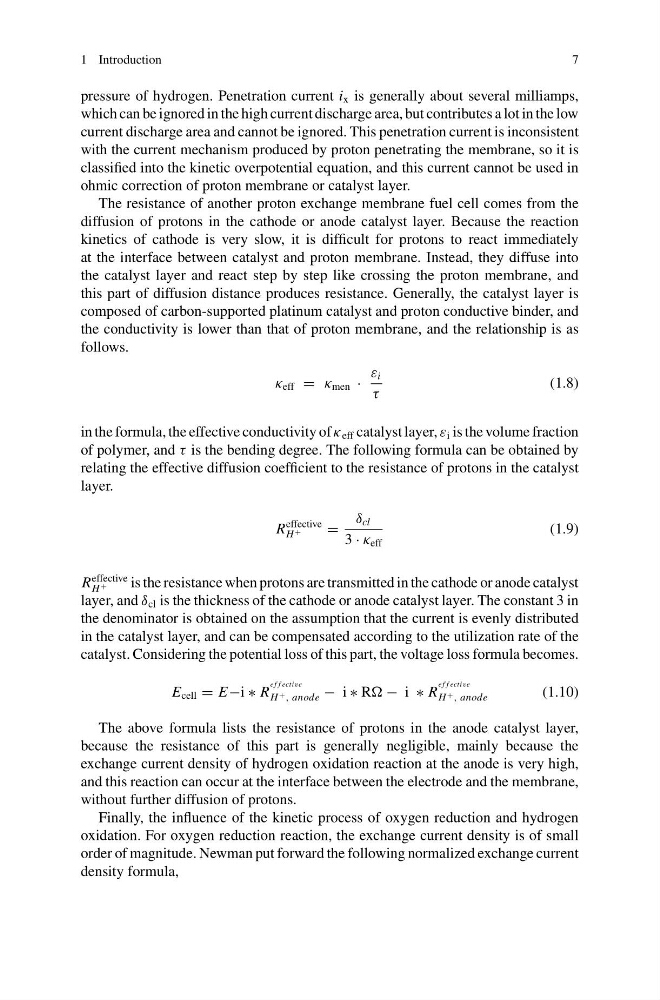
The resistance of another proton exchange membrane fuel cell comes from the
diffusion of protons in the cathode or anode catalyst layer. Because the reaction
kinetics of cathode is very slow, it is difficult for protons to react immediately
at the interface between catalyst and proton membrane. Instead, they diffuse into
the catalyst layer and react step by step like crossing the proton membrane, and
this part of diffusion distance produces resistance. Generally, the catalyst layer is
composed of carbon-supported platinum catalyst and proton conductive binder, and
the conductivity is lower than that of proton membrane, and the relationship is as
follows.
κ eff = κ men ·
ε i
τ
(1.8)
in the formula, the effective conductivity of κ eff catalyst layer, ε i is the volume fraction
of polymer, and τ is the bending degree. The following formula can be obtained by
relating the effective diffusion coefficient to the resistance of protons in the catalyst
layer.
R
effective
H +
=
δ cl
3 · κ eff
(1.9)
R
effective
H +
is the resistance when protons are transmitted in the cathode or anode catalyst
layer, and δ cl is the thickness of the cathode or anode catalyst layer. The constant 3 in
the denominator is obtained on the assumption that the current is evenly distributed
in the catalyst layer, and can be compensated according to the utilization rate of the
catalyst. Considering the potential loss of this part, the voltage loss formula becomes.
E cell = E−i ∗ R
e f f ective
H + , anode − i ∗ R − i ∗ R
e f f ective
H + , anode
(1.10)
The above formula lists the resistance of protons in the anode catalyst layer,
because the resistance of this part is generally negligible, mainly because the
exchange current density of hydrogen oxidation reaction at the anode is very high,
and this reaction can occur at the interface between the electrode and the membrane,
without further diffusion of protons.
Finally, the influence of the kinetic process of oxygen reduction and hydrogen
oxidation. For oxygen reduction reaction, the exchange current density is of small
order of magnitude. Newman put forward the following normalized exchange current
density formula,
7
pressure of hydrogen. Penetration current i x is generally about several milliamps,
which can be ignored in the high current discharge area, but contributes a lot in the low
current discharge area and cannot be ignored. This penetration current is inconsistent
with the current mechanism produced by proton penetrating the membrane, so it is
classified into the kinetic overpotential equation, and this current cannot be used in
ohmic correction of proton membrane or catalyst layer.
The resistance of another proton exchange membrane fuel cell comes from the
diffusion of protons in the cathode or anode catalyst layer. Because the reaction
kinetics of cathode is very slow, it is difficult for protons to react immediately
at the interface between catalyst and proton membrane. Instead, they diffuse into
the catalyst layer and react step by step like crossing the proton membrane, and
this part of diffusion distance produces resistance. Generally, the catalyst layer is
composed of carbon-supported platinum catalyst and proton conductive binder, and
the conductivity is lower than that of proton membrane, and the relationship is as
follows.
κ eff = κ men ·
ε i
τ
(1.8)
in the formula, the effective conductivity of κ eff catalyst layer, ε i is the volume fraction
of polymer, and τ is the bending degree. The following formula can be obtained by
relating the effective diffusion coefficient to the resistance of protons in the catalyst
layer.
R
effective
H +
=
δ cl
3 · κ eff
(1.9)
R
effective
H +
is the resistance when protons are transmitted in the cathode or anode catalyst
layer, and δ cl is the thickness of the cathode or anode catalyst layer. The constant 3 in
the denominator is obtained on the assumption that the current is evenly distributed
in the catalyst layer, and can be compensated according to the utilization rate of the
catalyst. Considering the potential loss of this part, the voltage loss formula becomes.
E cell = E−i ∗ R
e f f ective
H + , anode − i ∗ R − i ∗ R
e f f ective
H + , anode
(1.10)
The above formula lists the resistance of protons in the anode catalyst layer,
because the resistance of this part is generally negligible, mainly because the
exchange current density of hydrogen oxidation reaction at the anode is very high,
and this reaction can occur at the interface between the electrode and the membrane,
without further diffusion of protons.
Finally, the influence of the kinetic process of oxygen reduction and hydrogen
oxidation. For oxygen reduction reaction, the exchange current density is of small
order of magnitude. Newman put forward the following normalized exchange current
density formula,