

6
P. K. Shen
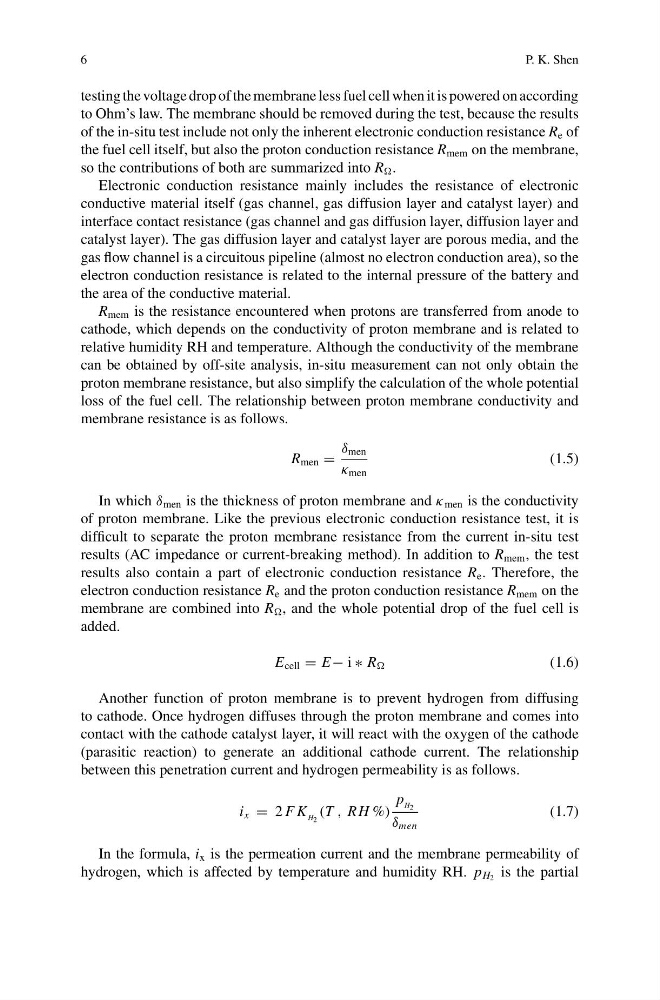
testing the voltage drop of the membrane less fuel cell when it is powered on according
to Ohm’s law. The membrane should be removed during the test, because the results
of the in-situ test include not only the inherent electronic conduction resistance R e of
the fuel cell itself, but also the proton conduction resistance R mem on the membrane,
so the contributions of both are summarized into R .
Electronic conduction resistance mainly includes the resistance of electronic
conductive material itself (gas channel, gas diffusion layer and catalyst layer) and
interface contact resistance (gas channel and gas diffusion layer, diffusion layer and
catalyst layer). The gas diffusion layer and catalyst layer are porous media, and the
gas flow channel is a circuitous pipeline (almost no electron conduction area), so the
electron conduction resistance is related to the internal pressure of the battery and
the area of the conductive material.
R mem is the resistance encountered when protons are transferred from anode to
cathode, which depends on the conductivity of proton membrane and is related to
relative humidity RH and temperature. Although the conductivity of the membrane
can be obtained by off-site analysis, in-situ measurement can not only obtain the
proton membrane resistance, but also simplify the calculation of the whole potential
loss of the fuel cell. The relationship between proton membrane conductivity and
membrane resistance is as follows.
R men =
δ men
κ men
(1.5)
In which δ men is the thickness of proton membrane and κ men is the conductivity
of proton membrane. Like the previous electronic conduction resistance test, it is
difficult to separate the proton membrane resistance from the current in-situ test
results (AC impedance or current-breaking method). In addition to R mem , the test
results also contain a part of electronic conduction resistance R e . Therefore, the
electron conduction resistance R e and the proton conduction resistance R mem on the
membrane are combined into R , and the whole potential drop of the fuel cell is
added.
E cell = E− i ∗ R
(1.6)
Another function of proton membrane is to prevent hydrogen from diffusing
to cathode. Once hydrogen diffuses through the proton membrane and comes into
contact with the cathode catalyst layer, it will react with the oxygen of the cathode
(parasitic reaction) to generate an additional cathode current. The relationship
between this penetration current and hydrogen permeability is as follows.
i x = 2 F K H 2 (T , R H %)
p H 2
δ men
(1.7)
In the formula, i x is the permeation current and the membrane permeability of
hydrogen, which is affected by temperature and humidity RH. p H 2 is the partial
P. K. Shen
testing the voltage drop of the membrane less fuel cell when it is powered on according
to Ohm’s law. The membrane should be removed during the test, because the results
of the in-situ test include not only the inherent electronic conduction resistance R e of
the fuel cell itself, but also the proton conduction resistance R mem on the membrane,
so the contributions of both are summarized into R .
Electronic conduction resistance mainly includes the resistance of electronic
conductive material itself (gas channel, gas diffusion layer and catalyst layer) and
interface contact resistance (gas channel and gas diffusion layer, diffusion layer and
catalyst layer). The gas diffusion layer and catalyst layer are porous media, and the
gas flow channel is a circuitous pipeline (almost no electron conduction area), so the
electron conduction resistance is related to the internal pressure of the battery and
the area of the conductive material.
R mem is the resistance encountered when protons are transferred from anode to
cathode, which depends on the conductivity of proton membrane and is related to
relative humidity RH and temperature. Although the conductivity of the membrane
can be obtained by off-site analysis, in-situ measurement can not only obtain the
proton membrane resistance, but also simplify the calculation of the whole potential
loss of the fuel cell. The relationship between proton membrane conductivity and
membrane resistance is as follows.
R men =
δ men
κ men
(1.5)
In which δ men is the thickness of proton membrane and κ men is the conductivity
of proton membrane. Like the previous electronic conduction resistance test, it is
difficult to separate the proton membrane resistance from the current in-situ test
results (AC impedance or current-breaking method). In addition to R mem , the test
results also contain a part of electronic conduction resistance R e . Therefore, the
electron conduction resistance R e and the proton conduction resistance R mem on the
membrane are combined into R , and the whole potential drop of the fuel cell is
added.
E cell = E− i ∗ R
(1.6)
Another function of proton membrane is to prevent hydrogen from diffusing
to cathode. Once hydrogen diffuses through the proton membrane and comes into
contact with the cathode catalyst layer, it will react with the oxygen of the cathode
(parasitic reaction) to generate an additional cathode current. The relationship
between this penetration current and hydrogen permeability is as follows.
i x = 2 F K H 2 (T , R H %)
p H 2
δ men
(1.7)
In the formula, i x is the permeation current and the membrane permeability of
hydrogen, which is affected by temperature and humidity RH. p H 2 is the partial