

4 Catalyst Materials for Oxygen Reduction Reaction
133
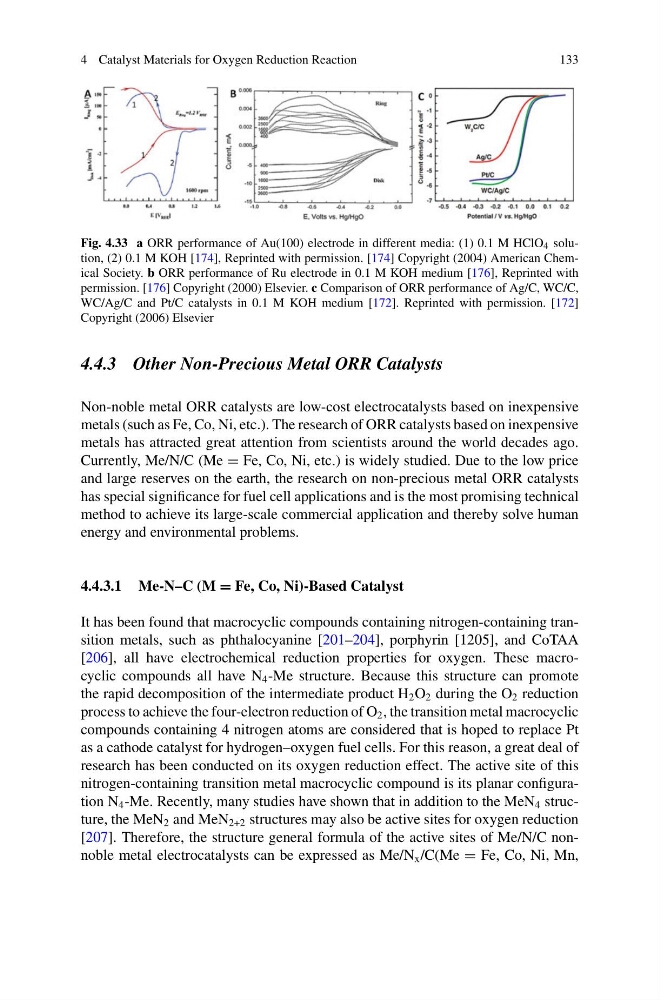
Fig. 4.33 a ORR performance of Au(100) electrode in different media: (1) 0.1 M HClO 4 solution, (2) 0.1 M KOH [174], Reprinted with permission. [174] Copyright (2004) American Chemical Society. b ORR performance of Ru electrode in 0.1 M KOH medium [176], Reprinted with
permission. [176] Copyright (2000) Elsevier. c Comparison of ORR performance of Ag/C, WC/C,
WC/Ag/C and Pt/C catalysts in 0.1 M KOH medium [172]. Reprinted with permission. [172]
Copyright (2006) Elsevier
4.4.3 Other Non-Precious Metal ORR Catalysts
Non-noble metal ORR catalysts are low-cost electrocatalysts based on inexpensive
metals (such as Fe, Co, Ni, etc.). The research of ORR catalysts based on inexpensive
metals has attracted great attention from scientists around the world decades ago.
Currently, Me/N/C (Me = Fe, Co, Ni, etc.) is widely studied. Due to the low price
and large reserves on the earth, the research on non-precious metal ORR catalysts
has special significance for fuel cell applications and is the most promising technical
method to achieve its large-scale commercial application and thereby solve human
energy and environmental problems.
4.4.3.1 Me-N–C (M = Fe, Co, Ni)-Based Catalyst
It has been found that macrocyclic compounds containing nitrogen-containing transition metals, such as phthalocyanine [201–204], porphyrin [1205], and CoTAA
[206], all have electrochemical reduction properties for oxygen. These macrocyclic compounds all have N 4 -Me structure. Because this structure can promote
the rapid decomposition of the intermediate product H 2 O 2 during the O 2 reduction
process to achieve the four-electron reduction of O 2 , the transition metal macrocyclic
compounds containing 4 nitrogen atoms are considered that is hoped to replace Pt
as a cathode catalyst for hydrogen–oxygen fuel cells. For this reason, a great deal of
research has been conducted on its oxygen reduction effect. The active site of this
nitrogen-containing transition metal macrocyclic compound is its planar configuration N 4 -Me. Recently, many studies have shown that in addition to the MeN 4 structure, the MeN 2 and MeN 2+2 structures may also be active sites for oxygen reduction
[207]. Therefore, the structure general formula of the active sites of Me/N/C nonnoble metal electrocatalysts can be expressed as Me/N x /C(Me = Fe, Co, Ni, Mn,
133
Fig. 4.33 a ORR performance of Au(100) electrode in different media: (1) 0.1 M HClO 4 solution, (2) 0.1 M KOH [174], Reprinted with permission. [174] Copyright (2004) American Chemical Society. b ORR performance of Ru electrode in 0.1 M KOH medium [176], Reprinted with
permission. [176] Copyright (2000) Elsevier. c Comparison of ORR performance of Ag/C, WC/C,
WC/Ag/C and Pt/C catalysts in 0.1 M KOH medium [172]. Reprinted with permission. [172]
Copyright (2006) Elsevier
4.4.3 Other Non-Precious Metal ORR Catalysts
Non-noble metal ORR catalysts are low-cost electrocatalysts based on inexpensive
metals (such as Fe, Co, Ni, etc.). The research of ORR catalysts based on inexpensive
metals has attracted great attention from scientists around the world decades ago.
Currently, Me/N/C (Me = Fe, Co, Ni, etc.) is widely studied. Due to the low price
and large reserves on the earth, the research on non-precious metal ORR catalysts
has special significance for fuel cell applications and is the most promising technical
method to achieve its large-scale commercial application and thereby solve human
energy and environmental problems.
4.4.3.1 Me-N–C (M = Fe, Co, Ni)-Based Catalyst
It has been found that macrocyclic compounds containing nitrogen-containing transition metals, such as phthalocyanine [201–204], porphyrin [1205], and CoTAA
[206], all have electrochemical reduction properties for oxygen. These macrocyclic compounds all have N 4 -Me structure. Because this structure can promote
the rapid decomposition of the intermediate product H 2 O 2 during the O 2 reduction
process to achieve the four-electron reduction of O 2 , the transition metal macrocyclic
compounds containing 4 nitrogen atoms are considered that is hoped to replace Pt
as a cathode catalyst for hydrogen–oxygen fuel cells. For this reason, a great deal of
research has been conducted on its oxygen reduction effect. The active site of this
nitrogen-containing transition metal macrocyclic compound is its planar configuration N 4 -Me. Recently, many studies have shown that in addition to the MeN 4 structure, the MeN 2 and MeN 2+2 structures may also be active sites for oxygen reduction
[207]. Therefore, the structure general formula of the active sites of Me/N/C nonnoble metal electrocatalysts can be expressed as Me/N x /C(Me = Fe, Co, Ni, Mn,