

132
Y. Li et al.
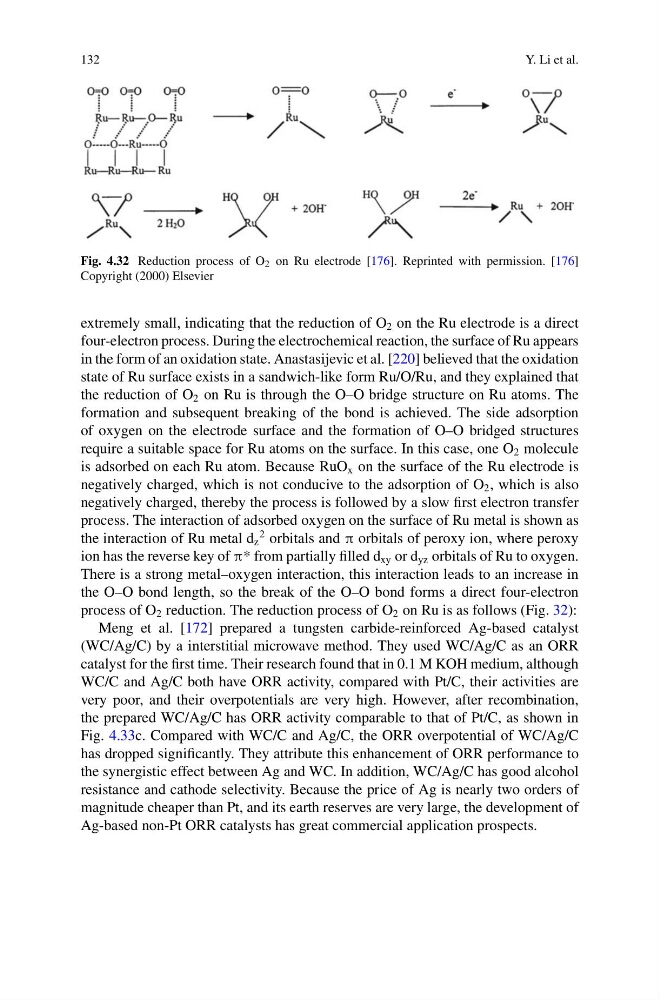
Fig. 4.32 Reduction process of O 2 on Ru electrode [176]. Reprinted with permission. [176]
Copyright (2000) Elsevier
extremely small, indicating that the reduction of O 2 on the Ru electrode is a direct
four-electron process. During the electrochemical reaction, the surface of Ru appears
in the form of an oxidation state. Anastasijevic et al. [220] believed that the oxidation
state of Ru surface exists in a sandwich-like form Ru/O/Ru, and they explained that
the reduction of O 2 on Ru is through the O–O bridge structure on Ru atoms. The
formation and subsequent breaking of the bond is achieved. The side adsorption
of oxygen on the electrode surface and the formation of O–O bridged structures
require a suitable space for Ru atoms on the surface. In this case, one O 2 molecule
is adsorbed on each Ru atom. Because RuO x on the surface of the Ru electrode is
negatively charged, which is not conducive to the adsorption of O 2 , which is also
negatively charged, thereby the process is followed by a slow first electron transfer
process. The interaction of adsorbed oxygen on the surface of Ru metal is shown as
the interaction of Ru metal d z
2 orbitals and π orbitals of peroxy ion, where peroxy
ion has the reverse key of π* from partially filled d xy or d yz orbitals of Ru to oxygen.
There is a strong metal–oxygen interaction, this interaction leads to an increase in
the O–O bond length, so the break of the O–O bond forms a direct four-electron
process of O 2 reduction. The reduction process of O 2 on Ru is as follows (Fig. 32):
Meng et al. [172] prepared a tungsten carbide-reinforced Ag-based catalyst
(WC/Ag/C) by a interstitial microwave method. They used WC/Ag/C as an ORR
catalyst for the first time. Their research found that in 0.1 M KOH medium, although
WC/C and Ag/C both have ORR activity, compared with Pt/C, their activities are
very poor, and their overpotentials are very high. However, after recombination,
the prepared WC/Ag/C has ORR activity comparable to that of Pt/C, as shown in
Fig. 4.33c. Compared with WC/C and Ag/C, the ORR overpotential of WC/Ag/C
has dropped significantly. They attribute this enhancement of ORR performance to
the synergistic effect between Ag and WC. In addition, WC/Ag/C has good alcohol
resistance and cathode selectivity. Because the price of Ag is nearly two orders of
magnitude cheaper than Pt, and its earth reserves are very large, the development of
Ag-based non-Pt ORR catalysts has great commercial application prospects.
Y. Li et al.
Fig. 4.32 Reduction process of O 2 on Ru electrode [176]. Reprinted with permission. [176]
Copyright (2000) Elsevier
extremely small, indicating that the reduction of O 2 on the Ru electrode is a direct
four-electron process. During the electrochemical reaction, the surface of Ru appears
in the form of an oxidation state. Anastasijevic et al. [220] believed that the oxidation
state of Ru surface exists in a sandwich-like form Ru/O/Ru, and they explained that
the reduction of O 2 on Ru is through the O–O bridge structure on Ru atoms. The
formation and subsequent breaking of the bond is achieved. The side adsorption
of oxygen on the electrode surface and the formation of O–O bridged structures
require a suitable space for Ru atoms on the surface. In this case, one O 2 molecule
is adsorbed on each Ru atom. Because RuO x on the surface of the Ru electrode is
negatively charged, which is not conducive to the adsorption of O 2 , which is also
negatively charged, thereby the process is followed by a slow first electron transfer
process. The interaction of adsorbed oxygen on the surface of Ru metal is shown as
the interaction of Ru metal d z
2 orbitals and π orbitals of peroxy ion, where peroxy
ion has the reverse key of π* from partially filled d xy or d yz orbitals of Ru to oxygen.
There is a strong metal–oxygen interaction, this interaction leads to an increase in
the O–O bond length, so the break of the O–O bond forms a direct four-electron
process of O 2 reduction. The reduction process of O 2 on Ru is as follows (Fig. 32):
Meng et al. [172] prepared a tungsten carbide-reinforced Ag-based catalyst
(WC/Ag/C) by a interstitial microwave method. They used WC/Ag/C as an ORR
catalyst for the first time. Their research found that in 0.1 M KOH medium, although
WC/C and Ag/C both have ORR activity, compared with Pt/C, their activities are
very poor, and their overpotentials are very high. However, after recombination,
the prepared WC/Ag/C has ORR activity comparable to that of Pt/C, as shown in
Fig. 4.33c. Compared with WC/C and Ag/C, the ORR overpotential of WC/Ag/C
has dropped significantly. They attribute this enhancement of ORR performance to
the synergistic effect between Ag and WC. In addition, WC/Ag/C has good alcohol
resistance and cathode selectivity. Because the price of Ag is nearly two orders of
magnitude cheaper than Pt, and its earth reserves are very large, the development of
Ag-based non-Pt ORR catalysts has great commercial application prospects.