

4 Catalyst Materials for Oxygen Reduction Reaction
131
catalysts to the synergistic effect between Pd and Co 3 W 3 C with electron-donating
properties [200]. Yin et al. [171] prepared a WC/C supported PdFe-WC/C catalyst by
a interstitial microwave method. In an acidic medium, as a non-Pt catalyst, the ORR
performance of this PdFe-WC/C alloy catalyst is comparable to that of a Pt/C catalyst.
In addition, in an acidic medium containing 1.0 M ethanol, the ORR performance
of the PdFe-WC/C alloy catalyst is almost unaffected, indicating that the PdFeWC/C alloy catalyst has alcohol resistance and cathodic selectivity, making it have
considerable application prospects in direct alcohol fuel cells. They also attributed
the improved ORR performance of PdFe-WC/C alloy catalysts to the synergistic
effect between Pd, Fe, and WC.
4.4.2 Other Non-Pt Metal-Based (Au, Ru, Ag) ORR Catalysts
The electrochemical reduction of oxygen and hydrogen peroxide on single crystal
Au electrodes is a typical reaction with pH effect and structure sensitivity. Blizanac
et al. [174] studied the oxygen reduction on the Au (100) surface in 0.1 M HClO 4
and 0.1 M KOH media using a rotating ring disk electrode. In an acidic medium,
at 0.46 V (vs. RHE), the kinetic current of the Au (100) plane i k = 2.74 mA cm
−2 ;
in an alkaline medium, at 0.8 V (vs. RHE), the kinetic current of the Au (100)
plane i k = 10.93 mA cm
−2 . Understanding the energy properties of the Au surface
and the correlation between the surface adsorption molecules O 2 and the reduction
intermediates is the key to studying the kinetics of the ORR reaction at the Au-solution
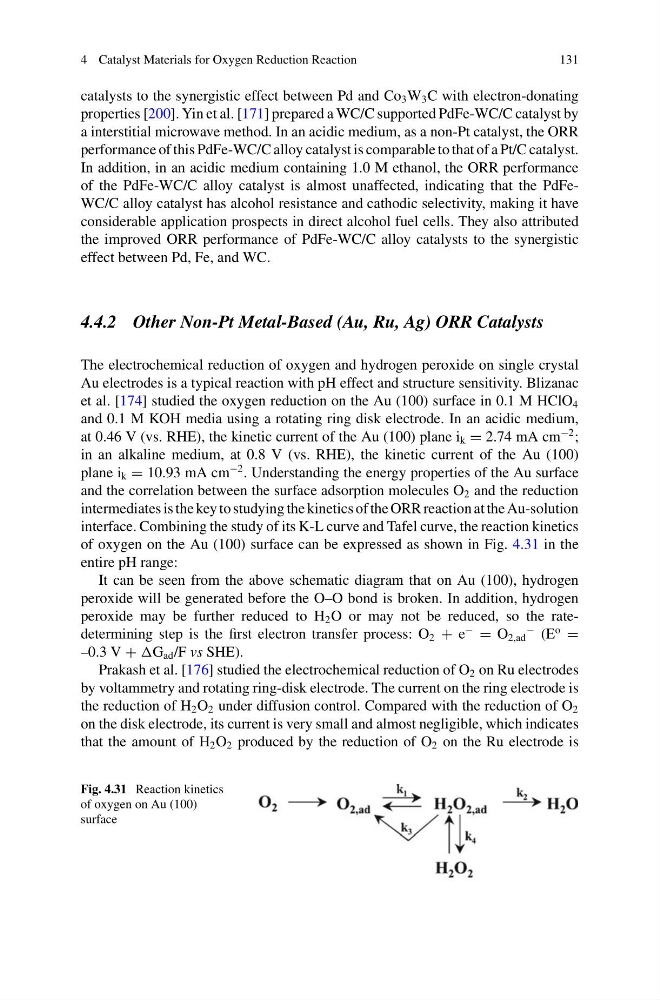
interface. Combining the study of its K-L curve and Tafel curve, the reaction kinetics
of oxygen on the Au (100) surface can be expressed as shown in Fig. 4.31 in the
entire pH range:
It can be seen from the above schematic diagram that on Au (100), hydrogen
peroxide will be generated before the O–O bond is broken. In addition, hydrogen
peroxide may be further reduced to H 2 O or may not be reduced, so the ratedetermining step is the first electron transfer process: O 2 + e
−
= O 2,ad
− (E
o
=
–0.3 V + G ad /F vs SHE).
Prakash et al. [176] studied the electrochemical reduction of O 2 on Ru electrodes
by voltammetry and rotating ring-disk electrode. The current on the ring electrode is
the reduction of H 2 O 2 under diffusion control. Compared with the reduction of O 2
on the disk electrode, its current is very small and almost negligible, which indicates
that the amount of H 2 O 2 produced by the reduction of O 2 on the Ru electrode is
Fig. 4.31 Reaction kinetics
of oxygen on Au (100)
surface
131
catalysts to the synergistic effect between Pd and Co 3 W 3 C with electron-donating
properties [200]. Yin et al. [171] prepared a WC/C supported PdFe-WC/C catalyst by
a interstitial microwave method. In an acidic medium, as a non-Pt catalyst, the ORR
performance of this PdFe-WC/C alloy catalyst is comparable to that of a Pt/C catalyst.
In addition, in an acidic medium containing 1.0 M ethanol, the ORR performance
of the PdFe-WC/C alloy catalyst is almost unaffected, indicating that the PdFeWC/C alloy catalyst has alcohol resistance and cathodic selectivity, making it have
considerable application prospects in direct alcohol fuel cells. They also attributed
the improved ORR performance of PdFe-WC/C alloy catalysts to the synergistic
effect between Pd, Fe, and WC.
4.4.2 Other Non-Pt Metal-Based (Au, Ru, Ag) ORR Catalysts
The electrochemical reduction of oxygen and hydrogen peroxide on single crystal
Au electrodes is a typical reaction with pH effect and structure sensitivity. Blizanac
et al. [174] studied the oxygen reduction on the Au (100) surface in 0.1 M HClO 4
and 0.1 M KOH media using a rotating ring disk electrode. In an acidic medium,
at 0.46 V (vs. RHE), the kinetic current of the Au (100) plane i k = 2.74 mA cm
−2 ;
in an alkaline medium, at 0.8 V (vs. RHE), the kinetic current of the Au (100)
plane i k = 10.93 mA cm
−2 . Understanding the energy properties of the Au surface
and the correlation between the surface adsorption molecules O 2 and the reduction
intermediates is the key to studying the kinetics of the ORR reaction at the Au-solution
interface. Combining the study of its K-L curve and Tafel curve, the reaction kinetics
of oxygen on the Au (100) surface can be expressed as shown in Fig. 4.31 in the
entire pH range:
It can be seen from the above schematic diagram that on Au (100), hydrogen
peroxide will be generated before the O–O bond is broken. In addition, hydrogen
peroxide may be further reduced to H 2 O or may not be reduced, so the ratedetermining step is the first electron transfer process: O 2 + e
−
= O 2,ad
− (E
o
=
–0.3 V + G ad /F vs SHE).
Prakash et al. [176] studied the electrochemical reduction of O 2 on Ru electrodes
by voltammetry and rotating ring-disk electrode. The current on the ring electrode is
the reduction of H 2 O 2 under diffusion control. Compared with the reduction of O 2
on the disk electrode, its current is very small and almost negligible, which indicates
that the amount of H 2 O 2 produced by the reduction of O 2 on the Ru electrode is
Fig. 4.31 Reaction kinetics
of oxygen on Au (100)
surface