

130
Y. Li et al.
Sabatier rule that the metal–oxygen interaction cannot be too strong or too weak, and
an appropriate value is needed. The ORR activity of the Pd layer on Ru (0001) and
PdFe (111) faces is not good because its kinetics of rate-determining step is slow,
while Pd and Pd/Au (111) are too strong for their oxygen binding, which ORR performance is also limited. Figure 4.29b shows the relationship between Pd–O binding
energy and kinetic current density on different single crystal faces. On the left side
of the figure, the ORR activity of the catalyst increases with the weakening of the
metal–oxygen bond, and the ORR kinetics depend on the desorption of the intermediate products. On the Pd layer on the surface of Pd3Fe alloy, the ORR activity
reached the maximum, and the binding energy BE 0 at this time was –1.86 eV, which
was 0.2 eV weaker than –2.04 eV of Pt, which was consistent with the prediction
of Stamenkovic et al. [152]. In addition to binary alloys based on Pd, ternary alloys
of Pd have also been studied as modified ORR catalysts. Park et al. [198] prepared
and studied 66 ternary alloys Pd-Ir-Ce with impregnation method, and studied their
ORR activity in acidic medium to find the optimal component is Pd: Ir: Ce is 79: 12:
9. At 0.85 V (vs. RHE), the ORR activity of Pd 79 Ir 12 Ce 9 /C is 1.5 times that of Pd/C.
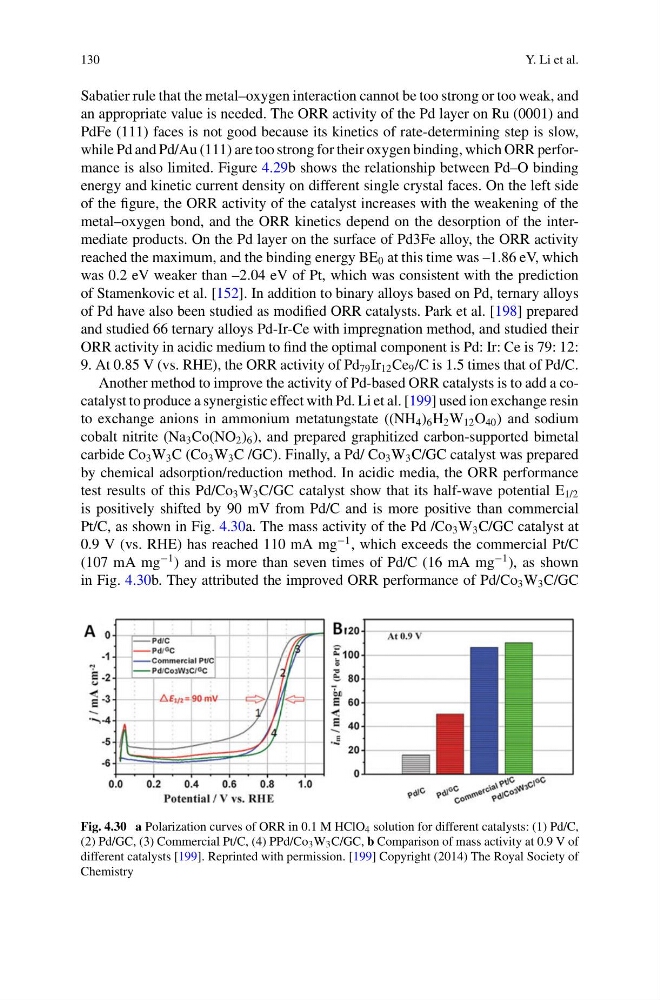
Another method to improve the activity of Pd-based ORR catalysts is to add a cocatalyst to produce a synergistic effect with Pd. Li et al. [199] used ion exchange resin
to exchange anions in ammonium metatungstate ((NH 4 ) 6 H 2 W 12 O 40 ) and sodium
cobalt nitrite (Na 3 Co(NO 2 ) 6 ), and prepared graphitized carbon-supported bimetal
carbide Co 3 W 3 C (Co 3 W 3 C /GC). Finally, a Pd/ Co 3 W 3 C/GC catalyst was prepared
by chemical adsorption/reduction method. In acidic media, the ORR performance
test results of this Pd/Co 3 W 3 C/GC catalyst show that its half-wave potential E 1/2
is positively shifted by 90 mV from Pd/C and is more positive than commercial
Pt/C, as shown in Fig. 4.30a. The mass activity of the Pd /Co 3 W 3 C/GC catalyst at
0.9 V (vs. RHE) has reached 110 mA mg
−1 , which exceeds the commercial Pt/C
(107 mA mg
−1 ) and is more than seven times of Pd/C (16 mA mg
−1 ), as shown
in Fig. 4.30b. They attributed the improved ORR performance of Pd/Co 3 W 3 C/GC
Fig. 4.30 a Polarization curves of ORR in 0.1 M HClO 4 solution for different catalysts: (1) Pd/C,
(2) Pd/GC, (3) Commercial Pt/C, (4) PPd/Co 3 W 3 C/GC, b Comparison of mass activity at 0.9 V of
different catalysts [199]. Reprinted with permission. [199] Copyright (2014) The Royal Society of
Chemistry
Y. Li et al.
Sabatier rule that the metal–oxygen interaction cannot be too strong or too weak, and
an appropriate value is needed. The ORR activity of the Pd layer on Ru (0001) and
PdFe (111) faces is not good because its kinetics of rate-determining step is slow,
while Pd and Pd/Au (111) are too strong for their oxygen binding, which ORR performance is also limited. Figure 4.29b shows the relationship between Pd–O binding
energy and kinetic current density on different single crystal faces. On the left side
of the figure, the ORR activity of the catalyst increases with the weakening of the
metal–oxygen bond, and the ORR kinetics depend on the desorption of the intermediate products. On the Pd layer on the surface of Pd3Fe alloy, the ORR activity
reached the maximum, and the binding energy BE 0 at this time was –1.86 eV, which
was 0.2 eV weaker than –2.04 eV of Pt, which was consistent with the prediction
of Stamenkovic et al. [152]. In addition to binary alloys based on Pd, ternary alloys
of Pd have also been studied as modified ORR catalysts. Park et al. [198] prepared
and studied 66 ternary alloys Pd-Ir-Ce with impregnation method, and studied their
ORR activity in acidic medium to find the optimal component is Pd: Ir: Ce is 79: 12:
9. At 0.85 V (vs. RHE), the ORR activity of Pd 79 Ir 12 Ce 9 /C is 1.5 times that of Pd/C.
Another method to improve the activity of Pd-based ORR catalysts is to add a cocatalyst to produce a synergistic effect with Pd. Li et al. [199] used ion exchange resin
to exchange anions in ammonium metatungstate ((NH 4 ) 6 H 2 W 12 O 40 ) and sodium
cobalt nitrite (Na 3 Co(NO 2 ) 6 ), and prepared graphitized carbon-supported bimetal
carbide Co 3 W 3 C (Co 3 W 3 C /GC). Finally, a Pd/ Co 3 W 3 C/GC catalyst was prepared
by chemical adsorption/reduction method. In acidic media, the ORR performance
test results of this Pd/Co 3 W 3 C/GC catalyst show that its half-wave potential E 1/2
is positively shifted by 90 mV from Pd/C and is more positive than commercial
Pt/C, as shown in Fig. 4.30a. The mass activity of the Pd /Co 3 W 3 C/GC catalyst at
0.9 V (vs. RHE) has reached 110 mA mg
−1 , which exceeds the commercial Pt/C
(107 mA mg
−1 ) and is more than seven times of Pd/C (16 mA mg
−1 ), as shown
in Fig. 4.30b. They attributed the improved ORR performance of Pd/Co 3 W 3 C/GC
Fig. 4.30 a Polarization curves of ORR in 0.1 M HClO 4 solution for different catalysts: (1) Pd/C,
(2) Pd/GC, (3) Commercial Pt/C, (4) PPd/Co 3 W 3 C/GC, b Comparison of mass activity at 0.9 V of
different catalysts [199]. Reprinted with permission. [199] Copyright (2014) The Royal Society of
Chemistry