

4 Catalyst Materials for Oxygen Reduction Reaction
129
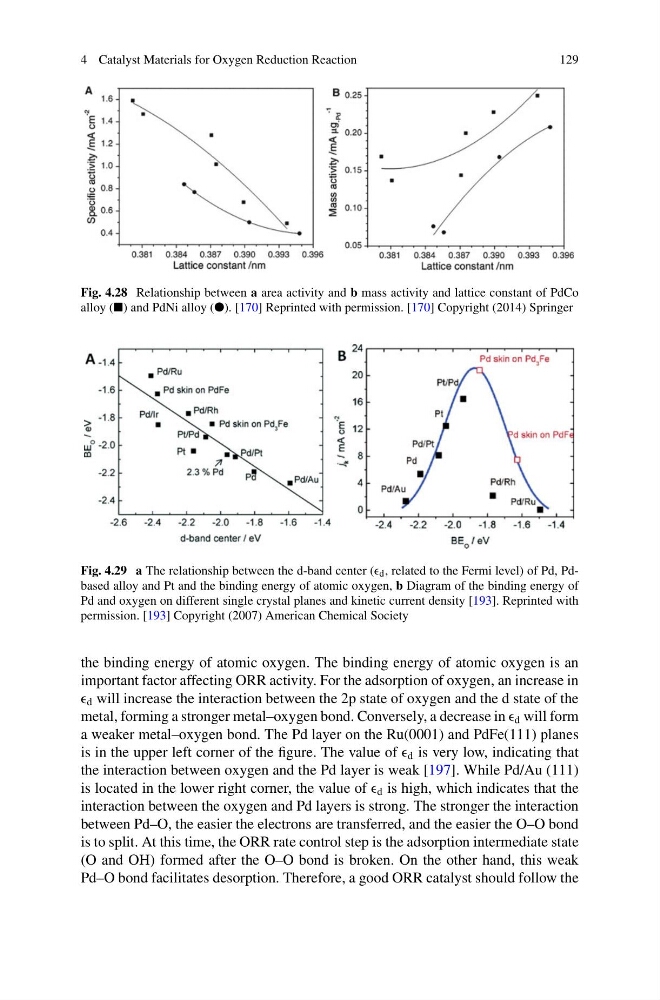
Fig. 4.28 Relationship between a area activity and b mass activity and lattice constant of PdCo
alloy () and PdNi alloy (●). [170] Reprinted with permission. [170] Copyright (2014) Springer
Fig. 4.29 a The relationship between the d-band center ( d , related to the Fermi level) of Pd, Pdbased alloy and Pt and the binding energy of atomic oxygen, b Diagram of the binding energy of
Pd and oxygen on different single crystal planes and kinetic current density [193]. Reprinted with
permission. [193] Copyright (2007) American Chemical Society
the binding energy of atomic oxygen. The binding energy of atomic oxygen is an
important factor affecting ORR activity. For the adsorption of oxygen, an increase in
d will increase the interaction between the 2p state of oxygen and the d state of the
metal, forming a stronger metal–oxygen bond. Conversely, a decrease in d will form
a weaker metal–oxygen bond. The Pd layer on the Ru(0001) and PdFe(111) planes
is in the upper left corner of the figure. The value of d is very low, indicating that
the interaction between oxygen and the Pd layer is weak [197]. While Pd/Au (111)
is located in the lower right corner, the value of d is high, which indicates that the
interaction between the oxygen and Pd layers is strong. The stronger the interaction
between Pd–O, the easier the electrons are transferred, and the easier the O–O bond
is to split. At this time, the ORR rate control step is the adsorption intermediate state
(O and OH) formed after the O–O bond is broken. On the other hand, this weak
Pd–O bond facilitates desorption. Therefore, a good ORR catalyst should follow the
129
Fig. 4.28 Relationship between a area activity and b mass activity and lattice constant of PdCo
alloy () and PdNi alloy (●). [170] Reprinted with permission. [170] Copyright (2014) Springer
Fig. 4.29 a The relationship between the d-band center ( d , related to the Fermi level) of Pd, Pdbased alloy and Pt and the binding energy of atomic oxygen, b Diagram of the binding energy of
Pd and oxygen on different single crystal planes and kinetic current density [193]. Reprinted with
permission. [193] Copyright (2007) American Chemical Society
the binding energy of atomic oxygen. The binding energy of atomic oxygen is an
important factor affecting ORR activity. For the adsorption of oxygen, an increase in
d will increase the interaction between the 2p state of oxygen and the d state of the
metal, forming a stronger metal–oxygen bond. Conversely, a decrease in d will form
a weaker metal–oxygen bond. The Pd layer on the Ru(0001) and PdFe(111) planes
is in the upper left corner of the figure. The value of d is very low, indicating that
the interaction between oxygen and the Pd layer is weak [197]. While Pd/Au (111)
is located in the lower right corner, the value of d is high, which indicates that the
interaction between the oxygen and Pd layers is strong. The stronger the interaction
between Pd–O, the easier the electrons are transferred, and the easier the O–O bond
is to split. At this time, the ORR rate control step is the adsorption intermediate state
(O and OH) formed after the O–O bond is broken. On the other hand, this weak
Pd–O bond facilitates desorption. Therefore, a good ORR catalyst should follow the