

114
Y. Li et al.
core–shell structure (M = Fe, Co, Ni, Cu, Pd, Ag, etc.) [189–192]. Most of Pt atoms
of this M@Pt core–shell structure participate in the ORR process, which greatly
improves the utilization of Pt.
According to the distribution of Pt atoms in the core–shell structure, M@Pt core–
shell structure can be divided into two basic types: ideal mono/multil atomic layer
mode and Pt-enriched surface layer mode.
(1) ideal mono/multil atomic layer mode
The ideal mono/multil atomic layer mode means that single or multiple layers of
Pt atoms are ideally divided on the outer surface layer of the transition metal M
nanoparticles to form an ideal M@Pt core–shell structure. This M@Pt core–shell
structure of ideal mono/multil atomic layer mode is generally prepared by the “in-situ
replacement” method: using the characteristics of large standard reduction potential
of Pt, the nano-nanoparticles of metal M (Fe, Co, Ni, Cu, etc.) with a small standard
reduction potential undergo a replacement reaction in a Pt precursor, forming a single
or multiple layers of Pt atoms on the surface of M.
If the standard reduction potential between M (for example, Pd) and Pt is too
small, this replacement method is difficult to obtain the core–shell structure, which
can be prepared by combining with the “underpotential deposition” (UPD) method.
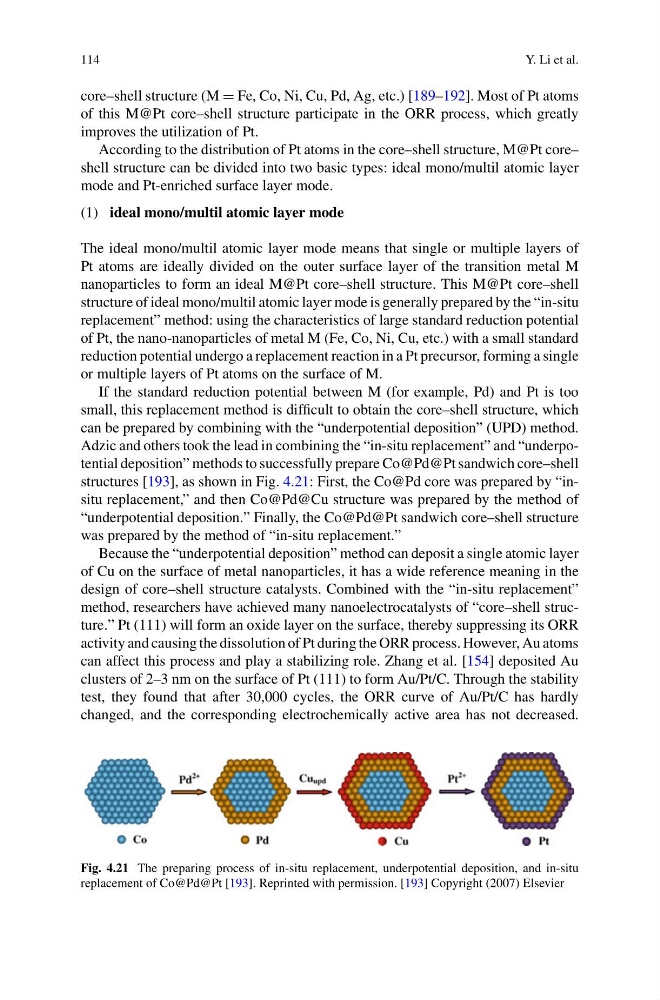
Adzic and others took the lead in combining the “in-situ replacement” and “underpotential deposition” methods to successfully prepare Co@Pd@Pt sandwich core–shell
structures [193], as shown in Fig. 4.21: First, the Co@Pd core was prepared by “insitu replacement,” and then Co@Pd@Cu structure was prepared by the method of
“underpotential deposition.” Finally, the Co@Pd@Pt sandwich core–shell structure
was prepared by the method of “in-situ replacement.”
Because the “underpotential deposition” method can deposit a single atomic layer
of Cu on the surface of metal nanoparticles, it has a wide reference meaning in the
design of core–shell structure catalysts. Combined with the “in-situ replacement”
method, researchers have achieved many nanoelectrocatalysts of “core–shell structure.” Pt (111) will form an oxide layer on the surface, thereby suppressing its ORR
activity and causing the dissolution of Pt during the ORR process. However, Au atoms
can affect this process and play a stabilizing role. Zhang et al. [154] deposited Au
clusters of 2–3 nm on the surface of Pt (111) to form Au/Pt/C. Through the stability
test, they found that after 30,000 cycles, the ORR curve of Au/Pt/C has hardly
changed, and the corresponding electrochemically active area has not decreased.
Fig. 4.21 The preparing process of in-situ replacement, underpotential deposition, and in-situ
replacement of Co@Pd@Pt [193]. Reprinted with permission. [193] Copyright (2007) Elsevier
Y. Li et al.
core–shell structure (M = Fe, Co, Ni, Cu, Pd, Ag, etc.) [189–192]. Most of Pt atoms
of this M@Pt core–shell structure participate in the ORR process, which greatly
improves the utilization of Pt.
According to the distribution of Pt atoms in the core–shell structure, M@Pt core–
shell structure can be divided into two basic types: ideal mono/multil atomic layer
mode and Pt-enriched surface layer mode.
(1) ideal mono/multil atomic layer mode
The ideal mono/multil atomic layer mode means that single or multiple layers of
Pt atoms are ideally divided on the outer surface layer of the transition metal M
nanoparticles to form an ideal M@Pt core–shell structure. This M@Pt core–shell
structure of ideal mono/multil atomic layer mode is generally prepared by the “in-situ
replacement” method: using the characteristics of large standard reduction potential
of Pt, the nano-nanoparticles of metal M (Fe, Co, Ni, Cu, etc.) with a small standard
reduction potential undergo a replacement reaction in a Pt precursor, forming a single
or multiple layers of Pt atoms on the surface of M.
If the standard reduction potential between M (for example, Pd) and Pt is too
small, this replacement method is difficult to obtain the core–shell structure, which
can be prepared by combining with the “underpotential deposition” (UPD) method.
Adzic and others took the lead in combining the “in-situ replacement” and “underpotential deposition” methods to successfully prepare Co@Pd@Pt sandwich core–shell
structures [193], as shown in Fig. 4.21: First, the Co@Pd core was prepared by “insitu replacement,” and then Co@Pd@Cu structure was prepared by the method of
“underpotential deposition.” Finally, the Co@Pd@Pt sandwich core–shell structure
was prepared by the method of “in-situ replacement.”
Because the “underpotential deposition” method can deposit a single atomic layer
of Cu on the surface of metal nanoparticles, it has a wide reference meaning in the
design of core–shell structure catalysts. Combined with the “in-situ replacement”
method, researchers have achieved many nanoelectrocatalysts of “core–shell structure.” Pt (111) will form an oxide layer on the surface, thereby suppressing its ORR
activity and causing the dissolution of Pt during the ORR process. However, Au atoms
can affect this process and play a stabilizing role. Zhang et al. [154] deposited Au
clusters of 2–3 nm on the surface of Pt (111) to form Au/Pt/C. Through the stability
test, they found that after 30,000 cycles, the ORR curve of Au/Pt/C has hardly
changed, and the corresponding electrochemically active area has not decreased.
Fig. 4.21 The preparing process of in-situ replacement, underpotential deposition, and in-situ
replacement of Co@Pd@Pt [193]. Reprinted with permission. [193] Copyright (2007) Elsevier