

4 Catalyst Materials for Oxygen Reduction Reaction
115
The commercial Pt/C catalysts tested under the same conditions have decreased a
lot. Although Au has been shown to greatly improve the stability of Pt, its initial
ORR activity has not improved much. The use of Au’s stabilization combined with
a shell-core structure is considered to be a very promising design scheme of ORR
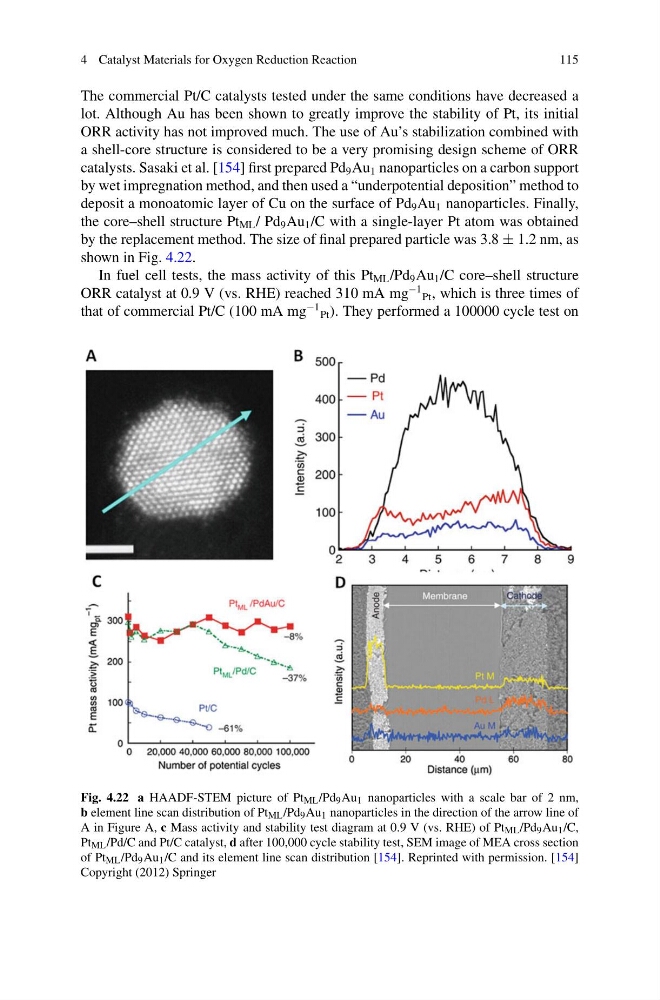
catalysts. Sasaki et al. [154] first prepared Pd 9 Au 1 nanoparticles on a carbon support
by wet impregnation method, and then used a “underpotential deposition” method to
deposit a monoatomic layer of Cu on the surface of Pd 9 Au 1 nanoparticles. Finally,
the core–shell structure Pt ML / Pd 9 Au 1 /C with a single-layer Pt atom was obtained
by the replacement method. The size of final prepared particle was 3.8 ± 1.2 nm, as
shown in Fig. 4.22.
In fuel cell tests, the mass activity of this Pt ML /Pd 9 Au 1 /C core–shell structure
ORR catalyst at 0.9 V (vs. RHE) reached 310 mA mg
−1
Pt , which is three times of
that of commercial Pt/C (100 mA mg
−1
Pt ). They performed a 100000 cycle test on
Fig. 4.22 a HAADF-STEM picture of Pt ML /Pd 9 Au 1 nanoparticles with a scale bar of 2 nm,
b element line scan distribution of Pt ML /Pd 9 Au 1 nanoparticles in the direction of the arrow line of
A in Figure A, c Mass activity and stability test diagram at 0.9 V (vs. RHE) of Pt ML /Pd 9 Au 1 /C,
Pt ML /Pd/C and Pt/C catalyst, d after 100,000 cycle stability test, SEM image of MEA cross section
of Pt ML /Pd 9 Au 1 /C and its element line scan distribution [154]. Reprinted with permission. [154]
Copyright (2012) Springer
115
The commercial Pt/C catalysts tested under the same conditions have decreased a
lot. Although Au has been shown to greatly improve the stability of Pt, its initial
ORR activity has not improved much. The use of Au’s stabilization combined with
a shell-core structure is considered to be a very promising design scheme of ORR
catalysts. Sasaki et al. [154] first prepared Pd 9 Au 1 nanoparticles on a carbon support
by wet impregnation method, and then used a “underpotential deposition” method to
deposit a monoatomic layer of Cu on the surface of Pd 9 Au 1 nanoparticles. Finally,
the core–shell structure Pt ML / Pd 9 Au 1 /C with a single-layer Pt atom was obtained
by the replacement method. The size of final prepared particle was 3.8 ± 1.2 nm, as
shown in Fig. 4.22.
In fuel cell tests, the mass activity of this Pt ML /Pd 9 Au 1 /C core–shell structure
ORR catalyst at 0.9 V (vs. RHE) reached 310 mA mg
−1
Pt , which is three times of
that of commercial Pt/C (100 mA mg
−1
Pt ). They performed a 100000 cycle test on
Fig. 4.22 a HAADF-STEM picture of Pt ML /Pd 9 Au 1 nanoparticles with a scale bar of 2 nm,
b element line scan distribution of Pt ML /Pd 9 Au 1 nanoparticles in the direction of the arrow line of
A in Figure A, c Mass activity and stability test diagram at 0.9 V (vs. RHE) of Pt ML /Pd 9 Au 1 /C,
Pt ML /Pd/C and Pt/C catalyst, d after 100,000 cycle stability test, SEM image of MEA cross section
of Pt ML /Pd 9 Au 1 /C and its element line scan distribution [154]. Reprinted with permission. [154]
Copyright (2012) Springer