

4 Catalyst Materials for Oxygen Reduction Reaction
113
analysis suggests that this significant increase in activity comes from its clean surface
and the exposure of the rich {111} crystal planes of Pt–Ni octahedrons.
At present, the research on ORR catalysts for building Pt-based nanostructures is
very rich, and some exciting results have been achieved. In particular, the synthesis
of Pt-based nanostructure alloys has raised the activity and stability of Pt-based ORR
to a new level, and is a powerful candidate for cathode catalysts used in cheap and
efficient PEMFCs in the future. However, the preparation process of such Pt-based
nanostructured ORR catalysts is usually more complicated, especially in the synthesis
process, some special templates are used or some organic surfactants are required.
The application of templates and the removal and addition of surfactants not only
increases the complexity of the synthesis process, increases the cost of preparation,
and poses a very large challenge to its batch preparation process.
4.2.4 M@Pt Core–Shell ORR Electrocatalyst
ORR is a surface-catalyzed electrochemical process. For Pt nanoparticles, only Pt
atoms distributed on its surface can be used to catalyze oxygen reduction reaction,
while Pt atoms inside the nanoparticles cannot directly participate in the ORR process
[188]. Therefore, the traditional ORR activity utilization rate of pure Pt nanoparticles
is very low, which results in its low ORR activity and the large amount of Pt nanoparticles in PEMFCs, which drives up the cost of application. Although alloying can
increase the activity of Pt-based ORR catalysts, reduce the amount of Pt, and increase
the Pt utilization rate, many Pt atoms inside the Pt-based alloy nanoparticles are still
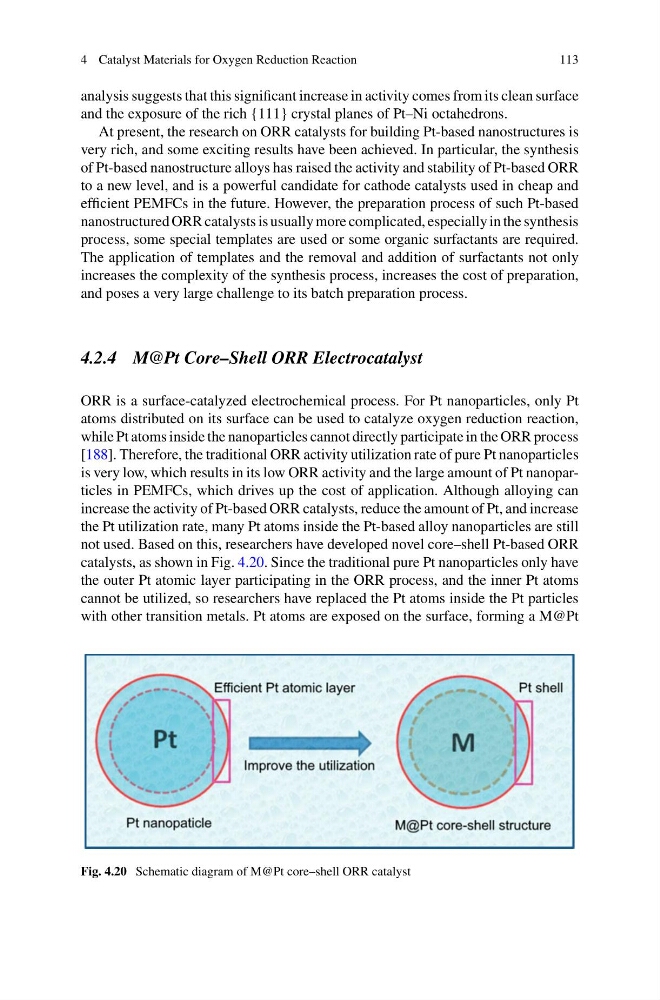
not used. Based on this, researchers have developed novel core–shell Pt-based ORR
catalysts, as shown in Fig. 4.20. Since the traditional pure Pt nanoparticles only have
the outer Pt atomic layer participating in the ORR process, and the inner Pt atoms
cannot be utilized, so researchers have replaced the Pt atoms inside the Pt particles
with other transition metals. Pt atoms are exposed on the surface, forming a M@Pt
Fig. 4.20 Schematic diagram of M@Pt core–shell ORR catalyst
113
analysis suggests that this significant increase in activity comes from its clean surface
and the exposure of the rich {111} crystal planes of Pt–Ni octahedrons.
At present, the research on ORR catalysts for building Pt-based nanostructures is
very rich, and some exciting results have been achieved. In particular, the synthesis
of Pt-based nanostructure alloys has raised the activity and stability of Pt-based ORR
to a new level, and is a powerful candidate for cathode catalysts used in cheap and
efficient PEMFCs in the future. However, the preparation process of such Pt-based
nanostructured ORR catalysts is usually more complicated, especially in the synthesis
process, some special templates are used or some organic surfactants are required.
The application of templates and the removal and addition of surfactants not only
increases the complexity of the synthesis process, increases the cost of preparation,
and poses a very large challenge to its batch preparation process.
4.2.4 M@Pt Core–Shell ORR Electrocatalyst
ORR is a surface-catalyzed electrochemical process. For Pt nanoparticles, only Pt
atoms distributed on its surface can be used to catalyze oxygen reduction reaction,
while Pt atoms inside the nanoparticles cannot directly participate in the ORR process
[188]. Therefore, the traditional ORR activity utilization rate of pure Pt nanoparticles
is very low, which results in its low ORR activity and the large amount of Pt nanoparticles in PEMFCs, which drives up the cost of application. Although alloying can
increase the activity of Pt-based ORR catalysts, reduce the amount of Pt, and increase
the Pt utilization rate, many Pt atoms inside the Pt-based alloy nanoparticles are still
not used. Based on this, researchers have developed novel core–shell Pt-based ORR
catalysts, as shown in Fig. 4.20. Since the traditional pure Pt nanoparticles only have
the outer Pt atomic layer participating in the ORR process, and the inner Pt atoms
cannot be utilized, so researchers have replaced the Pt atoms inside the Pt particles
with other transition metals. Pt atoms are exposed on the surface, forming a M@Pt
Fig. 4.20 Schematic diagram of M@Pt core–shell ORR catalyst