

4 Catalyst Materials for Oxygen Reduction Reaction
107
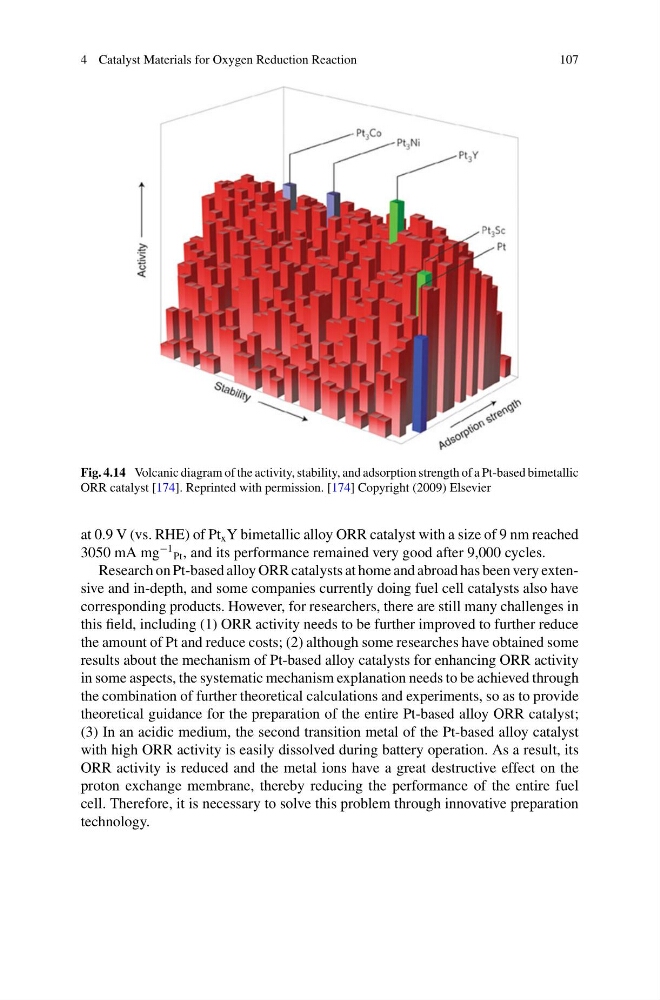
Fig. 4.14 Volcanic diagram of the activity, stability, and adsorption strength of a Pt-based bimetallic
ORR catalyst [174]. Reprinted with permission. [174] Copyright (2009) Elsevier
at 0.9 V (vs. RHE) of Pt x Y bimetallic alloy ORR catalyst with a size of 9 nm reached
3050 mA mg
−1
Pt , and its performance remained very good after 9,000 cycles.
Research on Pt-based alloy ORR catalysts at home and abroad has been very extensive and in-depth, and some companies currently doing fuel cell catalysts also have
corresponding products. However, for researchers, there are still many challenges in
this field, including (1) ORR activity needs to be further improved to further reduce
the amount of Pt and reduce costs; (2) although some researches have obtained some
results about the mechanism of Pt-based alloy catalysts for enhancing ORR activity
in some aspects, the systematic mechanism explanation needs to be achieved through
the combination of further theoretical calculations and experiments, so as to provide
theoretical guidance for the preparation of the entire Pt-based alloy ORR catalyst;
(3) In an acidic medium, the second transition metal of the Pt-based alloy catalyst
with high ORR activity is easily dissolved during battery operation. As a result, its
ORR activity is reduced and the metal ions have a great destructive effect on the
proton exchange membrane, thereby reducing the performance of the entire fuel
cell. Therefore, it is necessary to solve this problem through innovative preparation
technology.
107
Fig. 4.14 Volcanic diagram of the activity, stability, and adsorption strength of a Pt-based bimetallic
ORR catalyst [174]. Reprinted with permission. [174] Copyright (2009) Elsevier
at 0.9 V (vs. RHE) of Pt x Y bimetallic alloy ORR catalyst with a size of 9 nm reached
3050 mA mg
−1
Pt , and its performance remained very good after 9,000 cycles.
Research on Pt-based alloy ORR catalysts at home and abroad has been very extensive and in-depth, and some companies currently doing fuel cell catalysts also have
corresponding products. However, for researchers, there are still many challenges in
this field, including (1) ORR activity needs to be further improved to further reduce
the amount of Pt and reduce costs; (2) although some researches have obtained some
results about the mechanism of Pt-based alloy catalysts for enhancing ORR activity
in some aspects, the systematic mechanism explanation needs to be achieved through
the combination of further theoretical calculations and experiments, so as to provide
theoretical guidance for the preparation of the entire Pt-based alloy ORR catalyst;
(3) In an acidic medium, the second transition metal of the Pt-based alloy catalyst
with high ORR activity is easily dissolved during battery operation. As a result, its
ORR activity is reduced and the metal ions have a great destructive effect on the
proton exchange membrane, thereby reducing the performance of the entire fuel
cell. Therefore, it is necessary to solve this problem through innovative preparation
technology.