

106
Y. Li et al.
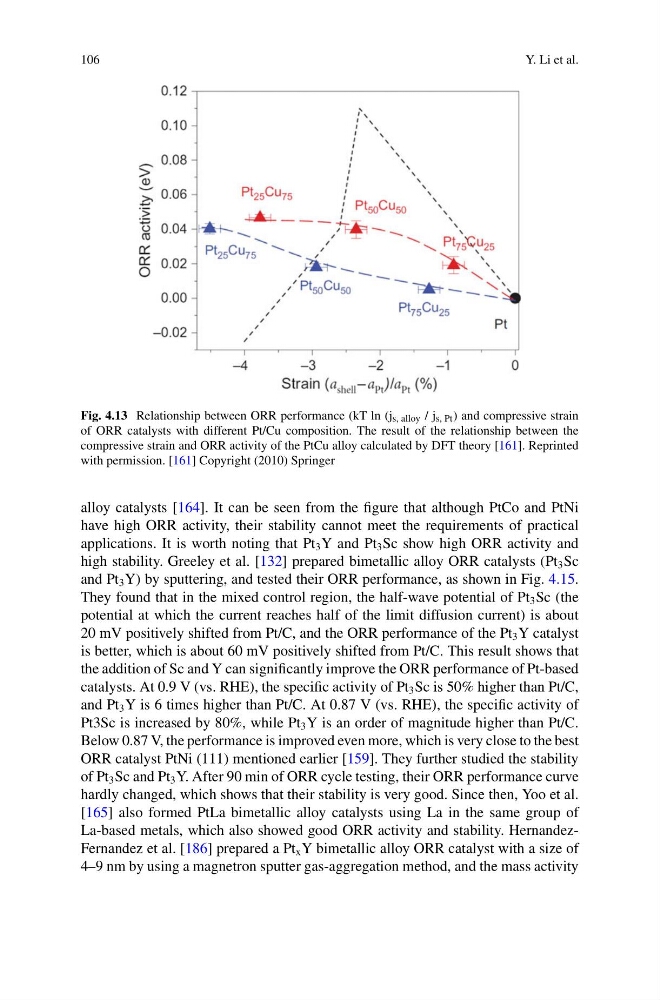
Fig. 4.13 Relationship between ORR performance (kT ln (j s, alloy / j s, Pt ) and compressive strain
of ORR catalysts with different Pt/Cu composition. The result of the relationship between the
compressive strain and ORR activity of the PtCu alloy calculated by DFT theory [161]. Reprinted
with permission. [161] Copyright (2010) Springer
alloy catalysts [164]. It can be seen from the figure that although PtCo and PtNi
have high ORR activity, their stability cannot meet the requirements of practical
applications. It is worth noting that Pt 3 Y and Pt 3 Sc show high ORR activity and
high stability. Greeley et al. [132] prepared bimetallic alloy ORR catalysts (Pt 3 Sc
and Pt 3 Y) by sputtering, and tested their ORR performance, as shown in Fig. 4.15.
They found that in the mixed control region, the half-wave potential of Pt 3 Sc (the
potential at which the current reaches half of the limit diffusion current) is about
20 mV positively shifted from Pt/C, and the ORR performance of the Pt 3 Y catalyst
is better, which is about 60 mV positively shifted from Pt/C. This result shows that
the addition of Sc and Y can significantly improve the ORR performance of Pt-based
catalysts. At 0.9 V (vs. RHE), the specific activity of Pt 3 Sc is 50% higher than Pt/C,
and Pt 3 Y is 6 times higher than Pt/C. At 0.87 V (vs. RHE), the specific activity of
Pt3Sc is increased by 80%, while Pt 3 Y is an order of magnitude higher than Pt/C.
Below 0.87 V, the performance is improved even more, which is very close to the best
ORR catalyst PtNi (111) mentioned earlier [159]. They further studied the stability
of Pt 3 Sc and Pt 3 Y. After 90 min of ORR cycle testing, their ORR performance curve
hardly changed, which shows that their stability is very good. Since then, Yoo et al.
[165] also formed PtLa bimetallic alloy catalysts using La in the same group of
La-based metals, which also showed good ORR activity and stability. HernandezFernandez et al. [186] prepared a Pt x Y bimetallic alloy ORR catalyst with a size of
4–9 nm by using a magnetron sputter gas-aggregation method, and the mass activity
Y. Li et al.
Fig. 4.13 Relationship between ORR performance (kT ln (j s, alloy / j s, Pt ) and compressive strain
of ORR catalysts with different Pt/Cu composition. The result of the relationship between the
compressive strain and ORR activity of the PtCu alloy calculated by DFT theory [161]. Reprinted
with permission. [161] Copyright (2010) Springer
alloy catalysts [164]. It can be seen from the figure that although PtCo and PtNi
have high ORR activity, their stability cannot meet the requirements of practical
applications. It is worth noting that Pt 3 Y and Pt 3 Sc show high ORR activity and
high stability. Greeley et al. [132] prepared bimetallic alloy ORR catalysts (Pt 3 Sc
and Pt 3 Y) by sputtering, and tested their ORR performance, as shown in Fig. 4.15.
They found that in the mixed control region, the half-wave potential of Pt 3 Sc (the
potential at which the current reaches half of the limit diffusion current) is about
20 mV positively shifted from Pt/C, and the ORR performance of the Pt 3 Y catalyst
is better, which is about 60 mV positively shifted from Pt/C. This result shows that
the addition of Sc and Y can significantly improve the ORR performance of Pt-based
catalysts. At 0.9 V (vs. RHE), the specific activity of Pt 3 Sc is 50% higher than Pt/C,
and Pt 3 Y is 6 times higher than Pt/C. At 0.87 V (vs. RHE), the specific activity of
Pt3Sc is increased by 80%, while Pt 3 Y is an order of magnitude higher than Pt/C.
Below 0.87 V, the performance is improved even more, which is very close to the best
ORR catalyst PtNi (111) mentioned earlier [159]. They further studied the stability
of Pt 3 Sc and Pt 3 Y. After 90 min of ORR cycle testing, their ORR performance curve
hardly changed, which shows that their stability is very good. Since then, Yoo et al.
[165] also formed PtLa bimetallic alloy catalysts using La in the same group of
La-based metals, which also showed good ORR activity and stability. HernandezFernandez et al. [186] prepared a Pt x Y bimetallic alloy ORR catalyst with a size of
4–9 nm by using a magnetron sputter gas-aggregation method, and the mass activity