

6 Molecular Magnetism of Metal Complexes and Light-Induced …
301
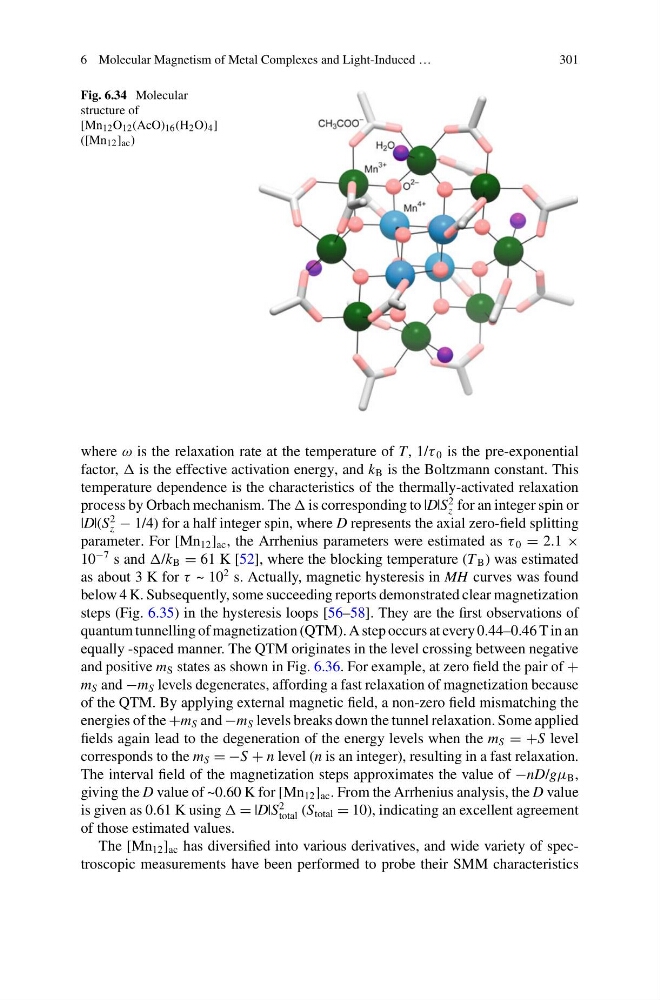
Fig. 6.34 Molecular
structure of
[Mn 12 O 12 (AcO) 16 (H 2 O) 4 ]
([Mn 12 ] ac )
where ω is the relaxation rate at the temperature of T, 1/τ 0 is the pre-exponential
factor, is the effective activation energy, and k B is the Boltzmann constant. This
temperature dependence is the characteristics of the thermally-activated relaxation
process by Orbach mechanism. The is corresponding to |D|S
2
z for an integer spin or
|D|(S
2
z − 1/4) for a half integer spin, where D represents the axial zero-field splitting
parameter. For [Mn 12 ] ac , the Arrhenius parameters were estimated as τ 0 = 2.1 ×
10
−7 s and /k B = 61 K [52], where the blocking temperature (T B ) was estimated
as about 3 K for τ ~ 10
2 s. Actually, magnetic hysteresis in MH curves was found
below 4 K. Subsequently, some succeeding reports demonstrated clear magnetization
steps (Fig. 6.35) in the hysteresis loops [56–58]. They are the first observations of
quantum tunnelling of magnetization (QTM). A step occurs at every 0.44–0.46 T in an
equally -spaced manner. The QTM originates in the level crossing between negative
and positive m S states as shown in Fig. 6.36. For example, at zero field the pair of +
m S and −m S levels degenerates, affording a fast relaxation of magnetization because
of the QTM. By applying external magnetic field, a non-zero field mismatching the
energies of the +m S and −m S levels breaks down the tunnel relaxation. Some applied
fields again lead to the degeneration of the energy levels when the m S = +S level
corresponds to the m S = −S + n level (n is an integer), resulting in a fast relaxation.
The interval field of the magnetization steps approximates the value of −nD/gμ B ,
giving the D value of ~0.60 K for [Mn 12 ] ac . From the Arrhenius analysis, the D value
is given as 0.61 K using = |D|S
2
total (S total = 10), indicating an excellent agreement
of those estimated values.
The [Mn 12 ] ac has diversified into various derivatives, and wide variety of spectroscopic measurements have been performed to probe their SMM characteristics
301
Fig. 6.34 Molecular
structure of
[Mn 12 O 12 (AcO) 16 (H 2 O) 4 ]
([Mn 12 ] ac )
where ω is the relaxation rate at the temperature of T, 1/τ 0 is the pre-exponential
factor, is the effective activation energy, and k B is the Boltzmann constant. This
temperature dependence is the characteristics of the thermally-activated relaxation
process by Orbach mechanism. The is corresponding to |D|S
2
z for an integer spin or
|D|(S
2
z − 1/4) for a half integer spin, where D represents the axial zero-field splitting
parameter. For [Mn 12 ] ac , the Arrhenius parameters were estimated as τ 0 = 2.1 ×
10
−7 s and /k B = 61 K [52], where the blocking temperature (T B ) was estimated
as about 3 K for τ ~ 10
2 s. Actually, magnetic hysteresis in MH curves was found
below 4 K. Subsequently, some succeeding reports demonstrated clear magnetization
steps (Fig. 6.35) in the hysteresis loops [56–58]. They are the first observations of
quantum tunnelling of magnetization (QTM). A step occurs at every 0.44–0.46 T in an
equally -spaced manner. The QTM originates in the level crossing between negative
and positive m S states as shown in Fig. 6.36. For example, at zero field the pair of +
m S and −m S levels degenerates, affording a fast relaxation of magnetization because
of the QTM. By applying external magnetic field, a non-zero field mismatching the
energies of the +m S and −m S levels breaks down the tunnel relaxation. Some applied
fields again lead to the degeneration of the energy levels when the m S = +S level
corresponds to the m S = −S + n level (n is an integer), resulting in a fast relaxation.
The interval field of the magnetization steps approximates the value of −nD/gμ B ,
giving the D value of ~0.60 K for [Mn 12 ] ac . From the Arrhenius analysis, the D value
is given as 0.61 K using = |D|S
2
total (S total = 10), indicating an excellent agreement
of those estimated values.
The [Mn 12 ] ac has diversified into various derivatives, and wide variety of spectroscopic measurements have been performed to probe their SMM characteristics