

468
Y. Yoshida
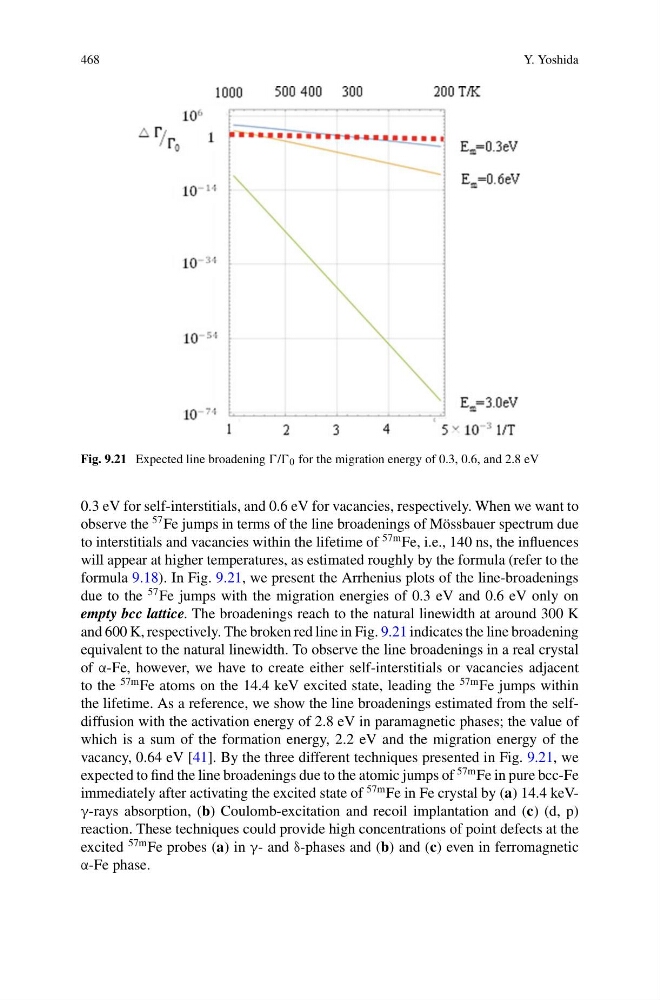
Fig. 9.21 Expected line broadening / 0 for the migration energy of 0.3, 0.6, and 2.8 eV
0.3 eV for self-interstitials, and 0.6 eV for vacancies, respectively. When we want to
observe the
57 Fe jumps in terms of the line broadenings of Mössbauer spectrum due
to interstitials and vacancies within the lifetime of
57m Fe, i.e., 140 ns, the influences
will appear at higher temperatures, as estimated roughly by the formula (refer to the
formula 9.18). In Fig. 9.21, we present the Arrhenius plots of the line-broadenings
due to the
57 Fe jumps with the migration energies of 0.3 eV and 0.6 eV only on
empty bcc lattice. The broadenings reach to the natural linewidth at around 300 K
and 600 K, respectively. The broken red line in Fig. 9.21 indicates the line broadening
equivalent to the natural linewidth. To observe the line broadenings in a real crystal
of α-Fe, however, we have to create either self-interstitials or vacancies adjacent
to the
57m Fe atoms on the 14.4 keV excited state, leading the
57m Fe jumps within
the lifetime. As a reference, we show the line broadenings estimated from the selfdiffusion with the activation energy of 2.8 eV in paramagnetic phases; the value of
which is a sum of the formation energy, 2.2 eV and the migration energy of the
vacancy, 0.64 eV [41]. By the three different techniques presented in Fig. 9.21, we
expected to find the line broadenings due to the atomic jumps of
57m Fe in pure bcc-Fe
immediately after activating the excited state of
57m Fe in Fe crystal by (a) 14.4 keVγ-rays absorption, (b) Coulomb-excitation and recoil implantation and (c) (d, p)
reaction. These techniques could provide high concentrations of point defects at the
excited
57m Fe probes (a) in γ- and δ-phases and (b) and (c) even in ferromagnetic
α-Fe phase.
Y. Yoshida
Fig. 9.21 Expected line broadening / 0 for the migration energy of 0.3, 0.6, and 2.8 eV
0.3 eV for self-interstitials, and 0.6 eV for vacancies, respectively. When we want to
observe the
57 Fe jumps in terms of the line broadenings of Mössbauer spectrum due
to interstitials and vacancies within the lifetime of
57m Fe, i.e., 140 ns, the influences
will appear at higher temperatures, as estimated roughly by the formula (refer to the
formula 9.18). In Fig. 9.21, we present the Arrhenius plots of the line-broadenings
due to the
57 Fe jumps with the migration energies of 0.3 eV and 0.6 eV only on
empty bcc lattice. The broadenings reach to the natural linewidth at around 300 K
and 600 K, respectively. The broken red line in Fig. 9.21 indicates the line broadening
equivalent to the natural linewidth. To observe the line broadenings in a real crystal
of α-Fe, however, we have to create either self-interstitials or vacancies adjacent
to the
57m Fe atoms on the 14.4 keV excited state, leading the
57m Fe jumps within
the lifetime. As a reference, we show the line broadenings estimated from the selfdiffusion with the activation energy of 2.8 eV in paramagnetic phases; the value of
which is a sum of the formation energy, 2.2 eV and the migration energy of the
vacancy, 0.64 eV [41]. By the three different techniques presented in Fig. 9.21, we
expected to find the line broadenings due to the atomic jumps of
57m Fe in pure bcc-Fe
immediately after activating the excited state of
57m Fe in Fe crystal by (a) 14.4 keVγ-rays absorption, (b) Coulomb-excitation and recoil implantation and (c) (d, p)
reaction. These techniques could provide high concentrations of point defects at the
excited
57m Fe probes (a) in γ- and δ-phases and (b) and (c) even in ferromagnetic
α-Fe phase.