

9 Mössbauer Spectroscopic Studies on Atomic Diffusion in Materials
467
stages I and III in the thermal scanning, corresponding to the activation enthalpies
of the mobility of interstitials and vacancies as 0.3 eV and 0.6 eV, respectively.
9.4 In-Situ Observations of Elementary Jump Processes
in Iron and Silicon
Between 1983 and 2014, we developed unique measuring techniques in
57 Fe Mössbauer Spectroscopy as international joint ventures between the Hahn-Meitner Institut
Berlin, Germany, and Institut für Festkörper Physik der Universität Wien, Austria
and later the RIKEN, Japan. We applied these techniques for the in-situ observations
of
57m Fe atoms jumping within the lifetime in pure iron where different point defect
concentrations and distributions are produced at around the nuclear probes of
57m Fe.
In this section from 9.4.1 to 9.4.3, we describe these experimental techniques to
study the self-diffusion in pure Fe, and also the Fe impurity-diffusion in Si. First
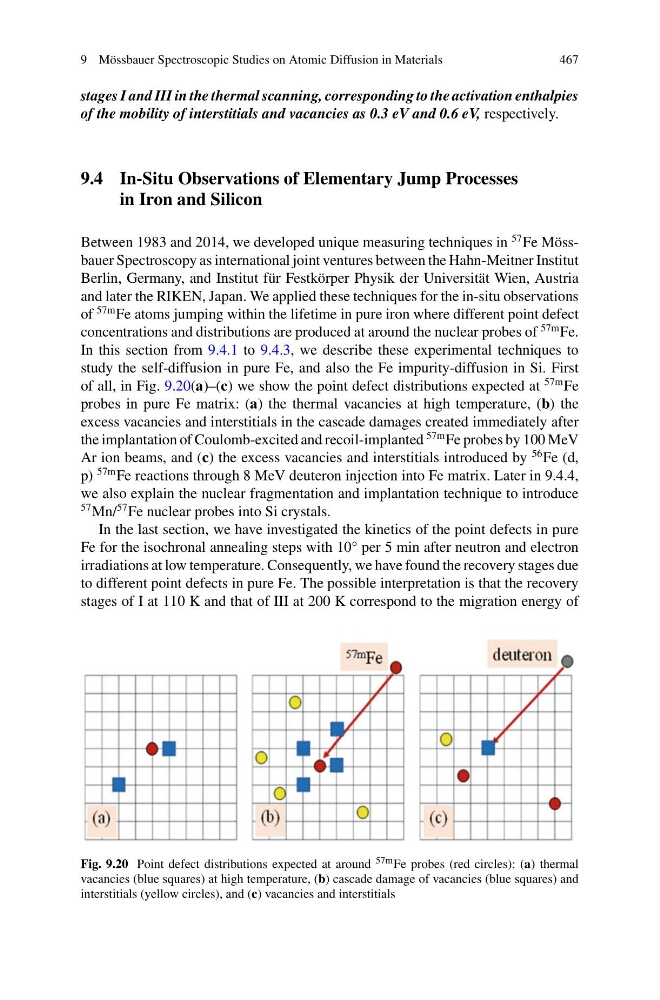
of all, in Fig. 9.20(a)–(c) we show the point defect distributions expected at
57m Fe
probes in pure Fe matrix: (a) the thermal vacancies at high temperature, (b) the
excess vacancies and interstitials in the cascade damages created immediately after
the implantation of Coulomb-excited and recoil-implanted
57m Fe probes by 100 MeV
Ar ion beams, and (c) the excess vacancies and interstitials introduced by
56 Fe (d,
p)
57m Fe reactions through 8 MeV deuteron injection into Fe matrix. Later in 9.4.4,
we also explain the nuclear fragmentation and implantation technique to introduce
57 Mn/
57 Fe nuclear probes into Si crystals.
In the last section, we have investigated the kinetics of the point defects in pure
Fe for the isochronal annealing steps with 10° per 5 min after neutron and electron
irradiations at low temperature. Consequently, we have found the recovery stages due
to different point defects in pure Fe. The possible interpretation is that the recovery
stages of I at 110 K and that of III at 200 K correspond to the migration energy of
Fig. 9.20 Point defect distributions expected at around 57m Fe probes (red circles): (a) thermal
vacancies (blue squares) at high temperature, (b) cascade damage of vacancies (blue squares) and
interstitials (yellow circles), and (c) vacancies and interstitials
467
stages I and III in the thermal scanning, corresponding to the activation enthalpies
of the mobility of interstitials and vacancies as 0.3 eV and 0.6 eV, respectively.
9.4 In-Situ Observations of Elementary Jump Processes
in Iron and Silicon
Between 1983 and 2014, we developed unique measuring techniques in
57 Fe Mössbauer Spectroscopy as international joint ventures between the Hahn-Meitner Institut
Berlin, Germany, and Institut für Festkörper Physik der Universität Wien, Austria
and later the RIKEN, Japan. We applied these techniques for the in-situ observations
of
57m Fe atoms jumping within the lifetime in pure iron where different point defect
concentrations and distributions are produced at around the nuclear probes of
57m Fe.
In this section from 9.4.1 to 9.4.3, we describe these experimental techniques to
study the self-diffusion in pure Fe, and also the Fe impurity-diffusion in Si. First
of all, in Fig. 9.20(a)–(c) we show the point defect distributions expected at
57m Fe
probes in pure Fe matrix: (a) the thermal vacancies at high temperature, (b) the
excess vacancies and interstitials in the cascade damages created immediately after
the implantation of Coulomb-excited and recoil-implanted
57m Fe probes by 100 MeV
Ar ion beams, and (c) the excess vacancies and interstitials introduced by
56 Fe (d,
p)
57m Fe reactions through 8 MeV deuteron injection into Fe matrix. Later in 9.4.4,
we also explain the nuclear fragmentation and implantation technique to introduce
57 Mn/
57 Fe nuclear probes into Si crystals.
In the last section, we have investigated the kinetics of the point defects in pure
Fe for the isochronal annealing steps with 10° per 5 min after neutron and electron
irradiations at low temperature. Consequently, we have found the recovery stages due
to different point defects in pure Fe. The possible interpretation is that the recovery
stages of I at 110 K and that of III at 200 K correspond to the migration energy of
Fig. 9.20 Point defect distributions expected at around 57m Fe probes (red circles): (a) thermal
vacancies (blue squares) at high temperature, (b) cascade damage of vacancies (blue squares) and
interstitials (yellow circles), and (c) vacancies and interstitials