

9 Mössbauer Spectroscopic Studies on Atomic Diffusion in Materials
469
9.4.1 High-Temperature UHV-Furnace and Encapsulation
Techniques
As the first step, we developed a “high-temperature UHV-furnace” at the HahnMeitner Institute Berlin, at University Wien, and later at Shizuoka Institute of Science
and Technology (SIST) to achieve an in-situ observation of self-diffusion of Fe
within the lifetime of 140 ns. It was not an easy task to measure pure Fe at high
temperatures. Iron has three different solid phases: the α-phase (bcc) up to 1184 K,
the γ-phase (fcc) up to 1665 K, and the δ-phase (bcc) up to the melting point of
1809 K. Especially challenging was to measure the Mössbauer Spectra in the δphase because of the high vapour pressure of Fe. In the δ-phase, we could not keep
the sample foil even for several hours in the UHV furnace. Accordingly, it was
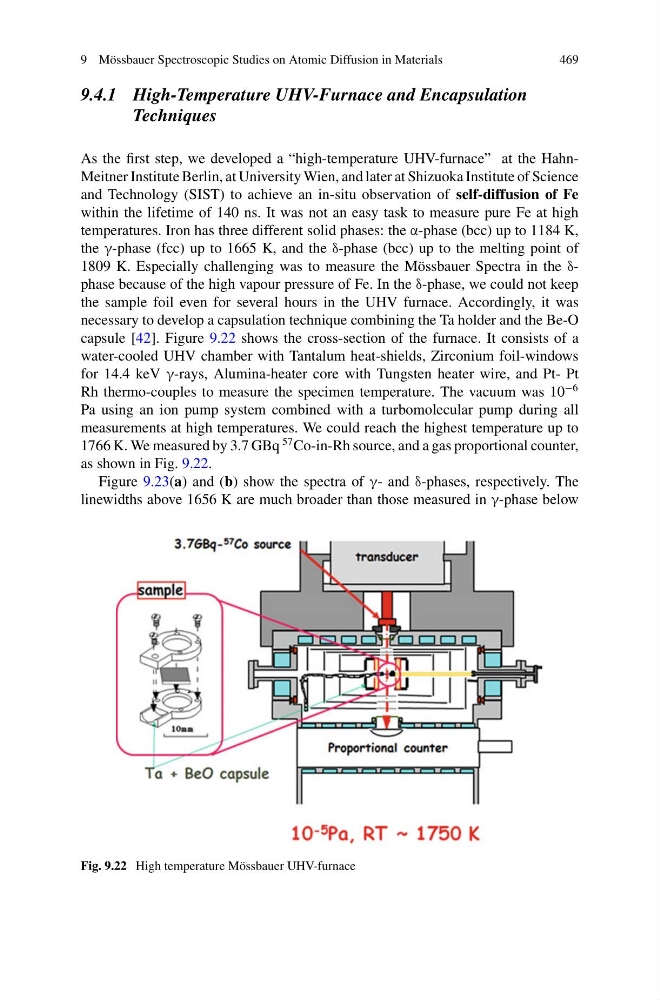
necessary to develop a capsulation technique combining the Ta holder and the Be-O
capsule [42]. Figure 9.22 shows the cross-section of the furnace. It consists of a
water-cooled UHV chamber with Tantalum heat-shields, Zirconium foil-windows
for 14.4 keV γ-rays, Alumina-heater core with Tungsten heater wire, and Pt- Pt
Rh thermo-couples to measure the specimen temperature. The vacuum was 10
−6
Pa using an ion pump system combined with a turbomolecular pump during all
measurements at high temperatures. We could reach the highest temperature up to
1766 K. We measured by 3.7 GBq
57 Co-in-Rh source, and a gas proportional counter,
as shown in Fig. 9.22.
Figure 9.23(a) and (b) show the spectra of γ- and δ-phases, respectively. The
linewidths above 1656 K are much broader than those measured in γ-phase below
Fig. 9.22 High temperature Mössbauer UHV-furnace
469
9.4.1 High-Temperature UHV-Furnace and Encapsulation
Techniques
As the first step, we developed a “high-temperature UHV-furnace” at the HahnMeitner Institute Berlin, at University Wien, and later at Shizuoka Institute of Science
and Technology (SIST) to achieve an in-situ observation of self-diffusion of Fe
within the lifetime of 140 ns. It was not an easy task to measure pure Fe at high
temperatures. Iron has three different solid phases: the α-phase (bcc) up to 1184 K,
the γ-phase (fcc) up to 1665 K, and the δ-phase (bcc) up to the melting point of
1809 K. Especially challenging was to measure the Mössbauer Spectra in the δphase because of the high vapour pressure of Fe. In the δ-phase, we could not keep
the sample foil even for several hours in the UHV furnace. Accordingly, it was
necessary to develop a capsulation technique combining the Ta holder and the Be-O
capsule [42]. Figure 9.22 shows the cross-section of the furnace. It consists of a
water-cooled UHV chamber with Tantalum heat-shields, Zirconium foil-windows
for 14.4 keV γ-rays, Alumina-heater core with Tungsten heater wire, and Pt- Pt
Rh thermo-couples to measure the specimen temperature. The vacuum was 10
−6
Pa using an ion pump system combined with a turbomolecular pump during all
measurements at high temperatures. We could reach the highest temperature up to
1766 K. We measured by 3.7 GBq
57 Co-in-Rh source, and a gas proportional counter,
as shown in Fig. 9.22.
Figure 9.23(a) and (b) show the spectra of γ- and δ-phases, respectively. The
linewidths above 1656 K are much broader than those measured in γ-phase below
Fig. 9.22 High temperature Mössbauer UHV-furnace