

9 Mössbauer Spectroscopic Studies on Atomic Diffusion in Materials
455
sites, the
57 Fe can jump from a lattice site to another, leading to diffusion. The duration of one jump is about 10
–12 s, which is orders magnitude shorter than that of
the atom staying on a lattice site. It turns out that the
57 Fe performs a few jumps
during emitting or absorbing γ-ray, and that the jump process breaks the coherency
of the wave train. Consequently, we observe the lifetime of the 14.4 keV γ-ray apparently shorter than the natural lifetime. Considering of the Heisenberg time-energy
uncertainty principle, E τ M ≈ è, a shorter lifetime provides a broader linewidth
of the Mössbauer resonance. The line broadenings have been observed indeed in
pure Fe using different experimental techniques, such as high temperatures UHVfurnace, Coulomb excitation and recoil-implantations and (d, p) reactions, as will
be presented in Sect. 9.4. These techniques provide different point defects and their
concentrations adjacent to
57m Fe atoms.
In 1960, immediately after the discovery of the Mössbauer effect, Singwi and
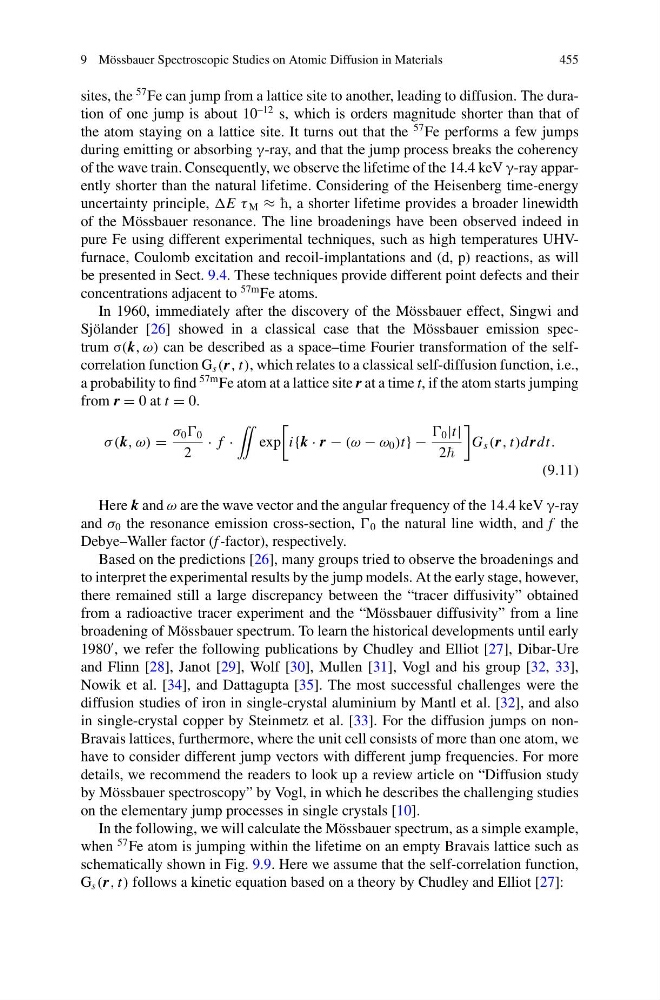
Sjölander [26] showed in a classical case that the Mössbauer emission spectrum σ(k, ω) can be described as a space–time Fourier transformation of the selfcorrelation function G s (r, t), which relates to a classical self-diffusion function, i.e.,
a probability to find
57m Fe atom at a lattice site r at a time t, if the atom starts jumping
from r = 0 at t = 0.
σ (k, ω) =
σ 0 0
2
· f ·
¨
exp
i{k · r − (ω − ω 0 )t} −
0 |t|
2
G s (r, t)d rdt.
(9.11)
Here k and ω are the wave vector and the angular frequency of the 14.4 keV γ-ray
and σ 0 the resonance emission cross-section, 0 the natural line width, and f the
Debye–Waller factor (f -factor), respectively.
Based on the predictions [26], many groups tried to observe the broadenings and
to interpret the experimental results by the jump models. At the early stage, however,
there remained still a large discrepancy between the “tracer diffusivity” obtained
from a radioactive tracer experiment and the “Mössbauer diffusivity” from a line
broadening of Mössbauer spectrum. To learn the historical developments until early
1980
, we refer the following publications by Chudley and Elliot [27], Dibar-Ure
and Flinn [28], Janot [29], Wolf [30], Mullen [31], Vogl and his group [32, 33],
Nowik et al. [34], and Dattagupta [35]. The most successful challenges were the
diffusion studies of iron in single-crystal aluminium by Mantl et al. [32], and also
in single-crystal copper by Steinmetz et al. [33]. For the diffusion jumps on nonBravais lattices, furthermore, where the unit cell consists of more than one atom, we
have to consider different jump vectors with different jump frequencies. For more
details, we recommend the readers to look up a review article on “Diffusion study
by Mössbauer spectroscopy” by Vogl, in which he describes the challenging studies
on the elementary jump processes in single crystals [10].
In the following, we will calculate the Mössbauer spectrum, as a simple example,
when
57 Fe atom is jumping within the lifetime on an empty Bravais lattice such as
schematically shown in Fig. 9.9. Here we assume that the self-correlation function,
G s (r, t) follows a kinetic equation based on a theory by Chudley and Elliot [27]:
455
sites, the
57 Fe can jump from a lattice site to another, leading to diffusion. The duration of one jump is about 10
–12 s, which is orders magnitude shorter than that of
the atom staying on a lattice site. It turns out that the
57 Fe performs a few jumps
during emitting or absorbing γ-ray, and that the jump process breaks the coherency
of the wave train. Consequently, we observe the lifetime of the 14.4 keV γ-ray apparently shorter than the natural lifetime. Considering of the Heisenberg time-energy
uncertainty principle, E τ M ≈ è, a shorter lifetime provides a broader linewidth
of the Mössbauer resonance. The line broadenings have been observed indeed in
pure Fe using different experimental techniques, such as high temperatures UHVfurnace, Coulomb excitation and recoil-implantations and (d, p) reactions, as will
be presented in Sect. 9.4. These techniques provide different point defects and their
concentrations adjacent to
57m Fe atoms.
In 1960, immediately after the discovery of the Mössbauer effect, Singwi and
Sjölander [26] showed in a classical case that the Mössbauer emission spectrum σ(k, ω) can be described as a space–time Fourier transformation of the selfcorrelation function G s (r, t), which relates to a classical self-diffusion function, i.e.,
a probability to find
57m Fe atom at a lattice site r at a time t, if the atom starts jumping
from r = 0 at t = 0.
σ (k, ω) =
σ 0 0
2
· f ·
¨
exp
i{k · r − (ω − ω 0 )t} −
0 |t|
2
G s (r, t)d rdt.
(9.11)
Here k and ω are the wave vector and the angular frequency of the 14.4 keV γ-ray
and σ 0 the resonance emission cross-section, 0 the natural line width, and f the
Debye–Waller factor (f -factor), respectively.
Based on the predictions [26], many groups tried to observe the broadenings and
to interpret the experimental results by the jump models. At the early stage, however,
there remained still a large discrepancy between the “tracer diffusivity” obtained
from a radioactive tracer experiment and the “Mössbauer diffusivity” from a line
broadening of Mössbauer spectrum. To learn the historical developments until early
1980
, we refer the following publications by Chudley and Elliot [27], Dibar-Ure
and Flinn [28], Janot [29], Wolf [30], Mullen [31], Vogl and his group [32, 33],
Nowik et al. [34], and Dattagupta [35]. The most successful challenges were the
diffusion studies of iron in single-crystal aluminium by Mantl et al. [32], and also
in single-crystal copper by Steinmetz et al. [33]. For the diffusion jumps on nonBravais lattices, furthermore, where the unit cell consists of more than one atom, we
have to consider different jump vectors with different jump frequencies. For more
details, we recommend the readers to look up a review article on “Diffusion study
by Mössbauer spectroscopy” by Vogl, in which he describes the challenging studies
on the elementary jump processes in single crystals [10].
In the following, we will calculate the Mössbauer spectrum, as a simple example,
when
57 Fe atom is jumping within the lifetime on an empty Bravais lattice such as
schematically shown in Fig. 9.9. Here we assume that the self-correlation function,
G s (r, t) follows a kinetic equation based on a theory by Chudley and Elliot [27]: