

454
Y. Yoshida
where μ is the magnetic dipole moment, g N the nuclear Landè factor, and β N the
nuclear Bohr magneton. The selection rule for magnetic dipole transitions leads to
the sextet as in Fig. 9.8(b). Furthermore, each sextet line will be shifted, as in the
right-hand side in Fig. 9.8(b), when the magnetic dipole interaction is dominant in
comparison with the electric dipole interaction. If the EFG tensor is axially symmetric
and its principal axis makes an angle β, the nuclear energy is given by
E = −g N β N Bm I + (−1)
|m I |+1/2
(eQV zz /8)
3 cos
2
β − 1
.
(9.10)
A typical example of (9.10) will appear in a spectrum of Fe–C steel in Sect. 9.6.
9.2.3 Principle of Mössbauer Study on Atomic Diffusion
In this section, we explain how atomic jumps affect the Mössbauer spectrum.
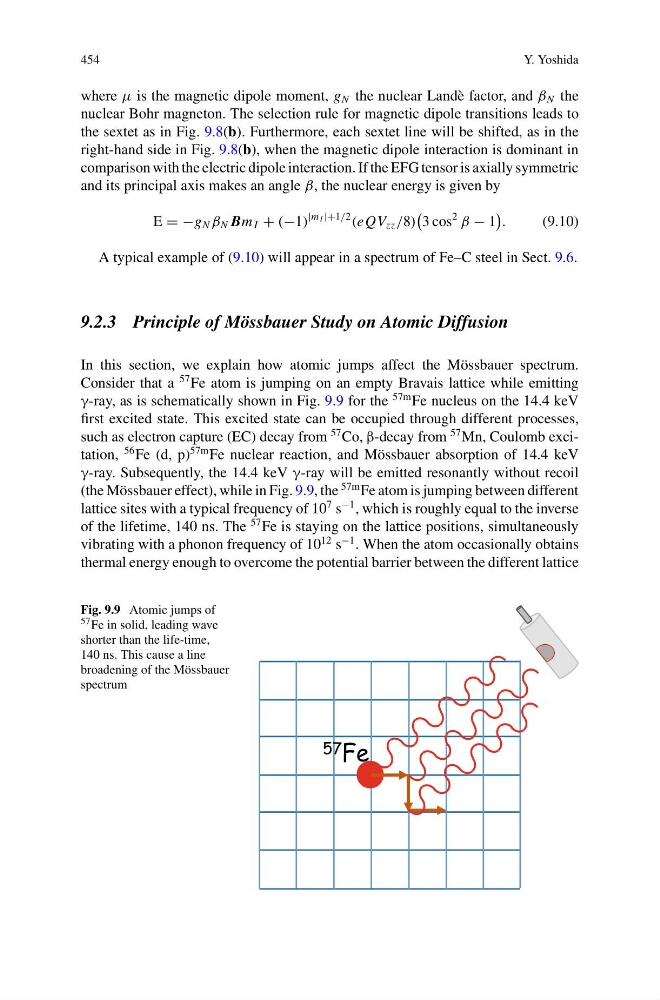
Consider that a
57 Fe atom is jumping on an empty Bravais lattice while emitting
γ-ray, as is schematically shown in Fig. 9.9 for the
57m Fe nucleus on the 14.4 keV
first excited state. This excited state can be occupied through different processes,
such as electron capture (EC) decay from
57 Co, β-decay from
57 Mn, Coulomb excitation,
56 Fe (d, p)
57m Fe nuclear reaction, and Mössbauer absorption of 14.4 keV
γ-ray. Subsequently, the 14.4 keV γ-ray will be emitted resonantly without recoil
(the Mössbauer effect), while in Fig. 9.9, the
57m Fe atom is jumping between different
lattice sites with a typical frequency of 10
7 s
−1 , which is roughly equal to the inverse
of the lifetime, 140 ns. The
57 Fe is staying on the lattice positions, simultaneously
vibrating with a phonon frequency of 10
12 s
−1 . When the atom occasionally obtains
thermal energy enough to overcome the potential barrier between the different lattice
Fig. 9.9 Atomic jumps of
57 Fe in solid, leading wave
shorter than the life-time,
140 ns. This cause a line
broadening of the Mössbauer
spectrum
Y. Yoshida
where μ is the magnetic dipole moment, g N the nuclear Landè factor, and β N the
nuclear Bohr magneton. The selection rule for magnetic dipole transitions leads to
the sextet as in Fig. 9.8(b). Furthermore, each sextet line will be shifted, as in the
right-hand side in Fig. 9.8(b), when the magnetic dipole interaction is dominant in
comparison with the electric dipole interaction. If the EFG tensor is axially symmetric
and its principal axis makes an angle β, the nuclear energy is given by
E = −g N β N Bm I + (−1)
|m I |+1/2
(eQV zz /8)
3 cos
2
β − 1
.
(9.10)
A typical example of (9.10) will appear in a spectrum of Fe–C steel in Sect. 9.6.
9.2.3 Principle of Mössbauer Study on Atomic Diffusion
In this section, we explain how atomic jumps affect the Mössbauer spectrum.
Consider that a
57 Fe atom is jumping on an empty Bravais lattice while emitting
γ-ray, as is schematically shown in Fig. 9.9 for the
57m Fe nucleus on the 14.4 keV
first excited state. This excited state can be occupied through different processes,
such as electron capture (EC) decay from
57 Co, β-decay from
57 Mn, Coulomb excitation,
56 Fe (d, p)
57m Fe nuclear reaction, and Mössbauer absorption of 14.4 keV
γ-ray. Subsequently, the 14.4 keV γ-ray will be emitted resonantly without recoil
(the Mössbauer effect), while in Fig. 9.9, the
57m Fe atom is jumping between different
lattice sites with a typical frequency of 10
7 s
−1 , which is roughly equal to the inverse
of the lifetime, 140 ns. The
57 Fe is staying on the lattice positions, simultaneously
vibrating with a phonon frequency of 10
12 s
−1 . When the atom occasionally obtains
thermal energy enough to overcome the potential barrier between the different lattice
Fig. 9.9 Atomic jumps of
57 Fe in solid, leading wave
shorter than the life-time,
140 ns. This cause a line
broadening of the Mössbauer
spectrum