

9 Mössbauer Spectroscopic Studies on Atomic Diffusion in Materials
453
δ = C
|ψ(0)|
2
A − |ψ(0)|
2
S
,
(9.6)
i.e., the difference in the charge densities between the source (S) and absorber (A).
As a reference of isomer shift, we use the centre position of the sextet Mössbauer
spectrum of pure Fe at room temperature in this book. The isomer shift depends, for
instance, on different charge states of
57 Fe atoms in Si crystal, as will be explained
in Sects. 9.4 and 9.5.
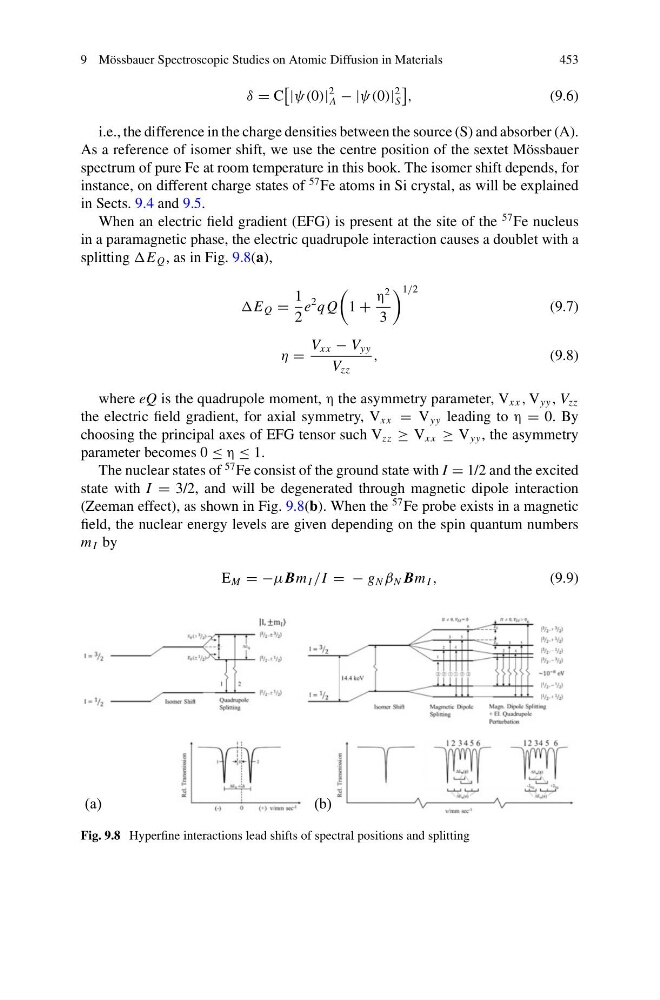
When an electric field gradient (EFG) is present at the site of the
57 Fe nucleus
in a paramagnetic phase, the electric quadrupole interaction causes a doublet with a
splitting Q , as in Fig. 9.8(a),
Q =
1
2
e
2 q Q
1 +
η
2
3
1/2
(9.7)
η =
V xx − V yy
V zz
,
(9.8)
where eQ is the quadrupole moment, η the asymmetry parameter, V xx , V yy , V zz
the electric field gradient, for axial symmetry, V xx = V yy leading to η = 0. By
choosing the principal axes of EFG tensor such V zz ≥ V xx ≥ V yy , the asymmetry
parameter becomes 0 ≤ η ≤ 1.
The nuclear states of
57 Fe consist of the ground state with I = 1/2 and the excited
state with I = 3/2, and will be degenerated through magnetic dipole interaction
(Zeeman effect), as shown in Fig. 9.8(b). When the
57 Fe probe exists in a magnetic
field, the nuclear energy levels are given depending on the spin quantum numbers
m I by
E M = −μBm I /I = − g N β N Bm I ,
(9.9)
(a)
(b)
Fig. 9.8 Hyperfine interactions lead shifts of spectral positions and splitting
453
δ = C
|ψ(0)|
2
A − |ψ(0)|
2
S
,
(9.6)
i.e., the difference in the charge densities between the source (S) and absorber (A).
As a reference of isomer shift, we use the centre position of the sextet Mössbauer
spectrum of pure Fe at room temperature in this book. The isomer shift depends, for
instance, on different charge states of
57 Fe atoms in Si crystal, as will be explained
in Sects. 9.4 and 9.5.
When an electric field gradient (EFG) is present at the site of the
57 Fe nucleus
in a paramagnetic phase, the electric quadrupole interaction causes a doublet with a
splitting Q , as in Fig. 9.8(a),
Q =
1
2
e
2 q Q
1 +
η
2
3
1/2
(9.7)
η =
V xx − V yy
V zz
,
(9.8)
where eQ is the quadrupole moment, η the asymmetry parameter, V xx , V yy , V zz
the electric field gradient, for axial symmetry, V xx = V yy leading to η = 0. By
choosing the principal axes of EFG tensor such V zz ≥ V xx ≥ V yy , the asymmetry
parameter becomes 0 ≤ η ≤ 1.
The nuclear states of
57 Fe consist of the ground state with I = 1/2 and the excited
state with I = 3/2, and will be degenerated through magnetic dipole interaction
(Zeeman effect), as shown in Fig. 9.8(b). When the
57 Fe probe exists in a magnetic
field, the nuclear energy levels are given depending on the spin quantum numbers
m I by
E M = −μBm I /I = − g N β N Bm I ,
(9.9)
(a)
(b)
Fig. 9.8 Hyperfine interactions lead shifts of spectral positions and splitting