

9 Mössbauer Spectroscopic Studies on Atomic Diffusion in Materials
447
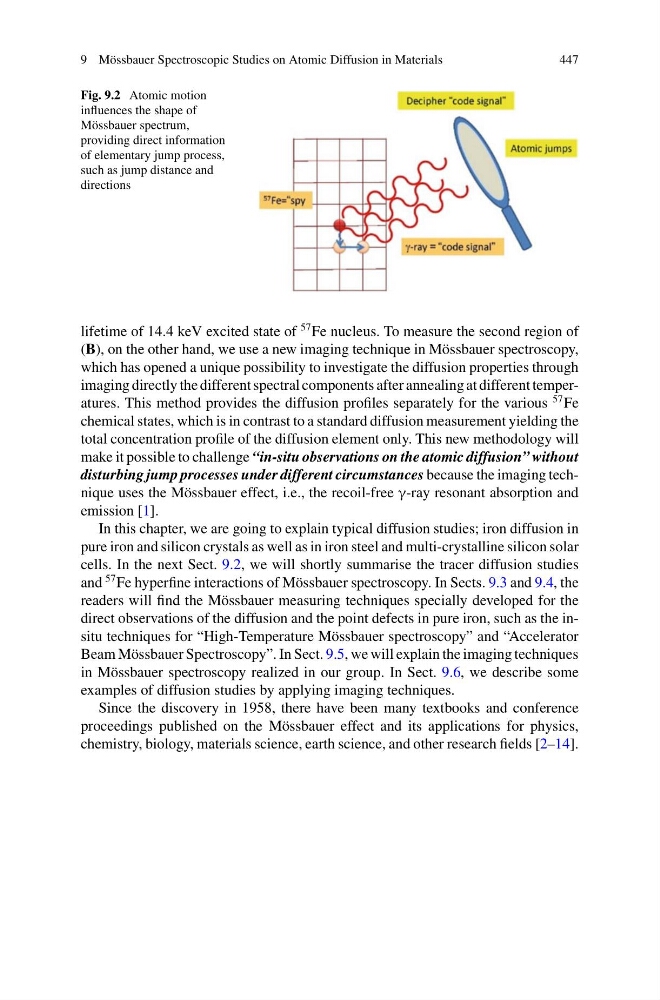
Fig. 9.2 Atomic motion
influences the shape of
Mössbauer spectrum,
providing direct information
of elementary jump process,
such as jump distance and
directions
lifetime of 14.4 keV excited state of
57 Fe nucleus. To measure the second region of
(B), on the other hand, we use a new imaging technique in Mössbauer spectroscopy,
which has opened a unique possibility to investigate the diffusion properties through
imaging directly the different spectral components after annealing at different temperatures. This method provides the diffusion profiles separately for the various
57 Fe
chemical states, which is in contrast to a standard diffusion measurement yielding the
total concentration profile of the diffusion element only. This new methodology will
make it possible to challenge “in-situ observations on the atomic diffusion” without
disturbing jump processes under different circumstances because the imaging technique uses the Mössbauer effect, i.e., the recoil-free γ-ray resonant absorption and
emission [1].
In this chapter, we are going to explain typical diffusion studies; iron diffusion in
pure iron and silicon crystals as well as in iron steel and multi-crystalline silicon solar
cells. In the next Sect. 9.2, we will shortly summarise the tracer diffusion studies
and
57 Fe hyperfine interactions of Mössbauer spectroscopy. In Sects. 9.3 and 9.4, the
readers will find the Mössbauer measuring techniques specially developed for the
direct observations of the diffusion and the point defects in pure iron, such as the insitu techniques for “High-Temperature Mössbauer spectroscopy” and “Accelerator
Beam Mössbauer Spectroscopy”. In Sect. 9.5, we will explain the imaging techniques
in Mössbauer spectroscopy realized in our group. In Sect. 9.6, we describe some
examples of diffusion studies by applying imaging techniques.
Since the discovery in 1958, there have been many textbooks and conference
proceedings published on the Mössbauer effect and its applications for physics,
chemistry, biology, materials science, earth science, and other research fields [2–14].
447
Fig. 9.2 Atomic motion
influences the shape of
Mössbauer spectrum,
providing direct information
of elementary jump process,
such as jump distance and
directions
lifetime of 14.4 keV excited state of
57 Fe nucleus. To measure the second region of
(B), on the other hand, we use a new imaging technique in Mössbauer spectroscopy,
which has opened a unique possibility to investigate the diffusion properties through
imaging directly the different spectral components after annealing at different temperatures. This method provides the diffusion profiles separately for the various
57 Fe
chemical states, which is in contrast to a standard diffusion measurement yielding the
total concentration profile of the diffusion element only. This new methodology will
make it possible to challenge “in-situ observations on the atomic diffusion” without
disturbing jump processes under different circumstances because the imaging technique uses the Mössbauer effect, i.e., the recoil-free γ-ray resonant absorption and
emission [1].
In this chapter, we are going to explain typical diffusion studies; iron diffusion in
pure iron and silicon crystals as well as in iron steel and multi-crystalline silicon solar
cells. In the next Sect. 9.2, we will shortly summarise the tracer diffusion studies
and
57 Fe hyperfine interactions of Mössbauer spectroscopy. In Sects. 9.3 and 9.4, the
readers will find the Mössbauer measuring techniques specially developed for the
direct observations of the diffusion and the point defects in pure iron, such as the insitu techniques for “High-Temperature Mössbauer spectroscopy” and “Accelerator
Beam Mössbauer Spectroscopy”. In Sect. 9.5, we will explain the imaging techniques
in Mössbauer spectroscopy realized in our group. In Sect. 9.6, we describe some
examples of diffusion studies by applying imaging techniques.
Since the discovery in 1958, there have been many textbooks and conference
proceedings published on the Mössbauer effect and its applications for physics,
chemistry, biology, materials science, earth science, and other research fields [2–14].