

448
Y. Yoshida
9.2 Historical Development of Diffusion Studies
9.2.1 Fick’ Principles and Brownian Motion Theory
Historically, there appear to be two dominant directions for diffusion studies in materials. In 1855, A. Fick contributed to define the diffusion coefficient and to measure
the diffusion of salt in water [15]. Further, G. K. von Hevesy first used radioisotopes
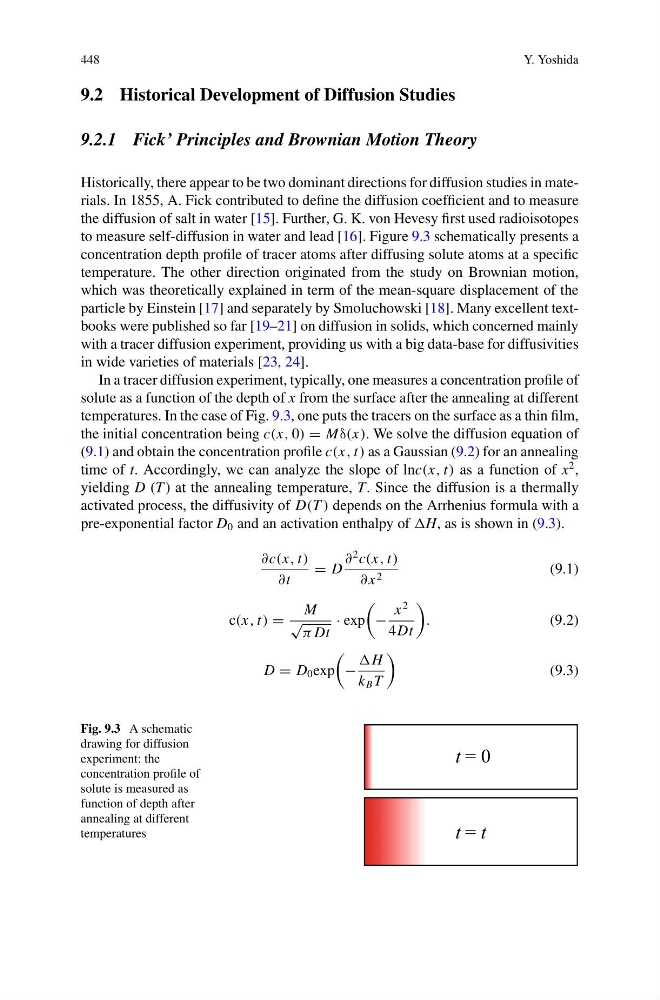
to measure self-diffusion in water and lead [16]. Figure 9.3 schematically presents a
concentration depth profile of tracer atoms after diffusing solute atoms at a specific
temperature. The other direction originated from the study on Brownian motion,
which was theoretically explained in term of the mean-square displacement of the
particle by Einstein [17] and separately by Smoluchowski [18]. Many excellent textbooks were published so far [19–21] on diffusion in solids, which concerned mainly
with a tracer diffusion experiment, providing us with a big data-base for diffusivities
in wide varieties of materials [23, 24].
In a tracer diffusion experiment, typically, one measures a concentration profile of
solute as a function of the depth of x from the surface after the annealing at different
temperatures. In the case of Fig. 9.3, one puts the tracers on the surface as a thin film,
the initial concentration being c(x, 0) = Mδ(x). We solve the diffusion equation of
(9.1) and obtain the concentration profile c(x, t) as a Gaussian (9.2) for an annealing
time of t. Accordingly, we can analyze the slope of lnc(x, t) as a function of x
2 ,
yielding D (T ) at the annealing temperature, T. Since the diffusion is a thermally
activated process, the diffusivity of D(T ) depends on the Arrhenius formula with a
pre-exponential factor D 0 and an activation enthalpy of as is shown in (9.3).
∂c(x, t)
∂t
= D
∂
2 c(x, t)
∂ x 2
(9.1)
c(x, t) =
M
√ π Dt
· exp
−
x
2
4Dt
.
(9.2)
D = D 0 exp
−
k B T
(9.3)
Fig. 9.3 A schematic
drawing for diffusion
experiment: the
concentration profile of
solute is measured as
function of depth after
annealing at different
temperatures
t = 0
t = t
Y. Yoshida
9.2 Historical Development of Diffusion Studies
9.2.1 Fick’ Principles and Brownian Motion Theory
Historically, there appear to be two dominant directions for diffusion studies in materials. In 1855, A. Fick contributed to define the diffusion coefficient and to measure
the diffusion of salt in water [15]. Further, G. K. von Hevesy first used radioisotopes
to measure self-diffusion in water and lead [16]. Figure 9.3 schematically presents a
concentration depth profile of tracer atoms after diffusing solute atoms at a specific
temperature. The other direction originated from the study on Brownian motion,
which was theoretically explained in term of the mean-square displacement of the
particle by Einstein [17] and separately by Smoluchowski [18]. Many excellent textbooks were published so far [19–21] on diffusion in solids, which concerned mainly
with a tracer diffusion experiment, providing us with a big data-base for diffusivities
in wide varieties of materials [23, 24].
In a tracer diffusion experiment, typically, one measures a concentration profile of
solute as a function of the depth of x from the surface after the annealing at different
temperatures. In the case of Fig. 9.3, one puts the tracers on the surface as a thin film,
the initial concentration being c(x, 0) = Mδ(x). We solve the diffusion equation of
(9.1) and obtain the concentration profile c(x, t) as a Gaussian (9.2) for an annealing
time of t. Accordingly, we can analyze the slope of lnc(x, t) as a function of x
2 ,
yielding D (T ) at the annealing temperature, T. Since the diffusion is a thermally
activated process, the diffusivity of D(T ) depends on the Arrhenius formula with a
pre-exponential factor D 0 and an activation enthalpy of as is shown in (9.3).
∂c(x, t)
∂t
= D
∂
2 c(x, t)
∂ x 2
(9.1)
c(x, t) =
M
√ π Dt
· exp
−
x
2
4Dt
.
(9.2)
D = D 0 exp
−
k B T
(9.3)
Fig. 9.3 A schematic
drawing for diffusion
experiment: the
concentration profile of
solute is measured as
function of depth after
annealing at different
temperatures
t = 0
t = t