

446
Y. Yoshida
9.1 Introduction
Atomic diffusion can be found in materials whenever a system containing many atoms
tends to change toward thermal equilibrium. The atoms flow even macroscopically
until the system reaches the thermal equilibrium, although they further continue to
perform random jumps at a finite temperature even on the equilibrium. There appear,
however, to remain many fundamental problems related to the diffusion mechanism,
which must be essential to understand and to control the microstructures as well
as their physical properties in many systems, including industrial materials, such
as iron steel and semiconductors. Accordingly, highly desirable must be atomistic
evaluation techniques accessible to such underlying problems without causing any
perturbations on the systems.
As far as
57 Fe Mössbauer spectroscopy concerns, the spectroscopy provides two
different possibilities to investigate the atomic diffusion corresponding to different
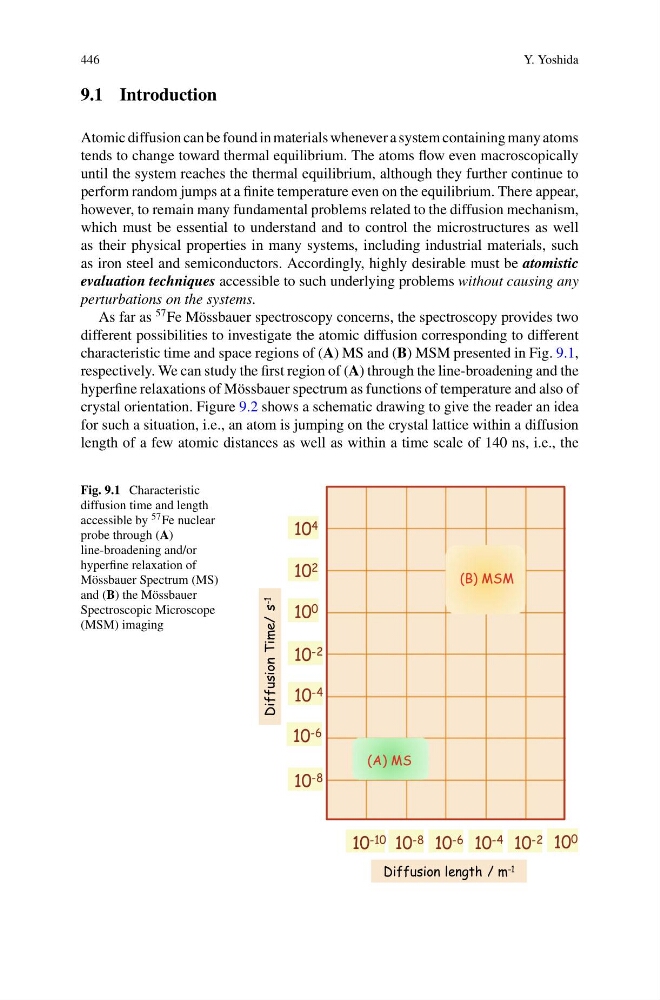
characteristic time and space regions of (A) MS and (B) MSM presented in Fig. 9.1,
respectively. We can study the first region of (A) through the line-broadening and the
hyperfine relaxations of Mössbauer spectrum as functions of temperature and also of
crystal orientation. Figure 9.2 shows a schematic drawing to give the reader an idea
for such a situation, i.e., an atom is jumping on the crystal lattice within a diffusion
length of a few atomic distances as well as within a time scale of 140 ns, i.e., the
Fig. 9.1 Characteristic
diffusion time and length
accessible by 57 Fe nuclear
probe through (A)
line-broadening and/or
hyperfine relaxation of
Mössbauer Spectrum (MS)
and (B) the Mössbauer
Spectroscopic Microscope
(MSM) imaging
Y. Yoshida
9.1 Introduction
Atomic diffusion can be found in materials whenever a system containing many atoms
tends to change toward thermal equilibrium. The atoms flow even macroscopically
until the system reaches the thermal equilibrium, although they further continue to
perform random jumps at a finite temperature even on the equilibrium. There appear,
however, to remain many fundamental problems related to the diffusion mechanism,
which must be essential to understand and to control the microstructures as well
as their physical properties in many systems, including industrial materials, such
as iron steel and semiconductors. Accordingly, highly desirable must be atomistic
evaluation techniques accessible to such underlying problems without causing any
perturbations on the systems.
As far as
57 Fe Mössbauer spectroscopy concerns, the spectroscopy provides two
different possibilities to investigate the atomic diffusion corresponding to different
characteristic time and space regions of (A) MS and (B) MSM presented in Fig. 9.1,
respectively. We can study the first region of (A) through the line-broadening and the
hyperfine relaxations of Mössbauer spectrum as functions of temperature and also of
crystal orientation. Figure 9.2 shows a schematic drawing to give the reader an idea
for such a situation, i.e., an atom is jumping on the crystal lattice within a diffusion
length of a few atomic distances as well as within a time scale of 140 ns, i.e., the
Fig. 9.1 Characteristic
diffusion time and length
accessible by 57 Fe nuclear
probe through (A)
line-broadening and/or
hyperfine relaxation of
Mössbauer Spectrum (MS)
and (B) the Mössbauer
Spectroscopic Microscope
(MSM) imaging