

7 Application of Mössbauer Spectroscopy to Li-Ion and Na-Ion …
371
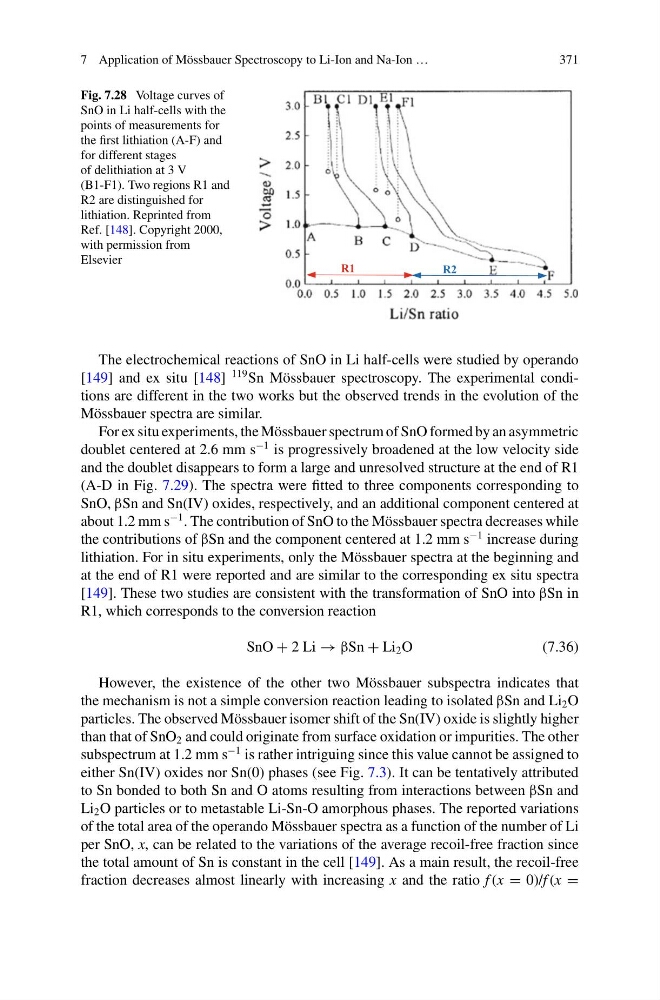
Fig. 7.28 Voltage curves of
SnO in Li half-cells with the
points of measurements for
the first lithiation (A-F) and
for different stages
of delithiation at 3 V
(B1-F1). Two regions R1 and
R2 are distinguished for
lithiation. Reprinted from
Ref. [148]. Copyright 2000,
with permission from
Elsevier
R1
R2
The electrochemical reactions of SnO in Li half-cells were studied by operando
[149] and ex situ [148]
119 Sn Mössbauer spectroscopy. The experimental conditions are different in the two works but the observed trends in the evolution of the
Mössbauer spectra are similar.
For ex situ experiments, the Mössbauer spectrum of SnO formed by an asymmetric
doublet centered at 2.6 mm s
−1 is progressively broadened at the low velocity side
and the doublet disappears to form a large and unresolved structure at the end of R1
(A-D in Fig. 7.29). The spectra were fitted to three components corresponding to
SnO, βSn and Sn(IV) oxides, respectively, and an additional component centered at
about 1.2 mm s
−1 . The contribution of SnO to the Mössbauer spectra decreases while
the contributions of βSn and the component centered at 1.2 mm s
−1 increase during
lithiation. For in situ experiments, only the Mössbauer spectra at the beginning and
at the end of R1 were reported and are similar to the corresponding ex situ spectra
[149]. These two studies are consistent with the transformation of SnO into βSn in
R1, which corresponds to the conversion reaction
SnO + 2 Li → βSn + Li 2 O
(7.36)
However, the existence of the other two Mössbauer subspectra indicates that
the mechanism is not a simple conversion reaction leading to isolated βSn and Li 2 O
particles. The observed Mössbauer isomer shift of the Sn(IV) oxide is slightly higher
than that of SnO 2 and could originate from surface oxidation or impurities. The other
subspectrum at 1.2 mm s
−1 is rather intriguing since this value cannot be assigned to
either Sn(IV) oxides nor Sn(0) phases (see Fig. 7.3). It can be tentatively attributed
to Sn bonded to both Sn and O atoms resulting from interactions between βSn and
Li 2 O particles or to metastable Li-Sn-O amorphous phases. The reported variations
of the total area of the operando Mössbauer spectra as a function of the number of Li
per SnO, x, can be related to the variations of the average recoil-free fraction since
the total amount of Sn is constant in the cell [149]. As a main result, the recoil-free
fraction decreases almost linearly with increasing x and the ratio f (x = 0)/f (x =
371
Fig. 7.28 Voltage curves of
SnO in Li half-cells with the
points of measurements for
the first lithiation (A-F) and
for different stages
of delithiation at 3 V
(B1-F1). Two regions R1 and
R2 are distinguished for
lithiation. Reprinted from
Ref. [148]. Copyright 2000,
with permission from
Elsevier
R1
R2
The electrochemical reactions of SnO in Li half-cells were studied by operando
[149] and ex situ [148]
119 Sn Mössbauer spectroscopy. The experimental conditions are different in the two works but the observed trends in the evolution of the
Mössbauer spectra are similar.
For ex situ experiments, the Mössbauer spectrum of SnO formed by an asymmetric
doublet centered at 2.6 mm s
−1 is progressively broadened at the low velocity side
and the doublet disappears to form a large and unresolved structure at the end of R1
(A-D in Fig. 7.29). The spectra were fitted to three components corresponding to
SnO, βSn and Sn(IV) oxides, respectively, and an additional component centered at
about 1.2 mm s
−1 . The contribution of SnO to the Mössbauer spectra decreases while
the contributions of βSn and the component centered at 1.2 mm s
−1 increase during
lithiation. For in situ experiments, only the Mössbauer spectra at the beginning and
at the end of R1 were reported and are similar to the corresponding ex situ spectra
[149]. These two studies are consistent with the transformation of SnO into βSn in
R1, which corresponds to the conversion reaction
SnO + 2 Li → βSn + Li 2 O
(7.36)
However, the existence of the other two Mössbauer subspectra indicates that
the mechanism is not a simple conversion reaction leading to isolated βSn and Li 2 O
particles. The observed Mössbauer isomer shift of the Sn(IV) oxide is slightly higher
than that of SnO 2 and could originate from surface oxidation or impurities. The other
subspectrum at 1.2 mm s
−1 is rather intriguing since this value cannot be assigned to
either Sn(IV) oxides nor Sn(0) phases (see Fig. 7.3). It can be tentatively attributed
to Sn bonded to both Sn and O atoms resulting from interactions between βSn and
Li 2 O particles or to metastable Li-Sn-O amorphous phases. The reported variations
of the total area of the operando Mössbauer spectra as a function of the number of Li
per SnO, x, can be related to the variations of the average recoil-free fraction since
the total amount of Sn is constant in the cell [149]. As a main result, the recoil-free
fraction decreases almost linearly with increasing x and the ratio f (x = 0)/f (x =