

372
P.-E. Lippens
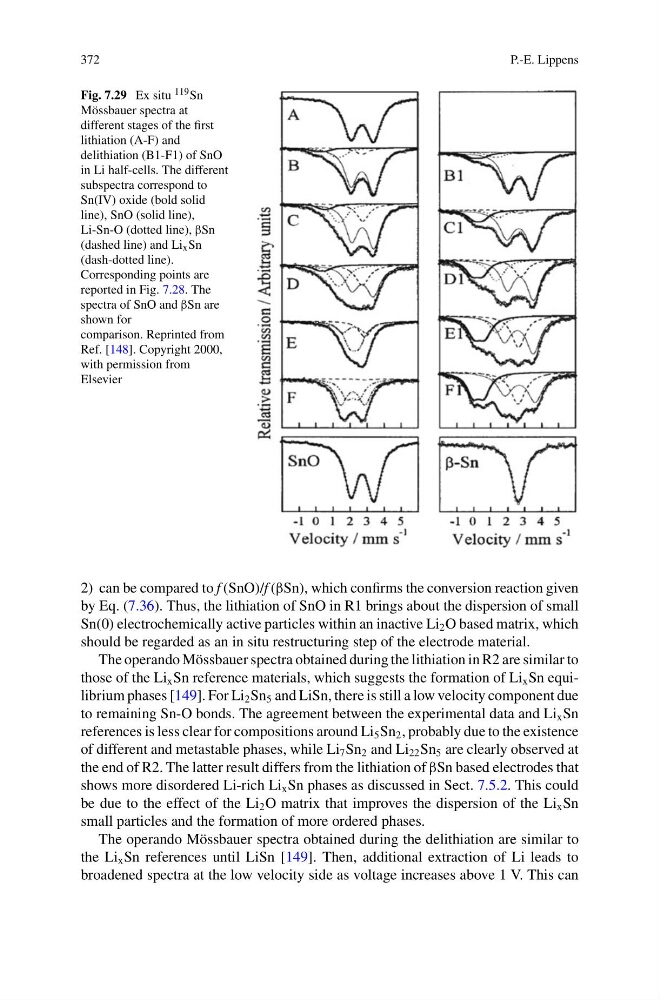
Fig. 7.29 Ex situ 119 Sn
Mössbauer spectra at
different stages of the first
lithiation (A-F) and
delithiation (B1-F1) of SnO
in Li half-cells. The different
subspectra correspond to
Sn(IV) oxide (bold solid
line), SnO (solid line),
Li-Sn-O (dotted line), βSn
(dashed line) and Li x Sn
(dash-dotted line).
Corresponding points are
reported in Fig. 7.28. The
spectra of SnO and βSn are
shown for
comparison. Reprinted from
Ref. [148]. Copyright 2000,
with permission from
Elsevier
2) can be compared to f (SnO)/f (βSn), which confirms the conversion reaction given
by Eq. (7.36). Thus, the lithiation of SnO in R1 brings about the dispersion of small
Sn(0) electrochemically active particles within an inactive Li 2 O based matrix, which
should be regarded as an in situ restructuring step of the electrode material.
The operando Mössbauer spectra obtained during the lithiation in R2 are similar to
those of the Li x Sn reference materials, which suggests the formation of Li x Sn equilibrium phases [149]. For Li 2 Sn 5 and LiSn, there is still a low velocity component due
to remaining Sn-O bonds. The agreement between the experimental data and Li x Sn
references is less clear for compositions around Li 5 Sn 2 , probably due to the existence
of different and metastable phases, while Li 7 Sn 2 and Li 22 Sn 5 are clearly observed at
the end of R2. The latter result differs from the lithiation of βSn based electrodes that
shows more disordered Li-rich Li x Sn phases as discussed in Sect. 7.5.2. This could
be due to the effect of the Li 2 O matrix that improves the dispersion of the Li x Sn
small particles and the formation of more ordered phases.
The operando Mössbauer spectra obtained during the delithiation are similar to
the Li x Sn references until LiSn [149]. Then, additional extraction of Li leads to
broadened spectra at the low velocity side as voltage increases above 1 V. This can
P.-E. Lippens
Fig. 7.29 Ex situ 119 Sn
Mössbauer spectra at
different stages of the first
lithiation (A-F) and
delithiation (B1-F1) of SnO
in Li half-cells. The different
subspectra correspond to
Sn(IV) oxide (bold solid
line), SnO (solid line),
Li-Sn-O (dotted line), βSn
(dashed line) and Li x Sn
(dash-dotted line).
Corresponding points are
reported in Fig. 7.28. The
spectra of SnO and βSn are
shown for
comparison. Reprinted from
Ref. [148]. Copyright 2000,
with permission from
Elsevier
2) can be compared to f (SnO)/f (βSn), which confirms the conversion reaction given
by Eq. (7.36). Thus, the lithiation of SnO in R1 brings about the dispersion of small
Sn(0) electrochemically active particles within an inactive Li 2 O based matrix, which
should be regarded as an in situ restructuring step of the electrode material.
The operando Mössbauer spectra obtained during the lithiation in R2 are similar to
those of the Li x Sn reference materials, which suggests the formation of Li x Sn equilibrium phases [149]. For Li 2 Sn 5 and LiSn, there is still a low velocity component due
to remaining Sn-O bonds. The agreement between the experimental data and Li x Sn
references is less clear for compositions around Li 5 Sn 2 , probably due to the existence
of different and metastable phases, while Li 7 Sn 2 and Li 22 Sn 5 are clearly observed at
the end of R2. The latter result differs from the lithiation of βSn based electrodes that
shows more disordered Li-rich Li x Sn phases as discussed in Sect. 7.5.2. This could
be due to the effect of the Li 2 O matrix that improves the dispersion of the Li x Sn
small particles and the formation of more ordered phases.
The operando Mössbauer spectra obtained during the delithiation are similar to
the Li x Sn references until LiSn [149]. Then, additional extraction of Li leads to
broadened spectra at the low velocity side as voltage increases above 1 V. This can