

284
N. Kojima and A. Okazawa
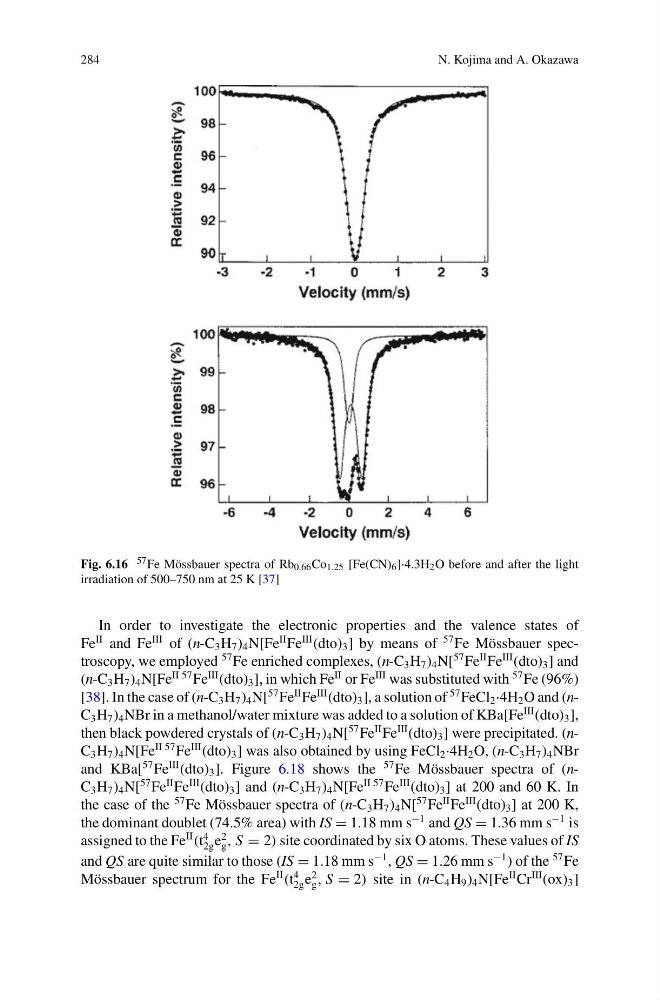
Fig. 6.16 57 Fe Mössbauer spectra of Rb 0.66 Co 1.25 [Fe(CN) 6 ]·4.3H 2 O before and after the light
irradiation of 500–750 nm at 25 K [37]
In order to investigate the electronic properties and the valence states of
Fe
II and Fe
III of (n-C 3 H 7 ) 4 N[Fe
II Fe
III (dto) 3 ] by means of
57 Fe Mössbauer spectroscopy, we employed
57 Fe enriched complexes, (n-C 3 H 7 ) 4 N[
57 Fe
II Fe
III (dto) 3 ] and
(n-C 3 H 7 ) 4 N[Fe
II 57 Fe
III (dto) 3 ], in which Fe
II or Fe
III was substituted with
57 Fe (96%)
[38]. In the case of (n-C 3 H 7 ) 4 N[
57 Fe
II Fe
III (dto) 3 ], a solution of
57 FeCl 2 ·4H 2 O and (nC 3 H 7 ) 4 NBr in a methanol/water mixture was added to a solution of KBa[Fe
III (dto) 3 ],
then black powdered crystals of (n-C 3 H 7 ) 4 N[
57 Fe
II Fe
III (dto) 3 ] were precipitated. (nC 3 H 7 ) 4 N[Fe
II 57 Fe
III (dto) 3 ] was also obtained by using FeCl 2 ·4H 2 O, (n-C 3 H 7 ) 4 NBr
and KBa[
57 Fe
III (dto) 3 ]. Figure 6.18 shows the
57 Fe Mössbauer spectra of (nC 3 H 7 ) 4 N[
57 Fe
II Fe
III (dto) 3 ] and (n-C 3 H 7 ) 4 N[Fe
II 57 Fe
III (dto) 3 ] at 200 and 60 K. In
the case of the
57 Fe Mössbauer spectra of (n-C 3 H 7 ) 4 N[
57 Fe
II Fe
III (dto) 3 ] at 200 K,
the dominant doublet (74.5% area) with IS = 1.18 mm s
−1 and QS = 1.36 mm s
−1 is
assigned to the Fe
II
(t
4
2g e
2
g , S = 2) site coordinated by six O atoms. These values of IS
and QS are quite similar to those (IS = 1.18 mm s
−1 , QS = 1.26 mm s
−1 ) of the
57 Fe
Mössbauer spectrum for the Fe
II
(t
4
2g e
2
g , S = 2) site in (n-C 4 H 9 ) 4 N[Fe
II Cr
III (ox) 3 ]
N. Kojima and A. Okazawa
Fig. 6.16 57 Fe Mössbauer spectra of Rb 0.66 Co 1.25 [Fe(CN) 6 ]·4.3H 2 O before and after the light
irradiation of 500–750 nm at 25 K [37]
In order to investigate the electronic properties and the valence states of
Fe
II and Fe
III of (n-C 3 H 7 ) 4 N[Fe
II Fe
III (dto) 3 ] by means of
57 Fe Mössbauer spectroscopy, we employed
57 Fe enriched complexes, (n-C 3 H 7 ) 4 N[
57 Fe
II Fe
III (dto) 3 ] and
(n-C 3 H 7 ) 4 N[Fe
II 57 Fe
III (dto) 3 ], in which Fe
II or Fe
III was substituted with
57 Fe (96%)
[38]. In the case of (n-C 3 H 7 ) 4 N[
57 Fe
II Fe
III (dto) 3 ], a solution of
57 FeCl 2 ·4H 2 O and (nC 3 H 7 ) 4 NBr in a methanol/water mixture was added to a solution of KBa[Fe
III (dto) 3 ],
then black powdered crystals of (n-C 3 H 7 ) 4 N[
57 Fe
II Fe
III (dto) 3 ] were precipitated. (nC 3 H 7 ) 4 N[Fe
II 57 Fe
III (dto) 3 ] was also obtained by using FeCl 2 ·4H 2 O, (n-C 3 H 7 ) 4 NBr
and KBa[
57 Fe
III (dto) 3 ]. Figure 6.18 shows the
57 Fe Mössbauer spectra of (nC 3 H 7 ) 4 N[
57 Fe
II Fe
III (dto) 3 ] and (n-C 3 H 7 ) 4 N[Fe
II 57 Fe
III (dto) 3 ] at 200 and 60 K. In
the case of the
57 Fe Mössbauer spectra of (n-C 3 H 7 ) 4 N[
57 Fe
II Fe
III (dto) 3 ] at 200 K,
the dominant doublet (74.5% area) with IS = 1.18 mm s
−1 and QS = 1.36 mm s
−1 is
assigned to the Fe
II
(t
4
2g e
2
g , S = 2) site coordinated by six O atoms. These values of IS
and QS are quite similar to those (IS = 1.18 mm s
−1 , QS = 1.26 mm s
−1 ) of the
57 Fe
Mössbauer spectrum for the Fe
II
(t
4
2g e
2
g , S = 2) site in (n-C 4 H 9 ) 4 N[Fe
II Cr
III (ox) 3 ]