

6 Molecular Magnetism of Metal Complexes and Light-Induced …
283
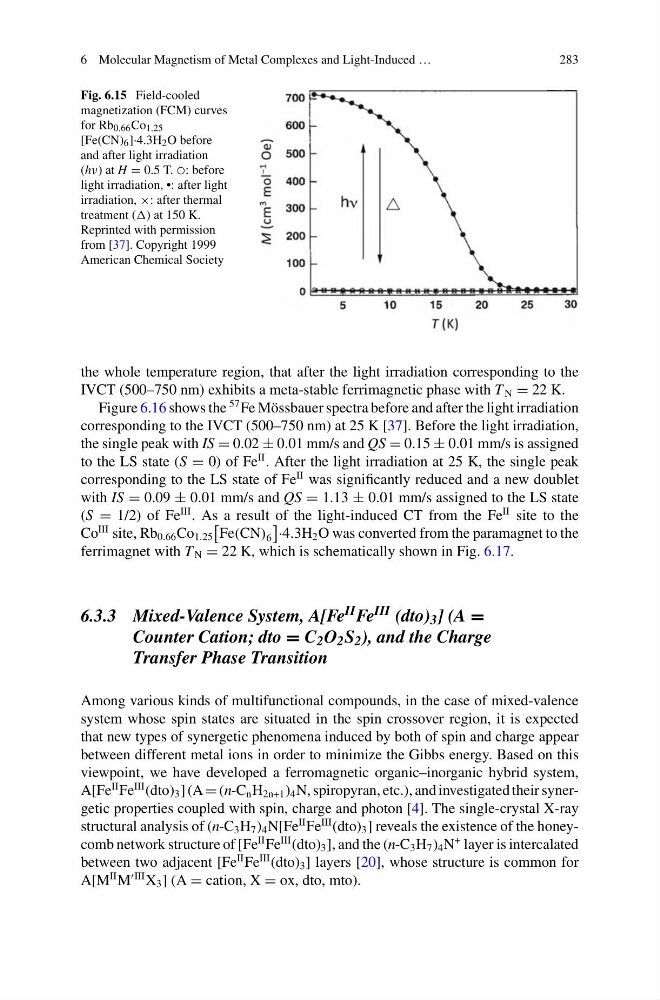
Fig. 6.15 Field-cooled
magnetization (FCM) curves
for Rb 0.66 Co 1.25
[Fe(CN) 6 ]·4.3H 2 O before
and after light irradiation
(hν) at H = 0.5 T. ◯: before
light irradiation, •: after light
irradiation, ×: after thermal
treatment () at 150 K.
Reprinted with permission
from [37]. Copyright 1999
American Chemical Society
the whole temperature region, that after the light irradiation corresponding to the
IVCT (500–750 nm) exhibits a meta-stable ferrimagnetic phase with T N = 22 K.
Figure 6.16 shows the
57 Fe Mössbauer spectra before and after the light irradiation
corresponding to the IVCT (500–750 nm) at 25 K [37]. Before the light irradiation,
the single peak with IS = 0.02 ± 0.01 mm/s and QS = 0.15 ± 0.01 mm/s is assigned
to the LS state (S = 0) of Fe
II . After the light irradiation at 25 K, the single peak
corresponding to the LS state of Fe
II was significantly reduced and a new doublet
with IS = 0.09 ± 0.01 mm/s and QS = 1.13 ± 0.01 mm/s assigned to the LS state
(S = 1/2) of Fe
III . As a result of the light-induced CT from the Fe
II site to the
Co
III site, Rb 0.66 Co 1.25
Fe(CN) 6
·4.3H 2 O was converted from the paramagnet to the
ferrimagnet with T N = 22 K, which is schematically shown in Fig. 6.17.
6.3.3 Mixed-Valence System, A[Fe II Fe III (dto) 3 ] (A =
Counter Cation; dto = C 2 O 2 S 2 ), and the Charge
Transfer Phase Transition
Among various kinds of multifunctional compounds, in the case of mixed-valence
system whose spin states are situated in the spin crossover region, it is expected
that new types of synergetic phenomena induced by both of spin and charge appear
between different metal ions in order to minimize the Gibbs energy. Based on this
viewpoint, we have developed a ferromagnetic organic–inorganic hybrid system,
A[Fe
II Fe
III (dto) 3 ] (A = (n-C n H 2n+1 ) 4 N, spiropyran, etc.), and investigated their synergetic properties coupled with spin, charge and photon [4]. The single-crystal X-ray
structural analysis of (n-C 3 H 7 ) 4 N[Fe
II Fe
III (dto) 3 ] reveals the existence of the honeycomb network structure of [Fe
II Fe
III (dto) 3 ], and the (n-C 3 H 7 ) 4 N
+ layer is intercalated
between two adjacent [Fe
II Fe
III (dto) 3 ] layers [20], whose structure is common for
A[M
II M
III X 3 ] (A = cation, X = ox, dto, mto).
283
Fig. 6.15 Field-cooled
magnetization (FCM) curves
for Rb 0.66 Co 1.25
[Fe(CN) 6 ]·4.3H 2 O before
and after light irradiation
(hν) at H = 0.5 T. ◯: before
light irradiation, •: after light
irradiation, ×: after thermal
treatment () at 150 K.
Reprinted with permission
from [37]. Copyright 1999
American Chemical Society
the whole temperature region, that after the light irradiation corresponding to the
IVCT (500–750 nm) exhibits a meta-stable ferrimagnetic phase with T N = 22 K.
Figure 6.16 shows the
57 Fe Mössbauer spectra before and after the light irradiation
corresponding to the IVCT (500–750 nm) at 25 K [37]. Before the light irradiation,
the single peak with IS = 0.02 ± 0.01 mm/s and QS = 0.15 ± 0.01 mm/s is assigned
to the LS state (S = 0) of Fe
II . After the light irradiation at 25 K, the single peak
corresponding to the LS state of Fe
II was significantly reduced and a new doublet
with IS = 0.09 ± 0.01 mm/s and QS = 1.13 ± 0.01 mm/s assigned to the LS state
(S = 1/2) of Fe
III . As a result of the light-induced CT from the Fe
II site to the
Co
III site, Rb 0.66 Co 1.25
Fe(CN) 6
·4.3H 2 O was converted from the paramagnet to the
ferrimagnet with T N = 22 K, which is schematically shown in Fig. 6.17.
6.3.3 Mixed-Valence System, A[Fe II Fe III (dto) 3 ] (A =
Counter Cation; dto = C 2 O 2 S 2 ), and the Charge
Transfer Phase Transition
Among various kinds of multifunctional compounds, in the case of mixed-valence
system whose spin states are situated in the spin crossover region, it is expected
that new types of synergetic phenomena induced by both of spin and charge appear
between different metal ions in order to minimize the Gibbs energy. Based on this
viewpoint, we have developed a ferromagnetic organic–inorganic hybrid system,
A[Fe
II Fe
III (dto) 3 ] (A = (n-C n H 2n+1 ) 4 N, spiropyran, etc.), and investigated their synergetic properties coupled with spin, charge and photon [4]. The single-crystal X-ray
structural analysis of (n-C 3 H 7 ) 4 N[Fe
II Fe
III (dto) 3 ] reveals the existence of the honeycomb network structure of [Fe
II Fe
III (dto) 3 ], and the (n-C 3 H 7 ) 4 N
+ layer is intercalated
between two adjacent [Fe
II Fe
III (dto) 3 ] layers [20], whose structure is common for
A[M
II M
III X 3 ] (A = cation, X = ox, dto, mto).