

282
N. Kojima and A. Okazawa
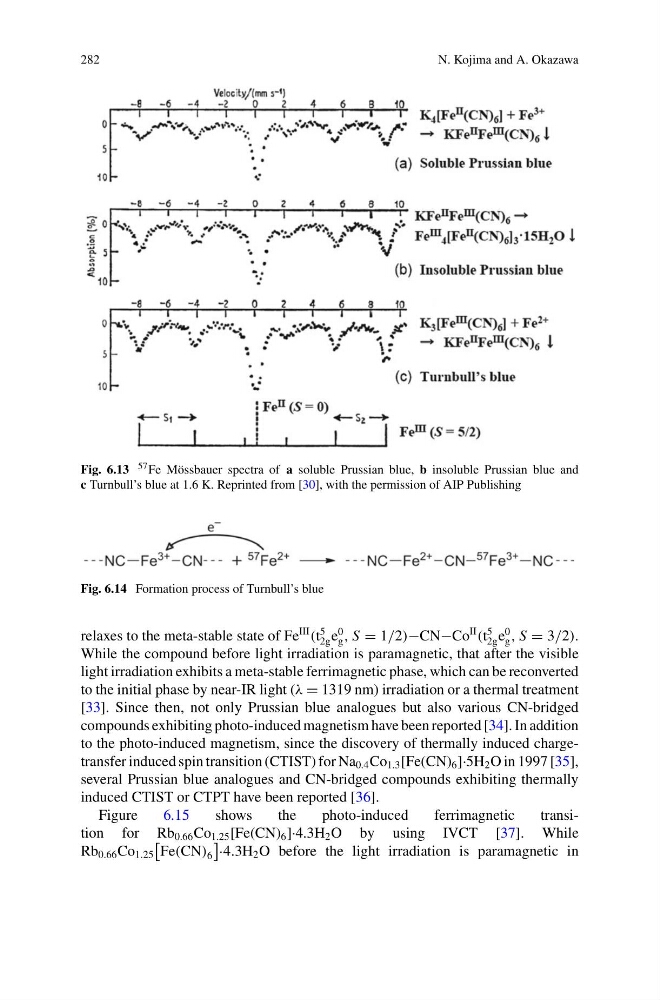
Fig. 6.13 57 Fe Mössbauer spectra of a soluble Prussian blue, b insoluble Prussian blue and
c Turnbull’s blue at 1.6 K. Reprinted from [30], with the permission of AIP Publishing
Fig. 6.14 Formation process of Turnbull’s blue
relaxes to the meta-stable state of Fe
III
(t
5
2g e
0
g , S = 1/2)−CN−Co
II
(t
5
2g e
0
g , S = 3/2).
While the compound before light irradiation is paramagnetic, that after the visible
light irradiation exhibits a meta-stable ferrimagnetic phase, which can be reconverted
to the initial phase by near-IR light (λ = 1319 nm) irradiation or a thermal treatment
[33]. Since then, not only Prussian blue analogues but also various CN-bridged
compounds exhibiting photo-induced magnetism have been reported [34]. In addition
to the photo-induced magnetism, since the discovery of thermally induced chargetransfer induced spin transition (CTIST) for Na 0.4 Co 1.3 [Fe(CN) 6 ]·5H 2 O in 1997 [35],
several Prussian blue analogues and CN-bridged compounds exhibiting thermally
induced CTIST or CTPT have been reported [36].
Figure
6.15
shows
the
photo-induced
ferrimagnetic
transition for Rb 0.66 Co 1.25 [Fe(CN) 6 ]·4.3H 2 O by using IVCT [37]. While
Rb 0.66 Co 1.25
Fe(CN) 6
·4.3H 2 O before the light irradiation is paramagnetic in
N. Kojima and A. Okazawa
Fig. 6.13 57 Fe Mössbauer spectra of a soluble Prussian blue, b insoluble Prussian blue and
c Turnbull’s blue at 1.6 K. Reprinted from [30], with the permission of AIP Publishing
Fig. 6.14 Formation process of Turnbull’s blue
relaxes to the meta-stable state of Fe
III
(t
5
2g e
0
g , S = 1/2)−CN−Co
II
(t
5
2g e
0
g , S = 3/2).
While the compound before light irradiation is paramagnetic, that after the visible
light irradiation exhibits a meta-stable ferrimagnetic phase, which can be reconverted
to the initial phase by near-IR light (λ = 1319 nm) irradiation or a thermal treatment
[33]. Since then, not only Prussian blue analogues but also various CN-bridged
compounds exhibiting photo-induced magnetism have been reported [34]. In addition
to the photo-induced magnetism, since the discovery of thermally induced chargetransfer induced spin transition (CTIST) for Na 0.4 Co 1.3 [Fe(CN) 6 ]·5H 2 O in 1997 [35],
several Prussian blue analogues and CN-bridged compounds exhibiting thermally
induced CTIST or CTPT have been reported [36].
Figure
6.15
shows
the
photo-induced
ferrimagnetic
transition for Rb 0.66 Co 1.25 [Fe(CN) 6 ]·4.3H 2 O by using IVCT [37]. While
Rb 0.66 Co 1.25
Fe(CN) 6
·4.3H 2 O before the light irradiation is paramagnetic in