

6 Molecular Magnetism of Metal Complexes and Light-Induced …
281
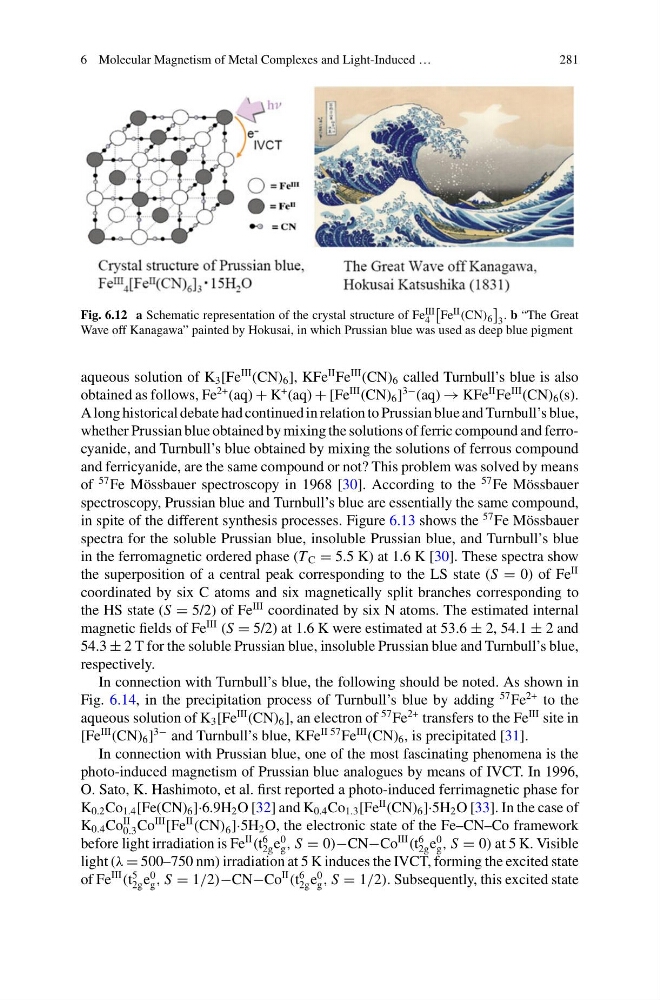
Fig. 6.12 a Schematic representation of the crystal structure of Fe III
4
Fe II (CN) 6
3
. b “The Great
Wave off Kanagawa” painted by Hokusai, in which Prussian blue was used as deep blue pigment
aqueous solution of K 3 [Fe
III (CN) 6 ], KFe
II Fe
III (CN) 6 called Turnbull’s blue is also
obtained as follows, Fe
2+ (aq) + K
+ (aq) + [Fe
III (CN) 6 ]
3− (aq) → KFe
II Fe
III (CN) 6 (s).
A long historical debate had continued in relation to Prussian blue and Turnbull’s blue,
whether Prussian blue obtained by mixing the solutions of ferric compound and ferrocyanide, and Turnbull’s blue obtained by mixing the solutions of ferrous compound
and ferricyanide, are the same compound or not? This problem was solved by means
of
57 Fe Mössbauer spectroscopy in 1968 [30]. According to the
57 Fe Mössbauer
spectroscopy, Prussian blue and Turnbull’s blue are essentially the same compound,
in spite of the different synthesis processes. Figure 6.13 shows the
57 Fe Mössbauer
spectra for the soluble Prussian blue, insoluble Prussian blue, and Turnbull’s blue
in the ferromagnetic ordered phase (T C = 5.5 K) at 1.6 K [30]. These spectra show
the superposition of a central peak corresponding to the LS state (S = 0) of Fe
II
coordinated by six C atoms and six magnetically split branches corresponding to
the HS state (S = 5/2) of Fe
III coordinated by six N atoms. The estimated internal
magnetic fields of Fe
III (S = 5/2) at 1.6 K were estimated at 53.6 ± 2, 54.1 ± 2 and
54.3 ± 2 T for the soluble Prussian blue, insoluble Prussian blue and Turnbull’s blue,
respectively.
In connection with Turnbull’s blue, the following should be noted. As shown in
Fig. 6.14, in the precipitation process of Turnbull’s blue by adding
57 Fe
2+ to the
aqueous solution of K 3 [Fe
III (CN) 6 ], an electron of
57 Fe
2+ transfers to the Fe
III site in
[Fe
III (CN) 6 ]
3− and Turnbull’s blue, KFe
II 57 Fe
III (CN) 6 , is precipitated [31].
In connection with Prussian blue, one of the most fascinating phenomena is the
photo-induced magnetism of Prussian blue analogues by means of IVCT. In 1996,
O. Sato, K. Hashimoto, et al. first reported a photo-induced ferrimagnetic phase for
K 0.2 Co 1.4 [Fe(CN) 6 ]·6.9H 2 O [32] and K 0.4 Co 1.3 [Fe
II (CN) 6 ]·5H 2 O [33]. In the case of
K 0.4 Co
II
0.3 Co
III
[Fe
II
(CN) 6 ]·5H 2 O, the electronic state of the Fe–CN–Co framework
before light irradiation is Fe
II
(t
6
2g e
0
g , S = 0)−CN−Co
III
(t
6
2g e
0
g , S = 0) at 5 K. Visible
light (λ = 500–750 nm) irradiation at 5 K induces the IVCT, forming the excited state
of Fe
III
(t
5
2g e
0
g , S = 1/2)−CN−Co
II
(t
6
2g e
0
g , S = 1/2). Subsequently, this excited state
281
Fig. 6.12 a Schematic representation of the crystal structure of Fe III
4
Fe II (CN) 6
3
. b “The Great
Wave off Kanagawa” painted by Hokusai, in which Prussian blue was used as deep blue pigment
aqueous solution of K 3 [Fe
III (CN) 6 ], KFe
II Fe
III (CN) 6 called Turnbull’s blue is also
obtained as follows, Fe
2+ (aq) + K
+ (aq) + [Fe
III (CN) 6 ]
3− (aq) → KFe
II Fe
III (CN) 6 (s).
A long historical debate had continued in relation to Prussian blue and Turnbull’s blue,
whether Prussian blue obtained by mixing the solutions of ferric compound and ferrocyanide, and Turnbull’s blue obtained by mixing the solutions of ferrous compound
and ferricyanide, are the same compound or not? This problem was solved by means
of
57 Fe Mössbauer spectroscopy in 1968 [30]. According to the
57 Fe Mössbauer
spectroscopy, Prussian blue and Turnbull’s blue are essentially the same compound,
in spite of the different synthesis processes. Figure 6.13 shows the
57 Fe Mössbauer
spectra for the soluble Prussian blue, insoluble Prussian blue, and Turnbull’s blue
in the ferromagnetic ordered phase (T C = 5.5 K) at 1.6 K [30]. These spectra show
the superposition of a central peak corresponding to the LS state (S = 0) of Fe
II
coordinated by six C atoms and six magnetically split branches corresponding to
the HS state (S = 5/2) of Fe
III coordinated by six N atoms. The estimated internal
magnetic fields of Fe
III (S = 5/2) at 1.6 K were estimated at 53.6 ± 2, 54.1 ± 2 and
54.3 ± 2 T for the soluble Prussian blue, insoluble Prussian blue and Turnbull’s blue,
respectively.
In connection with Turnbull’s blue, the following should be noted. As shown in
Fig. 6.14, in the precipitation process of Turnbull’s blue by adding
57 Fe
2+ to the
aqueous solution of K 3 [Fe
III (CN) 6 ], an electron of
57 Fe
2+ transfers to the Fe
III site in
[Fe
III (CN) 6 ]
3− and Turnbull’s blue, KFe
II 57 Fe
III (CN) 6 , is precipitated [31].
In connection with Prussian blue, one of the most fascinating phenomena is the
photo-induced magnetism of Prussian blue analogues by means of IVCT. In 1996,
O. Sato, K. Hashimoto, et al. first reported a photo-induced ferrimagnetic phase for
K 0.2 Co 1.4 [Fe(CN) 6 ]·6.9H 2 O [32] and K 0.4 Co 1.3 [Fe
II (CN) 6 ]·5H 2 O [33]. In the case of
K 0.4 Co
II
0.3 Co
III
[Fe
II
(CN) 6 ]·5H 2 O, the electronic state of the Fe–CN–Co framework
before light irradiation is Fe
II
(t
6
2g e
0
g , S = 0)−CN−Co
III
(t
6
2g e
0
g , S = 0) at 5 K. Visible
light (λ = 500–750 nm) irradiation at 5 K induces the IVCT, forming the excited state
of Fe
III
(t
5
2g e
0
g , S = 1/2)−CN−Co
II
(t
6
2g e
0
g , S = 1/2). Subsequently, this excited state