

280
N. Kojima and A. Okazawa
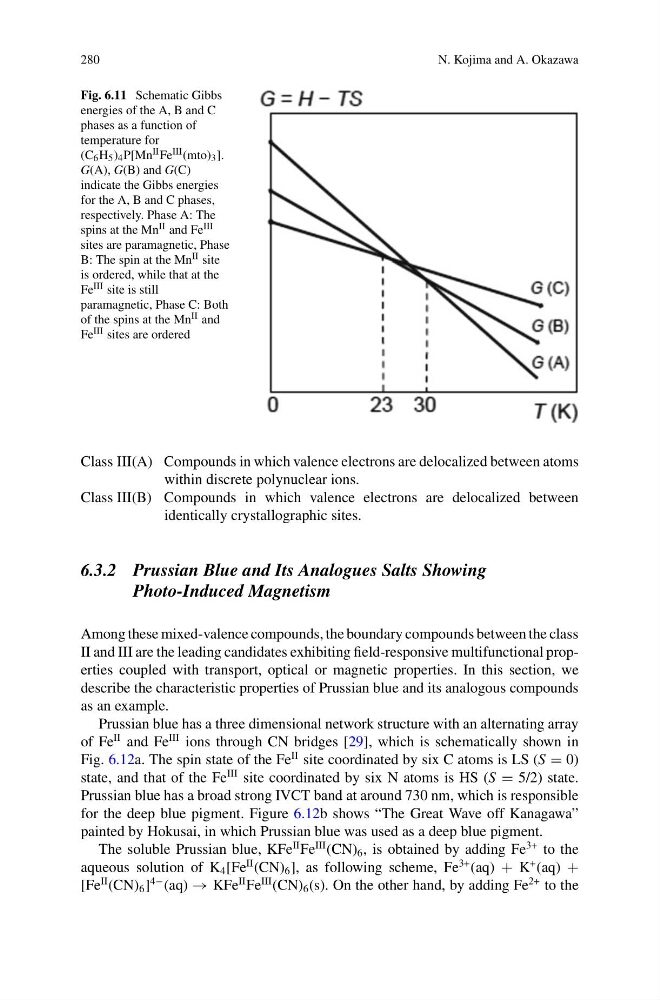
Fig. 6.11 Schematic Gibbs
energies of the A, B and C
phases as a function of
temperature for
(C 6 H 5 ) 4 P[Mn II Fe III (mto) 3 ].
G(A), G(B) and G(C)
indicate the Gibbs energies
for the A, B and C phases,
respectively. Phase A: The
spins at the Mn II and Fe III
sites are paramagnetic, Phase
B: The spin at the Mn II site
is ordered, while that at the
Fe III site is still
paramagnetic, Phase C: Both
of the spins at the Mn II and
Fe III sites are ordered
Class III(A) Compounds in which valence electrons are delocalized between atoms
within discrete polynuclear ions.
Class III(B) Compounds in which valence electrons are delocalized between
identically crystallographic sites.
6.3.2 Prussian Blue and Its Analogues Salts Showing
Photo-Induced Magnetism
Among these mixed-valence compounds, the boundary compounds between the class
II and III are the leading candidates exhibiting field-responsive multifunctional properties coupled with transport, optical or magnetic properties. In this section, we
describe the characteristic properties of Prussian blue and its analogous compounds
as an example.
Prussian blue has a three dimensional network structure with an alternating array
of Fe
II and Fe
III ions through CN bridges [29], which is schematically shown in
Fig. 6.12a. The spin state of the Fe
II site coordinated by six C atoms is LS (S = 0)
state, and that of the Fe
III site coordinated by six N atoms is HS (S = 5/2) state.
Prussian blue has a broad strong IVCT band at around 730 nm, which is responsible
for the deep blue pigment. Figure 6.12b shows “The Great Wave off Kanagawa”
painted by Hokusai, in which Prussian blue was used as a deep blue pigment.
The soluble Prussian blue, KFe
II Fe
III (CN) 6 , is obtained by adding Fe
3+ to the
aqueous solution of K 4 [Fe
II (CN) 6 ], as following scheme, Fe
3+ (aq) + K
+ (aq) +
[Fe
II (CN) 6 ]
4− (aq) → KFe
II Fe
III (CN) 6 (s). On the other hand, by adding Fe
2+ to the
N. Kojima and A. Okazawa
Fig. 6.11 Schematic Gibbs
energies of the A, B and C
phases as a function of
temperature for
(C 6 H 5 ) 4 P[Mn II Fe III (mto) 3 ].
G(A), G(B) and G(C)
indicate the Gibbs energies
for the A, B and C phases,
respectively. Phase A: The
spins at the Mn II and Fe III
sites are paramagnetic, Phase
B: The spin at the Mn II site
is ordered, while that at the
Fe III site is still
paramagnetic, Phase C: Both
of the spins at the Mn II and
Fe III sites are ordered
Class III(A) Compounds in which valence electrons are delocalized between atoms
within discrete polynuclear ions.
Class III(B) Compounds in which valence electrons are delocalized between
identically crystallographic sites.
6.3.2 Prussian Blue and Its Analogues Salts Showing
Photo-Induced Magnetism
Among these mixed-valence compounds, the boundary compounds between the class
II and III are the leading candidates exhibiting field-responsive multifunctional properties coupled with transport, optical or magnetic properties. In this section, we
describe the characteristic properties of Prussian blue and its analogous compounds
as an example.
Prussian blue has a three dimensional network structure with an alternating array
of Fe
II and Fe
III ions through CN bridges [29], which is schematically shown in
Fig. 6.12a. The spin state of the Fe
II site coordinated by six C atoms is LS (S = 0)
state, and that of the Fe
III site coordinated by six N atoms is HS (S = 5/2) state.
Prussian blue has a broad strong IVCT band at around 730 nm, which is responsible
for the deep blue pigment. Figure 6.12b shows “The Great Wave off Kanagawa”
painted by Hokusai, in which Prussian blue was used as a deep blue pigment.
The soluble Prussian blue, KFe
II Fe
III (CN) 6 , is obtained by adding Fe
3+ to the
aqueous solution of K 4 [Fe
II (CN) 6 ], as following scheme, Fe
3+ (aq) + K
+ (aq) +
[Fe
II (CN) 6 ]
4− (aq) → KFe
II Fe
III (CN) 6 (s). On the other hand, by adding Fe
2+ to the