

6 Molecular Magnetism of Metal Complexes and Light-Induced …
271
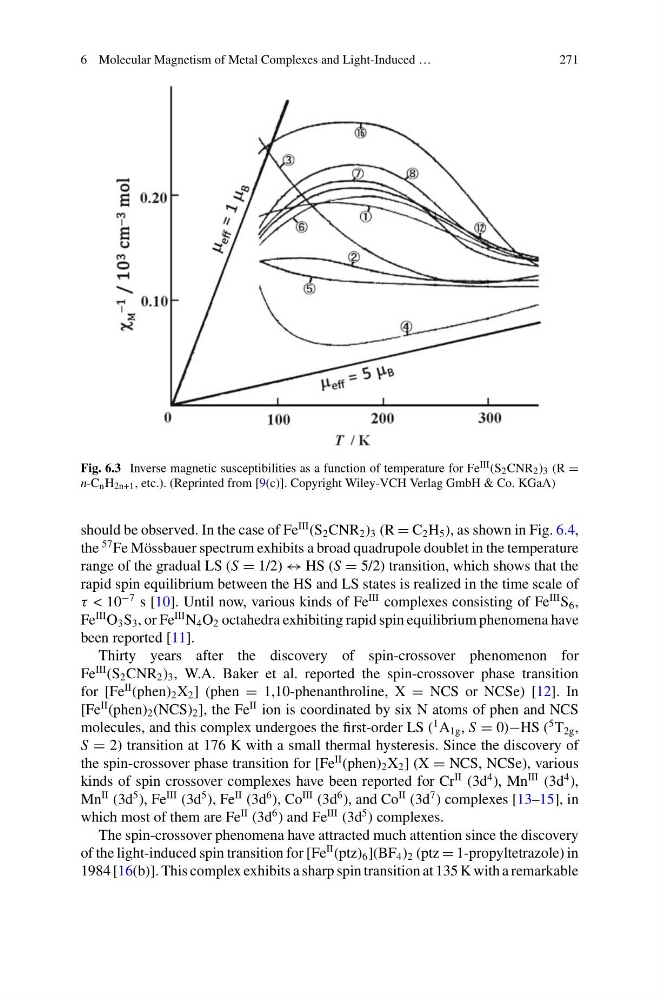
Fig. 6.3 Inverse magnetic susceptibilities as a function of temperature for Fe III (S 2 CNR 2 ) 3 (R =
n-C n H 2n+1 , etc.). (Reprinted from [9(c)]. Copyright Wiley-VCH Verlag GmbH & Co. KGaA)
should be observed. In the case of Fe
III (S 2 CNR 2 ) 3 (R = C 2 H 5 ), as shown in Fig. 6.4,
the
57 Fe Mössbauer spectrum exhibits a broad quadrupole doublet in the temperature
range of the gradual LS (S = 1/2) ↔ HS (S = 5/2) transition, which shows that the
rapid spin equilibrium between the HS and LS states is realized in the time scale of
τ < 10
−7 s [10]. Until now, various kinds of Fe
III complexes consisting of Fe
III S 6 ,
Fe
III O 3 S 3 , or Fe
III N 4 O 2 octahedra exhibiting rapid spin equilibrium phenomena have
been reported [11].
Thirty years after the discovery of spin-crossover phenomenon for
Fe
III (S 2 CNR 2 ) 3 , W.A. Baker et al. reported the spin-crossover phase transition
for [Fe
II (phen) 2 X 2 ] (phen = 1,10-phenanthroline, X = NCS or NCSe) [12]. In
[Fe
II (phen) 2 (NCS) 2 ], the Fe
II ion is coordinated by six N atoms of phen and NCS
molecules, and this complex undergoes the first-order LS (
1 A 1g , S = 0)−HS (
5 T 2g ,
S = 2) transition at 176 K with a small thermal hysteresis. Since the discovery of
the spin-crossover phase transition for [Fe
II (phen) 2 X 2 ] (X = NCS, NCSe), various
kinds of spin crossover complexes have been reported for Cr
II (3d
4 ), Mn
III (3d
4 ),
Mn
II (3d
5 ), Fe
III (3d
5 ), Fe
II (3d
6 ), Co
III (3d
6 ), and Co
II (3d
7 ) complexes [13–15], in
which most of them are Fe
II (3d
6 ) and Fe
III (3d
5 ) complexes.
The spin-crossover phenomena have attracted much attention since the discovery
of the light-induced spin transition for [Fe
II (ptz) 6 ](BF 4 ) 2 (ptz = 1-propyltetrazole) in
1984 [16(b)]. This complex exhibits a sharp spin transition at 135 K with a remarkable
271
Fig. 6.3 Inverse magnetic susceptibilities as a function of temperature for Fe III (S 2 CNR 2 ) 3 (R =
n-C n H 2n+1 , etc.). (Reprinted from [9(c)]. Copyright Wiley-VCH Verlag GmbH & Co. KGaA)
should be observed. In the case of Fe
III (S 2 CNR 2 ) 3 (R = C 2 H 5 ), as shown in Fig. 6.4,
the
57 Fe Mössbauer spectrum exhibits a broad quadrupole doublet in the temperature
range of the gradual LS (S = 1/2) ↔ HS (S = 5/2) transition, which shows that the
rapid spin equilibrium between the HS and LS states is realized in the time scale of
τ < 10
−7 s [10]. Until now, various kinds of Fe
III complexes consisting of Fe
III S 6 ,
Fe
III O 3 S 3 , or Fe
III N 4 O 2 octahedra exhibiting rapid spin equilibrium phenomena have
been reported [11].
Thirty years after the discovery of spin-crossover phenomenon for
Fe
III (S 2 CNR 2 ) 3 , W.A. Baker et al. reported the spin-crossover phase transition
for [Fe
II (phen) 2 X 2 ] (phen = 1,10-phenanthroline, X = NCS or NCSe) [12]. In
[Fe
II (phen) 2 (NCS) 2 ], the Fe
II ion is coordinated by six N atoms of phen and NCS
molecules, and this complex undergoes the first-order LS (
1 A 1g , S = 0)−HS (
5 T 2g ,
S = 2) transition at 176 K with a small thermal hysteresis. Since the discovery of
the spin-crossover phase transition for [Fe
II (phen) 2 X 2 ] (X = NCS, NCSe), various
kinds of spin crossover complexes have been reported for Cr
II (3d
4 ), Mn
III (3d
4 ),
Mn
II (3d
5 ), Fe
III (3d
5 ), Fe
II (3d
6 ), Co
III (3d
6 ), and Co
II (3d
7 ) complexes [13–15], in
which most of them are Fe
II (3d
6 ) and Fe
III (3d
5 ) complexes.
The spin-crossover phenomena have attracted much attention since the discovery
of the light-induced spin transition for [Fe
II (ptz) 6 ](BF 4 ) 2 (ptz = 1-propyltetrazole) in
1984 [16(b)]. This complex exhibits a sharp spin transition at 135 K with a remarkable