

270
N. Kojima and A. Okazawa
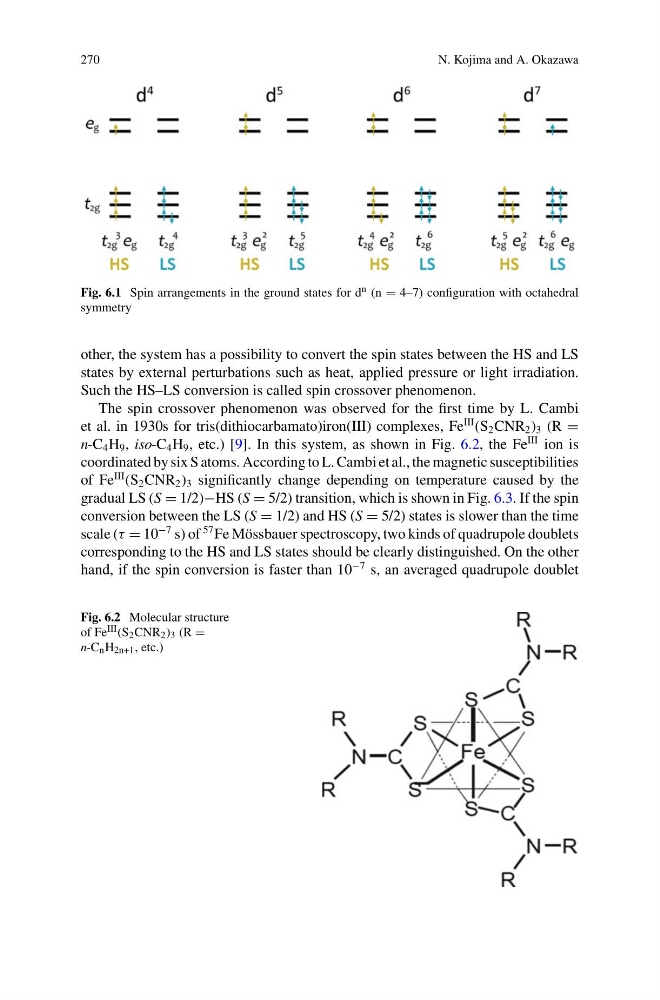
Fig. 6.1 Spin arrangements in the ground states for d n (n = 4–7) configuration with octahedral
symmetry
other, the system has a possibility to convert the spin states between the HS and LS
states by external perturbations such as heat, applied pressure or light irradiation.
Such the HS–LS conversion is called spin crossover phenomenon.
The spin crossover phenomenon was observed for the first time by L. Cambi
et al. in 1930s for tris(dithiocarbamato)iron(III) complexes, Fe
III (S 2 CNR 2 ) 3 (R =
n-C 4 H 9 , iso-C 4 H 9 , etc.) [9]. In this system, as shown in Fig. 6.2, the Fe
III ion is
coordinated by six S atoms. According to L. Cambi et al., the magnetic susceptibilities
of Fe
III (S 2 CNR 2 ) 3 significantly change depending on temperature caused by the
gradual LS (S = 1/2)−HS (S = 5/2) transition, which is shown in Fig. 6.3. If the spin
conversion between the LS (S = 1/2) and HS (S = 5/2) states is slower than the time
scale (τ = 10
−7 s) of
57 Fe Mössbauer spectroscopy, two kinds of quadrupole doublets
corresponding to the HS and LS states should be clearly distinguished. On the other
hand, if the spin conversion is faster than 10
−7 s, an averaged quadrupole doublet
Fig. 6.2 Molecular structure
of Fe III (S 2 CNR 2 ) 3 (R =
n-C n H 2n+1 , etc.)
N. Kojima and A. Okazawa
Fig. 6.1 Spin arrangements in the ground states for d n (n = 4–7) configuration with octahedral
symmetry
other, the system has a possibility to convert the spin states between the HS and LS
states by external perturbations such as heat, applied pressure or light irradiation.
Such the HS–LS conversion is called spin crossover phenomenon.
The spin crossover phenomenon was observed for the first time by L. Cambi
et al. in 1930s for tris(dithiocarbamato)iron(III) complexes, Fe
III (S 2 CNR 2 ) 3 (R =
n-C 4 H 9 , iso-C 4 H 9 , etc.) [9]. In this system, as shown in Fig. 6.2, the Fe
III ion is
coordinated by six S atoms. According to L. Cambi et al., the magnetic susceptibilities
of Fe
III (S 2 CNR 2 ) 3 significantly change depending on temperature caused by the
gradual LS (S = 1/2)−HS (S = 5/2) transition, which is shown in Fig. 6.3. If the spin
conversion between the LS (S = 1/2) and HS (S = 5/2) states is slower than the time
scale (τ = 10
−7 s) of
57 Fe Mössbauer spectroscopy, two kinds of quadrupole doublets
corresponding to the HS and LS states should be clearly distinguished. On the other
hand, if the spin conversion is faster than 10
−7 s, an averaged quadrupole doublet
Fig. 6.2 Molecular structure
of Fe III (S 2 CNR 2 ) 3 (R =
n-C n H 2n+1 , etc.)