

272
N. Kojima and A. Okazawa
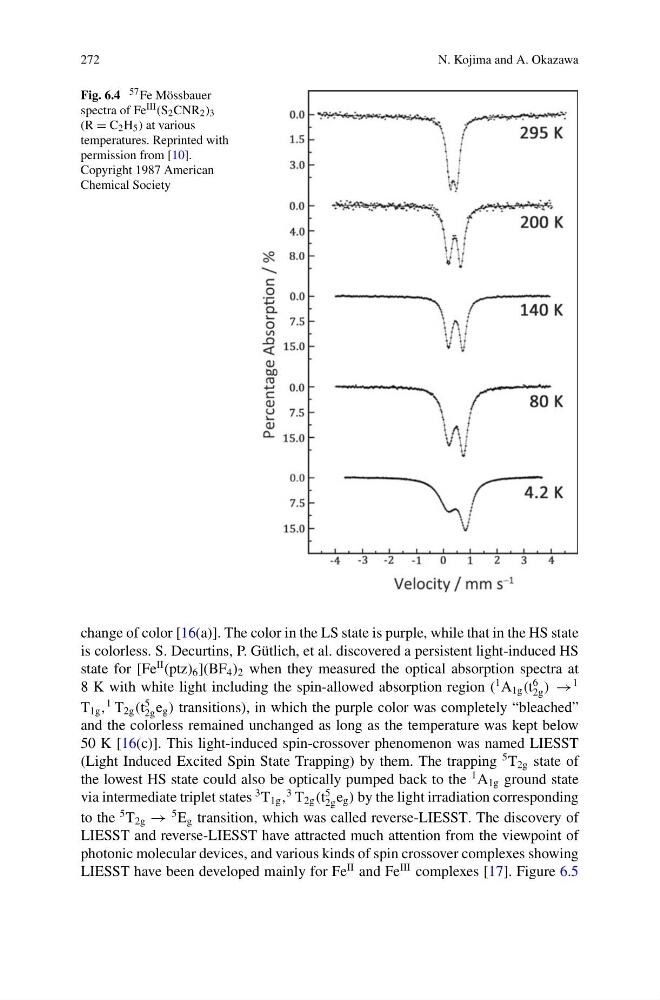
Fig. 6.4 57 Fe Mössbauer
spectra of Fe III (S 2 CNR 2 ) 3
(R = C 2 H 5 ) at various
temperatures. Reprinted with
permission from [10].
Copyright 1987 American
Chemical Society
change of color [16(a)]. The color in the LS state is purple, while that in the HS state
is colorless. S. Decurtins, P. Gütlich, et al. discovered a persistent light-induced HS
state for [Fe
II (ptz) 6 ](BF 4 ) 2 when they measured the optical absorption spectra at
8 K with white light including the spin-allowed absorption region (
1 A 1g (t
6
2g ) →
1
T 1g ,
1 T 2g (t
5
2g e g ) transitions), in which the purple color was completely “bleached”
and the colorless remained unchanged as long as the temperature was kept below
50 K [16(c)]. This light-induced spin-crossover phenomenon was named LIESST
(Light Induced Excited Spin State Trapping) by them. The trapping
5 T 2g state of
the lowest HS state could also be optically pumped back to the
1 A 1g ground state
via intermediate triplet states
3 T 1g ,
3 T 2g (t
5
2g e g ) by the light irradiation corresponding
to the
5 T 2g →
5 E g transition, which was called reverse-LIESST. The discovery of
LIESST and reverse-LIESST have attracted much attention from the viewpoint of
photonic molecular devices, and various kinds of spin crossover complexes showing
LIESST have been developed mainly for Fe
II and Fe
III complexes [17]. Figure 6.5
N. Kojima and A. Okazawa
Fig. 6.4 57 Fe Mössbauer
spectra of Fe III (S 2 CNR 2 ) 3
(R = C 2 H 5 ) at various
temperatures. Reprinted with
permission from [10].
Copyright 1987 American
Chemical Society
change of color [16(a)]. The color in the LS state is purple, while that in the HS state
is colorless. S. Decurtins, P. Gütlich, et al. discovered a persistent light-induced HS
state for [Fe
II (ptz) 6 ](BF 4 ) 2 when they measured the optical absorption spectra at
8 K with white light including the spin-allowed absorption region (
1 A 1g (t
6
2g ) →
1
T 1g ,
1 T 2g (t
5
2g e g ) transitions), in which the purple color was completely “bleached”
and the colorless remained unchanged as long as the temperature was kept below
50 K [16(c)]. This light-induced spin-crossover phenomenon was named LIESST
(Light Induced Excited Spin State Trapping) by them. The trapping
5 T 2g state of
the lowest HS state could also be optically pumped back to the
1 A 1g ground state
via intermediate triplet states
3 T 1g ,
3 T 2g (t
5
2g e g ) by the light irradiation corresponding
to the
5 T 2g →
5 E g transition, which was called reverse-LIESST. The discovery of
LIESST and reverse-LIESST have attracted much attention from the viewpoint of
photonic molecular devices, and various kinds of spin crossover complexes showing
LIESST have been developed mainly for Fe
II and Fe
III complexes [17]. Figure 6.5