

3 Quantum Optical Phenomena in Nuclear Resonant Scattering
121
corresponding to Bloch waves. The layers scatter into the same outgoing field modes,
which at the same time couples the different layers. As a result, the crystal of M layers
with a spacing of d will give rise to M different linear combinations of the singlelayer solutions [26]. Factorizing out the two-dimensional component corresponding
to the single-layer Bloch waves, the part of the excitonic state characterizing the
superposition of the different layers is given by
| e (k 0 ) =
1
√
M
⎛
⎜
⎜
⎜
⎝
1
e
ig 0 d
. . .
e
ig 0 d(M−1)
⎞
⎟
⎟
⎟
⎠
,
(3.26)
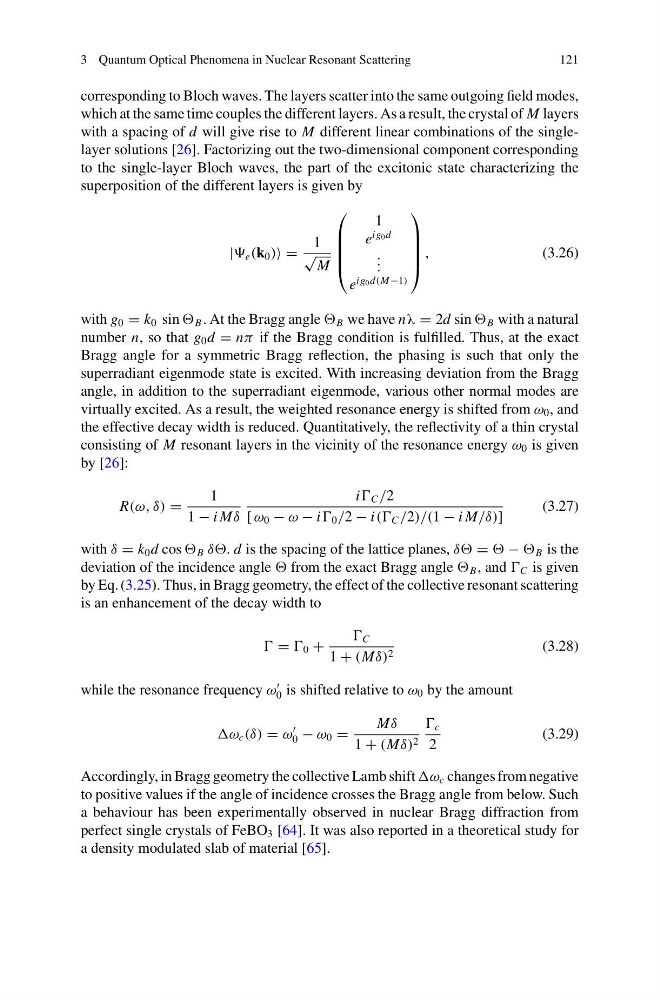
with g 0 = k 0 sin B . At the Bragg angle B we have nλ = 2d sin B with a natural
number n, so that g 0 d = nπ if the Bragg condition is fulfilled. Thus, at the exact
Bragg angle for a symmetric Bragg reflection, the phasing is such that only the
superradiant eigenmode state is excited. With increasing deviation from the Bragg
angle, in addition to the superradiant eigenmode, various other normal modes are
virtually excited. As a result, the weighted resonance energy is shifted from ω 0 , and
the effective decay width is reduced. Quantitatively, the reflectivity of a thin crystal
consisting of M resonant layers in the vicinity of the resonance energy ω 0 is given
by [26]:
R(ω, δ) =
1
1 − i Mδ
i C /2
[ ω 0 − ω − i 0 /2 − i(( C /2)/(1 − i M/δ)]
(3.27)
with δ = k 0 d cos B δδ. d is the spacing of the lattice planes, δδ = − B is the
deviation of the incidence angle from the exact Bragg angle B , and C is given
by Eq. (3.25). Thus, in Bragg geometry, the effect of the collective resonant scattering
is an enhancement of the decay width to
= 0 +
C
1 + (Mδ) 2
(3.28)
while the resonance frequency ω
0 is shifted relative to ω 0 by the amount
ω c (δ) = ω
0 − ω 0 =
Mδ
1 + (Mδ) 2
c
2
(3.29)
Accordingly, in Bragg geometry the collective Lamb shift ω c changes from negative
to positive values if the angle of incidence crosses the Bragg angle from below. Such
a behaviour has been experimentally observed in nuclear Bragg diffraction from
perfect single crystals of FeBO 3 [64]. It was also reported in a theoretical study for
a density modulated slab of material [65].
121
corresponding to Bloch waves. The layers scatter into the same outgoing field modes,
which at the same time couples the different layers. As a result, the crystal of M layers
with a spacing of d will give rise to M different linear combinations of the singlelayer solutions [26]. Factorizing out the two-dimensional component corresponding
to the single-layer Bloch waves, the part of the excitonic state characterizing the
superposition of the different layers is given by
| e (k 0 ) =
1
√
M
⎛
⎜
⎜
⎜
⎝
1
e
ig 0 d
. . .
e
ig 0 d(M−1)
⎞
⎟
⎟
⎟
⎠
,
(3.26)
with g 0 = k 0 sin B . At the Bragg angle B we have nλ = 2d sin B with a natural
number n, so that g 0 d = nπ if the Bragg condition is fulfilled. Thus, at the exact
Bragg angle for a symmetric Bragg reflection, the phasing is such that only the
superradiant eigenmode state is excited. With increasing deviation from the Bragg
angle, in addition to the superradiant eigenmode, various other normal modes are
virtually excited. As a result, the weighted resonance energy is shifted from ω 0 , and
the effective decay width is reduced. Quantitatively, the reflectivity of a thin crystal
consisting of M resonant layers in the vicinity of the resonance energy ω 0 is given
by [26]:
R(ω, δ) =
1
1 − i Mδ
i C /2
[ ω 0 − ω − i 0 /2 − i(( C /2)/(1 − i M/δ)]
(3.27)
with δ = k 0 d cos B δδ. d is the spacing of the lattice planes, δδ = − B is the
deviation of the incidence angle from the exact Bragg angle B , and C is given
by Eq. (3.25). Thus, in Bragg geometry, the effect of the collective resonant scattering
is an enhancement of the decay width to
= 0 +
C
1 + (Mδ) 2
(3.28)
while the resonance frequency ω
0 is shifted relative to ω 0 by the amount
ω c (δ) = ω
0 − ω 0 =
Mδ
1 + (Mδ) 2
c
2
(3.29)
Accordingly, in Bragg geometry the collective Lamb shift ω c changes from negative
to positive values if the angle of incidence crosses the Bragg angle from below. Such
a behaviour has been experimentally observed in nuclear Bragg diffraction from
perfect single crystals of FeBO 3 [64]. It was also reported in a theoretical study for
a density modulated slab of material [65].