

120
R. Röhlsberger and J. Evers
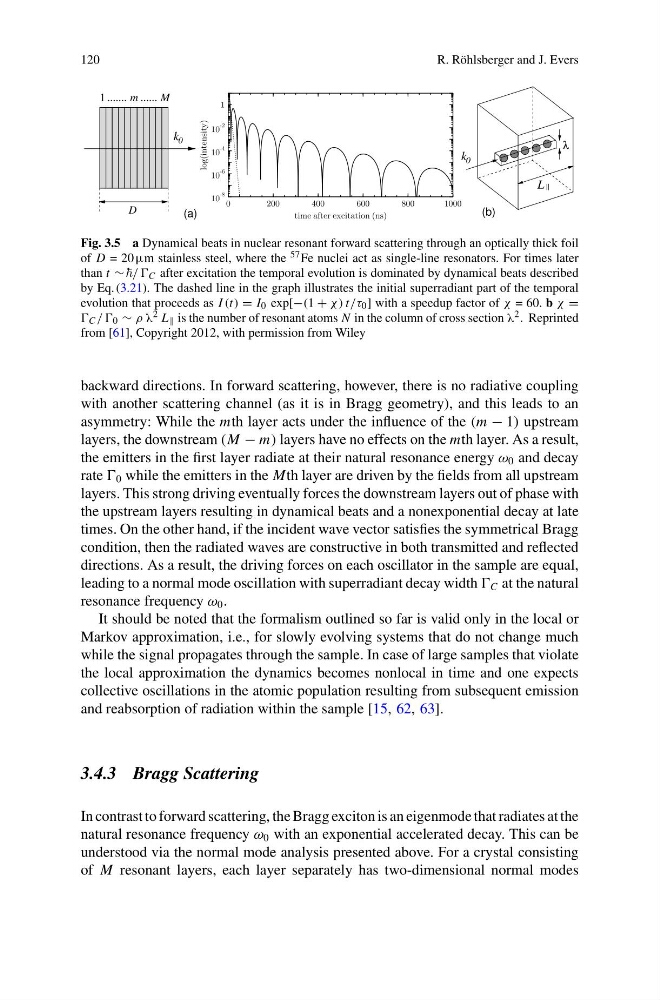
Fig. 3.5 a Dynamical beats in nuclear resonant forward scattering through an optically thick foil
of D = 20μm stainless steel, where the 57 Fe nuclei act as single-line resonators. For times later
than t ∼ / / C after excitation the temporal evolution is dominated by dynamical beats described
by Eq. (3.21). The dashed line in the graph illustrates the initial superradiant part of the temporal
evolution that proceeds as I (t) = I 0 exp[−(1 + χ) t/τ 0 ] with a speedup factor of χ = 60. b χ =
C / / 0 ∼ ρ λ 2 L is the number of resonant atoms N in the column of cross section λ 2 . Reprinted
from [61], Copyright 2012, with permission from Wiley
backward directions. In forward scattering, however, there is no radiative coupling
with another scattering channel (as it is in Bragg geometry), and this leads to an
asymmetry: While the mth layer acts under the influence of the (m − 1) upstream
layers, the downstream (M − m) layers have no effects on the mth layer. As a result,
the emitters in the first layer radiate at their natural resonance energy ω 0 and decay
rate 0 while the emitters in the Mth layer are driven by the fields from all upstream
layers. This strong driving eventually forces the downstream layers out of phase with
the upstream layers resulting in dynamical beats and a nonexponential decay at late
times. On the other hand, if the incident wave vector satisfies the symmetrical Bragg
condition, then the radiated waves are constructive in both transmitted and reflected
directions. As a result, the driving forces on each oscillator in the sample are equal,
leading to a normal mode oscillation with superradiant decay width C at the natural
resonance frequency ω 0 .
It should be noted that the formalism outlined so far is valid only in the local or
Markov approximation, i.e., for slowly evolving systems that do not change much
while the signal propagates through the sample. In case of large samples that violate
the local approximation the dynamics becomes nonlocal in time and one expects
collective oscillations in the atomic population resulting from subsequent emission
and reabsorption of radiation within the sample [15, 62, 63].
3.4.3 Bragg Scattering
In contrast to forward scattering, the Bragg exciton is an eigenmode that radiates at the
natural resonance frequency ω 0 with an exponential accelerated decay. This can be
understood via the normal mode analysis presented above. For a crystal consisting
of M resonant layers, each layer separately has two-dimensional normal modes
R. Röhlsberger and J. Evers
Fig. 3.5 a Dynamical beats in nuclear resonant forward scattering through an optically thick foil
of D = 20μm stainless steel, where the 57 Fe nuclei act as single-line resonators. For times later
than t ∼ / / C after excitation the temporal evolution is dominated by dynamical beats described
by Eq. (3.21). The dashed line in the graph illustrates the initial superradiant part of the temporal
evolution that proceeds as I (t) = I 0 exp[−(1 + χ) t/τ 0 ] with a speedup factor of χ = 60. b χ =
C / / 0 ∼ ρ λ 2 L is the number of resonant atoms N in the column of cross section λ 2 . Reprinted
from [61], Copyright 2012, with permission from Wiley
backward directions. In forward scattering, however, there is no radiative coupling
with another scattering channel (as it is in Bragg geometry), and this leads to an
asymmetry: While the mth layer acts under the influence of the (m − 1) upstream
layers, the downstream (M − m) layers have no effects on the mth layer. As a result,
the emitters in the first layer radiate at their natural resonance energy ω 0 and decay
rate 0 while the emitters in the Mth layer are driven by the fields from all upstream
layers. This strong driving eventually forces the downstream layers out of phase with
the upstream layers resulting in dynamical beats and a nonexponential decay at late
times. On the other hand, if the incident wave vector satisfies the symmetrical Bragg
condition, then the radiated waves are constructive in both transmitted and reflected
directions. As a result, the driving forces on each oscillator in the sample are equal,
leading to a normal mode oscillation with superradiant decay width C at the natural
resonance frequency ω 0 .
It should be noted that the formalism outlined so far is valid only in the local or
Markov approximation, i.e., for slowly evolving systems that do not change much
while the signal propagates through the sample. In case of large samples that violate
the local approximation the dynamics becomes nonlocal in time and one expects
collective oscillations in the atomic population resulting from subsequent emission
and reabsorption of radiation within the sample [15, 62, 63].
3.4.3 Bragg Scattering
In contrast to forward scattering, the Bragg exciton is an eigenmode that radiates at the
natural resonance frequency ω 0 with an exponential accelerated decay. This can be
understood via the normal mode analysis presented above. For a crystal consisting
of M resonant layers, each layer separately has two-dimensional normal modes