

122
R. Röhlsberger and J. Evers
3.5 Cooperative Emission and the Collective Lamb Shift
in a Cavity
It has been shown in the previous Sect. 3.4.3 that radiative eigenstates of a resonant
collection of identical atoms can be selectively excited by proper phasing of the
resonators. This is the case, for example, if the atoms are arranged in a crystal and
the incident wavevector matches a symmetric Bragg reflection. Here we discuss
another phasing scheme for a superradiant eigenstate that leads to large cooperative
effects and exhibits a high degree of experimental tunability. This is the case if the
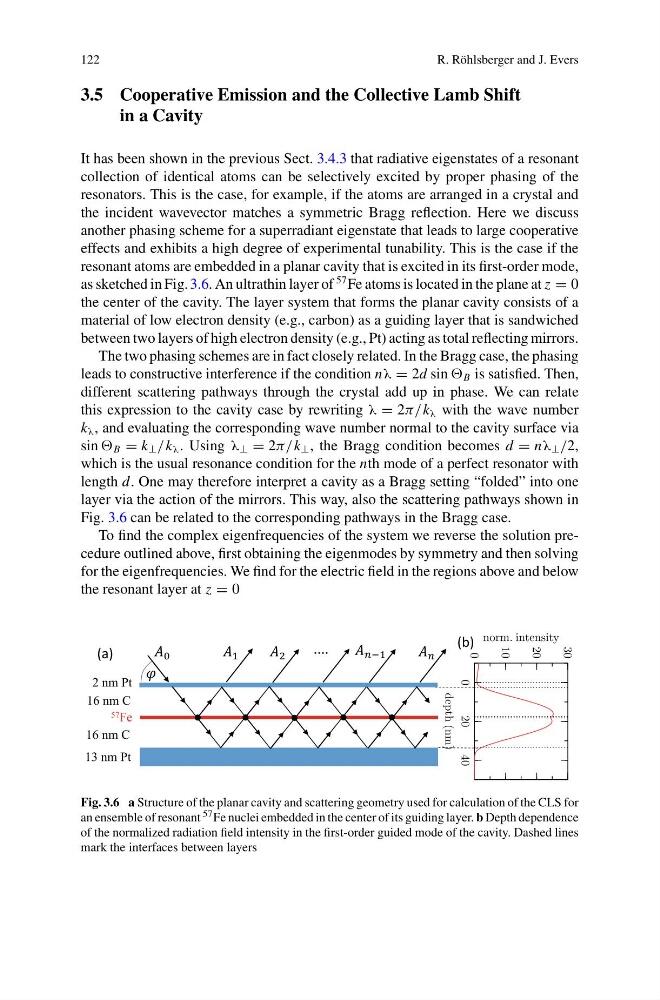
resonant atoms are embedded in a planar cavity that is excited in its first-order mode,
as sketched in Fig. 3.6. An ultrathin layer of
57 Fe atoms is located in the plane at z = 0
the center of the cavity. The layer system that forms the planar cavity consists of a
material of low electron density (e.g., carbon) as a guiding layer that is sandwiched
between two layers of high electron density (e.g., Pt) acting as total reflecting mirrors.
The two phasing schemes are in fact closely related. In the Bragg case, the phasing
leads to constructive interference if the condition nλ = 2d sin B is satisfied. Then,
different scattering pathways through the crystal add up in phase. We can relate
this expression to the cavity case by rewriting λ = 2π/k λ with the wave number
k λ , and evaluating the corresponding wave number normal to the cavity surface via
sin B = k ⊥ /k λ . Using λ ⊥ = 2π/k ⊥ , the Bragg condition becomes d = nλ ⊥ /2,
which is the usual resonance condition for the nth mode of a perfect resonator with
length d. One may therefore interpret a cavity as a Bragg setting “folded” into one
layer via the action of the mirrors. This way, also the scattering pathways shown in
Fig. 3.6 can be related to the corresponding pathways in the Bragg case.
To find the complex eigenfrequencies of the system we reverse the solution precedure outlined above, first obtaining the eigenmodes by symmetry and then solving
for the eigenfrequencies. We find for the electric field in the regions above and below
the resonant layer at z = 0
Fig. 3.6 a Structure of the planar cavity and scattering geometry used for calculation of the CLS for
an ensemble of resonant 57 Fe nuclei embedded in the center of its guiding layer. b Depth dependence
of the normalized radiation field intensity in the first-order guided mode of the cavity. Dashed lines
mark the interfaces between layers
R. Röhlsberger and J. Evers
3.5 Cooperative Emission and the Collective Lamb Shift
in a Cavity
It has been shown in the previous Sect. 3.4.3 that radiative eigenstates of a resonant
collection of identical atoms can be selectively excited by proper phasing of the
resonators. This is the case, for example, if the atoms are arranged in a crystal and
the incident wavevector matches a symmetric Bragg reflection. Here we discuss
another phasing scheme for a superradiant eigenstate that leads to large cooperative
effects and exhibits a high degree of experimental tunability. This is the case if the
resonant atoms are embedded in a planar cavity that is excited in its first-order mode,
as sketched in Fig. 3.6. An ultrathin layer of
57 Fe atoms is located in the plane at z = 0
the center of the cavity. The layer system that forms the planar cavity consists of a
material of low electron density (e.g., carbon) as a guiding layer that is sandwiched
between two layers of high electron density (e.g., Pt) acting as total reflecting mirrors.
The two phasing schemes are in fact closely related. In the Bragg case, the phasing
leads to constructive interference if the condition nλ = 2d sin B is satisfied. Then,
different scattering pathways through the crystal add up in phase. We can relate
this expression to the cavity case by rewriting λ = 2π/k λ with the wave number
k λ , and evaluating the corresponding wave number normal to the cavity surface via
sin B = k ⊥ /k λ . Using λ ⊥ = 2π/k ⊥ , the Bragg condition becomes d = nλ ⊥ /2,
which is the usual resonance condition for the nth mode of a perfect resonator with
length d. One may therefore interpret a cavity as a Bragg setting “folded” into one
layer via the action of the mirrors. This way, also the scattering pathways shown in
Fig. 3.6 can be related to the corresponding pathways in the Bragg case.
To find the complex eigenfrequencies of the system we reverse the solution precedure outlined above, first obtaining the eigenmodes by symmetry and then solving
for the eigenfrequencies. We find for the electric field in the regions above and below
the resonant layer at z = 0
Fig. 3.6 a Structure of the planar cavity and scattering geometry used for calculation of the CLS for
an ensemble of resonant 57 Fe nuclei embedded in the center of its guiding layer. b Depth dependence
of the normalized radiation field intensity in the first-order guided mode of the cavity. Dashed lines
mark the interfaces between layers