

94
4 Technetium Coordinated by Organic Ligands …
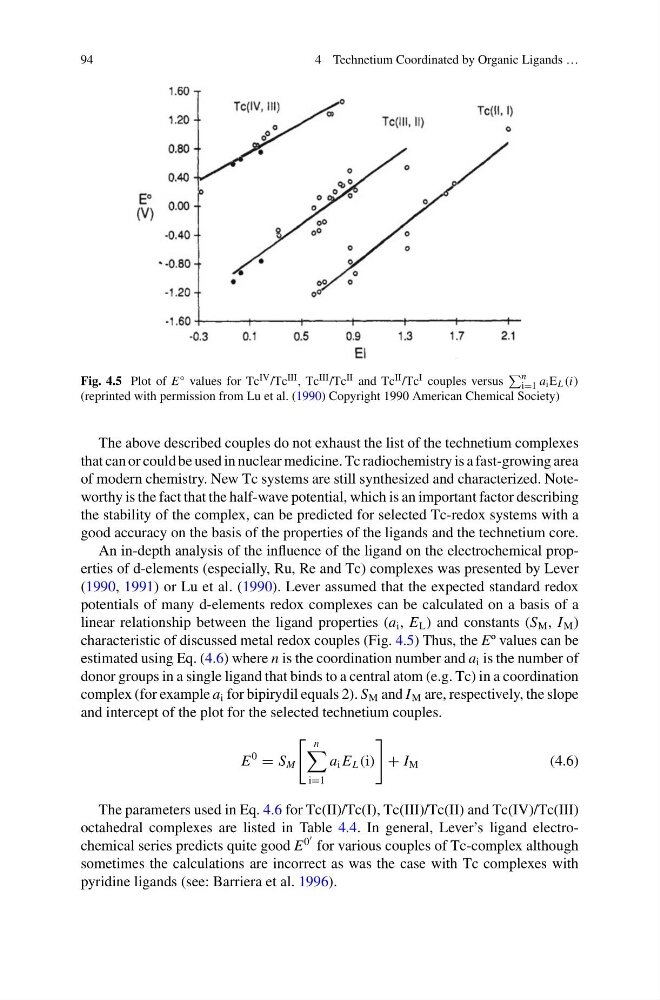
Fig. 4.5 Plot of E° values for Tc IV /Tc III , Tc III /Tc II and Tc II /Tc I couples versus
n
i=1 a i E L (i)
(reprinted with permission from Lu et al. (1990) Copyright 1990 American Chemical Society)
The above described couples do not exhaust the list of the technetium complexes
that can or could be used in nuclear medicine. Tc radiochemistry is a fast-growing area
of modern chemistry. New Tc systems are still synthesized and characterized. Noteworthy is the fact that the half-wave potential, which is an important factor describing
the stability of the complex, can be predicted for selected Tc-redox systems with a
good accuracy on the basis of the properties of the ligands and the technetium core.
An in-depth analysis of the influence of the ligand on the electrochemical properties of d-elements (especially, Ru, Re and Tc) complexes was presented by Lever
(1990, 1991) or Lu et al. (1990). Lever assumed that the expected standard redox
potentials of many d-elements redox complexes can be calculated on a basis of a
linear relationship between the ligand properties (a i , E L ) and constants (S M , I M )
characteristic of discussed metal redox couples (Fig. 4.5) Thus, the Eº values can be
estimated using Eq. (4.6) where n is the coordination number and a i is the number of
donor groups in a single ligand that binds to a central atom (e.g. Tc) in a coordination
complex (for example a i for bipirydil equals 2). S M and I M are, respectively, the slope
and intercept of the plot for the selected technetium couples.
E
0
= S M
n
i=1
a i E L (i)
+ I M
(4.6)
The parameters used in Eq. 4.6 for Tc(II)/Tc(I), Tc(III)/Tc(II) and Tc(IV)/Tc(III)
octahedral complexes are listed in Table 4.4. In general, Lever’s ligand electrochemical series predicts quite good E
0 for various couples of Tc-complex although
sometimes the calculations are incorrect as was the case with Tc complexes with
pyridine ligands (see: Barriera et al. 1996).
4 Technetium Coordinated by Organic Ligands …
Fig. 4.5 Plot of E° values for Tc IV /Tc III , Tc III /Tc II and Tc II /Tc I couples versus
n
i=1 a i E L (i)
(reprinted with permission from Lu et al. (1990) Copyright 1990 American Chemical Society)
The above described couples do not exhaust the list of the technetium complexes
that can or could be used in nuclear medicine. Tc radiochemistry is a fast-growing area
of modern chemistry. New Tc systems are still synthesized and characterized. Noteworthy is the fact that the half-wave potential, which is an important factor describing
the stability of the complex, can be predicted for selected Tc-redox systems with a
good accuracy on the basis of the properties of the ligands and the technetium core.
An in-depth analysis of the influence of the ligand on the electrochemical properties of d-elements (especially, Ru, Re and Tc) complexes was presented by Lever
(1990, 1991) or Lu et al. (1990). Lever assumed that the expected standard redox
potentials of many d-elements redox complexes can be calculated on a basis of a
linear relationship between the ligand properties (a i , E L ) and constants (S M , I M )
characteristic of discussed metal redox couples (Fig. 4.5) Thus, the Eº values can be
estimated using Eq. (4.6) where n is the coordination number and a i is the number of
donor groups in a single ligand that binds to a central atom (e.g. Tc) in a coordination
complex (for example a i for bipirydil equals 2). S M and I M are, respectively, the slope
and intercept of the plot for the selected technetium couples.
E
0
= S M
n
i=1
a i E L (i)
+ I M
(4.6)
The parameters used in Eq. 4.6 for Tc(II)/Tc(I), Tc(III)/Tc(II) and Tc(IV)/Tc(III)
octahedral complexes are listed in Table 4.4. In general, Lever’s ligand electrochemical series predicts quite good E
0 for various couples of Tc-complex although
sometimes the calculations are incorrect as was the case with Tc complexes with
pyridine ligands (see: Barriera et al. 1996).