

4.2 Aqueous Solutions
95
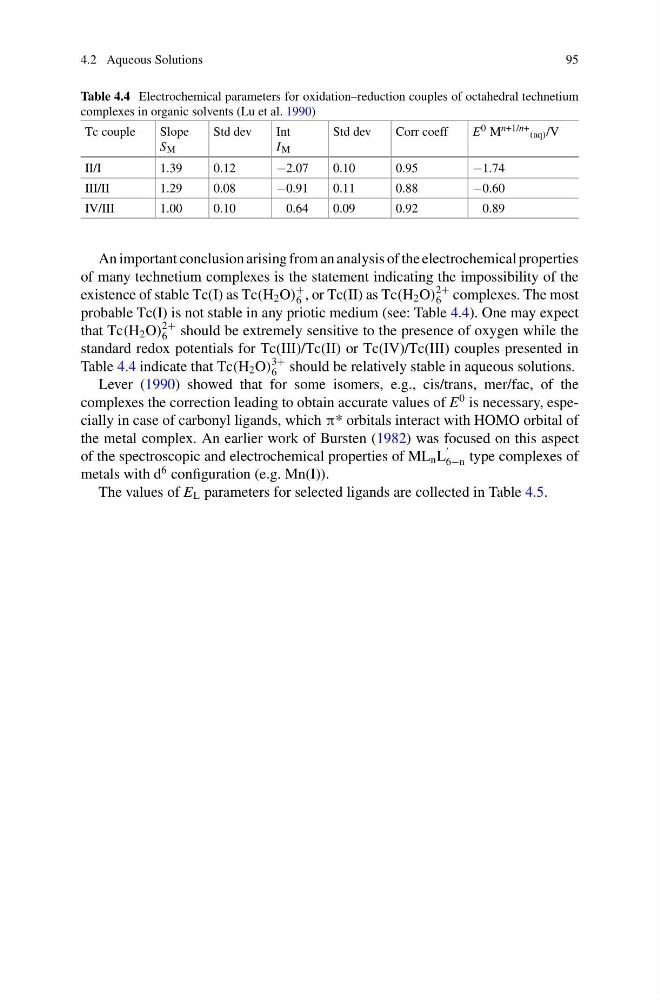
Table 4.4 Electrochemical parameters for oxidation–reduction couples of octahedral technetium
complexes in organic solvents (Lu et al. 1990)
Tc couple
Slope
S M
Std dev
Int
I M
Std dev
Corr coeff
E 0 M n+1/n+ (aq) /V
II/I
1.39
0.12
−2.07
0.10
0.95
−1.74
III/II
1.29
0.08
−0.91
0.11
0.88
−0.60
IV/III
1.00
0.10
0.64
0.09
0.92
0.89
An important conclusion arising from an analysis of the electrochemical properties
of many technetium complexes is the statement indicating the impossibility of the
existence of stable Tc(I) as Tc(H 2 O)
+
6 , or Tc(II) as Tc(H 2 O)
2+
6 complexes. The most
probable Tc(I) is not stable in any priotic medium (see: Table 4.4). One may expect
that Tc(H 2 O)
2+
6 should be extremely sensitive to the presence of oxygen while the
standard redox potentials for Tc(III)/Tc(II) or Tc(IV)/Tc(III) couples presented in
Table 4.4 indicate that Tc(H 2 O)
3+
6 should be relatively stable in aqueous solutions.
Lever (1990) showed that for some isomers, e.g., cis/trans, mer/fac, of the
complexes the correction leading to obtain accurate values of E
0 is necessary, especially in case of carbonyl ligands, which π* orbitals interact with HOMO orbital of
the metal complex. An earlier work of Bursten (1982) was focused on this aspect
of the spectroscopic and electrochemical properties of ML n L
6−n type complexes of
metals with d
6 configuration (e.g. Mn(I)).
The values of E L parameters for selected ligands are collected in Table 4.5.
95
Table 4.4 Electrochemical parameters for oxidation–reduction couples of octahedral technetium
complexes in organic solvents (Lu et al. 1990)
Tc couple
Slope
S M
Std dev
Int
I M
Std dev
Corr coeff
E 0 M n+1/n+ (aq) /V
II/I
1.39
0.12
−2.07
0.10
0.95
−1.74
III/II
1.29
0.08
−0.91
0.11
0.88
−0.60
IV/III
1.00
0.10
0.64
0.09
0.92
0.89
An important conclusion arising from an analysis of the electrochemical properties
of many technetium complexes is the statement indicating the impossibility of the
existence of stable Tc(I) as Tc(H 2 O)
+
6 , or Tc(II) as Tc(H 2 O)
2+
6 complexes. The most
probable Tc(I) is not stable in any priotic medium (see: Table 4.4). One may expect
that Tc(H 2 O)
2+
6 should be extremely sensitive to the presence of oxygen while the
standard redox potentials for Tc(III)/Tc(II) or Tc(IV)/Tc(III) couples presented in
Table 4.4 indicate that Tc(H 2 O)
3+
6 should be relatively stable in aqueous solutions.
Lever (1990) showed that for some isomers, e.g., cis/trans, mer/fac, of the
complexes the correction leading to obtain accurate values of E
0 is necessary, especially in case of carbonyl ligands, which π* orbitals interact with HOMO orbital of
the metal complex. An earlier work of Bursten (1982) was focused on this aspect
of the spectroscopic and electrochemical properties of ML n L
6−n type complexes of
metals with d
6 configuration (e.g. Mn(I)).
The values of E L parameters for selected ligands are collected in Table 4.5.