

4.2 Aqueous Solutions
79
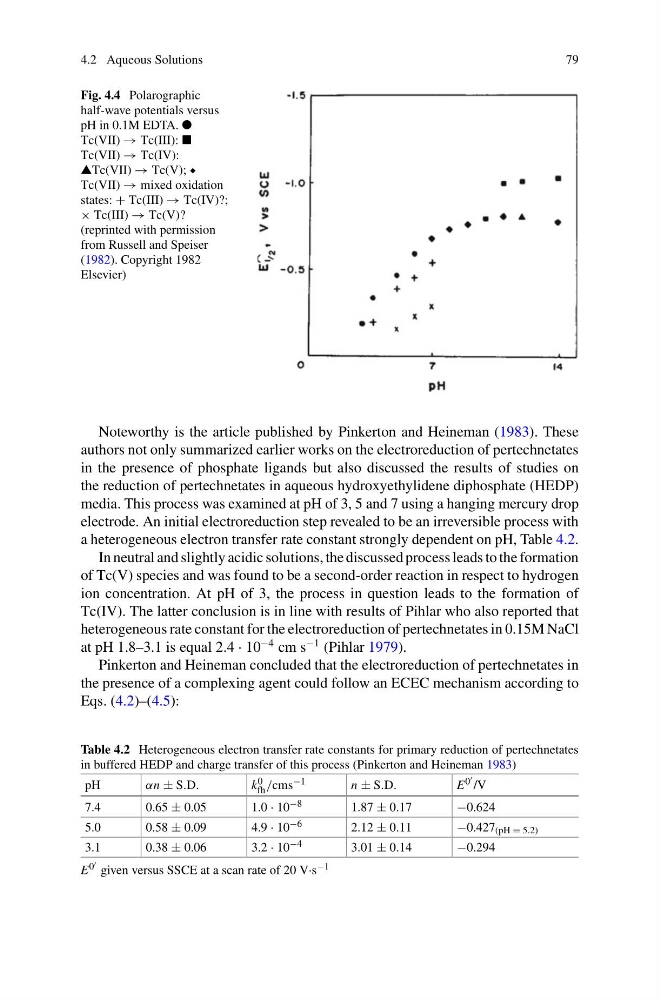
Fig. 4.4 Polarographic
half-wave potentials versus
pH in 0.1M EDTA. ●
Tc(VII) → Tc(III):
Tc(VII) → Tc(IV):
▲Tc(VII) → Tc(V); ˛
Tc(VII) → mixed oxidation
states: + Tc(III) → Tc(IV)?;
× Tc(III) → Tc(V)?
(reprinted with permission
from Russell and Speiser
(1982). Copyright 1982
Elsevier)
Noteworthy is the article published by Pinkerton and Heineman (1983). These
authors not only summarized earlier works on the electroreduction of pertechnetates
in the presence of phosphate ligands but also discussed the results of studies on
the reduction of pertechnetates in aqueous hydroxyethylidene diphosphate (HEDP)
media. This process was examined at pH of 3, 5 and 7 using a hanging mercury drop
electrode. An initial electroreduction step revealed to be an irreversible process with
a heterogeneous electron transfer rate constant strongly dependent on pH, Table 4.2.
In neutral and slightly acidic solutions, the discussed process leads to the formation
of Tc(V) species and was found to be a second-order reaction in respect to hydrogen
ion concentration. At pH of 3, the process in question leads to the formation of
Tc(IV). The latter conclusion is in line with results of Pihlar who also reported that
heterogeneous rate constant for the electroreduction of pertechnetates in 0.15M NaCl
at pH 1.8–3.1 is equal 2.4 · 10
−4 cm s
−1 (Pihlar 1979).
Pinkerton and Heineman concluded that the electroreduction of pertechnetates in
the presence of a complexing agent could follow an ECEC mechanism according to
Eqs. (4.2)–(4.5):
Table 4.2 Heterogeneous electron transfer rate constants for primary reduction of pertechnetates
in buffered HEDP and charge transfer of this process (Pinkerton and Heineman 1983)
pH
αn ± S.D.
k 0
fh /cms −1
n ± S.D.
E 0 /V
7.4
0.65 ± 0.05
1.0 · 10 −8
1.87 ± 0.17
−0.624
5.0
0.58 ± 0.09
4.9 · 10 −6
2.12 ± 0.11
−0.427 (pH = 5.2)
3.1
0.38 ± 0.06
3.2 · 10 −4
3.01 ± 0.14
−0.294
E 0 given versus SSCE at a scan rate of 20 V·s −1
79
Fig. 4.4 Polarographic
half-wave potentials versus
pH in 0.1M EDTA. ●
Tc(VII) → Tc(III):
Tc(VII) → Tc(IV):
▲Tc(VII) → Tc(V); ˛
Tc(VII) → mixed oxidation
states: + Tc(III) → Tc(IV)?;
× Tc(III) → Tc(V)?
(reprinted with permission
from Russell and Speiser
(1982). Copyright 1982
Elsevier)
Noteworthy is the article published by Pinkerton and Heineman (1983). These
authors not only summarized earlier works on the electroreduction of pertechnetates
in the presence of phosphate ligands but also discussed the results of studies on
the reduction of pertechnetates in aqueous hydroxyethylidene diphosphate (HEDP)
media. This process was examined at pH of 3, 5 and 7 using a hanging mercury drop
electrode. An initial electroreduction step revealed to be an irreversible process with
a heterogeneous electron transfer rate constant strongly dependent on pH, Table 4.2.
In neutral and slightly acidic solutions, the discussed process leads to the formation
of Tc(V) species and was found to be a second-order reaction in respect to hydrogen
ion concentration. At pH of 3, the process in question leads to the formation of
Tc(IV). The latter conclusion is in line with results of Pihlar who also reported that
heterogeneous rate constant for the electroreduction of pertechnetates in 0.15M NaCl
at pH 1.8–3.1 is equal 2.4 · 10
−4 cm s
−1 (Pihlar 1979).
Pinkerton and Heineman concluded that the electroreduction of pertechnetates in
the presence of a complexing agent could follow an ECEC mechanism according to
Eqs. (4.2)–(4.5):
Table 4.2 Heterogeneous electron transfer rate constants for primary reduction of pertechnetates
in buffered HEDP and charge transfer of this process (Pinkerton and Heineman 1983)
pH
αn ± S.D.
k 0
fh /cms −1
n ± S.D.
E 0 /V
7.4
0.65 ± 0.05
1.0 · 10 −8
1.87 ± 0.17
−0.624
5.0
0.58 ± 0.09
4.9 · 10 −6
2.12 ± 0.11
−0.427 (pH = 5.2)
3.1
0.38 ± 0.06
3.2 · 10 −4
3.01 ± 0.14
−0.294
E 0 given versus SSCE at a scan rate of 20 V·s −1