

80
4 Technetium Coordinated by Organic Ligands …
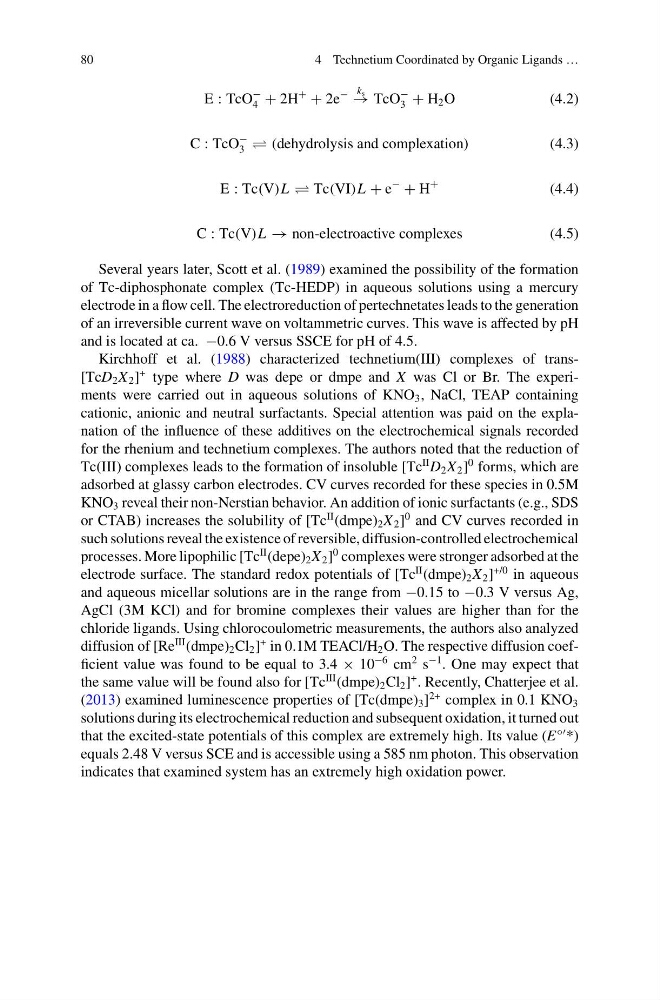
E : TcO
−
4 + 2H
+
+ 2e
− k s
→ TcO
−
3 + H 2 O
( 4 . 2 )
C : TcO
−
3 (dehydrolysis and complexation)
(4.3)
E : Tc(V)L Tc(VI)L + e
−
+ H
+
(4.4)
C : Tc(V)L → non-electroactive complexes
(4.5)
Several years later, Scott et al. (1989) examined the possibility of the formation
of Tc-diphosphonate complex (Tc-HEDP) in aqueous solutions using a mercury
electrode in a flow cell. The electroreduction of pertechnetates leads to the generation
of an irreversible current wave on voltammetric curves. This wave is affected by pH
and is located at ca. −0.6 V versus SSCE for pH of 4.5.
Kirchhoff et al. (1988) characterized technetium(III) complexes of trans[TcD 2 X 2 ]
+ type where D was depe or dmpe and X was Cl or Br. The experiments were carried out in aqueous solutions of KNO 3 , NaCl, TEAP containing
cationic, anionic and neutral surfactants. Special attention was paid on the explanation of the influence of these additives on the electrochemical signals recorded
for the rhenium and technetium complexes. The authors noted that the reduction of
Tc(III) complexes leads to the formation of insoluble [Tc
II D 2 X 2 ]
0 forms, which are
adsorbed at glassy carbon electrodes. CV curves recorded for these species in 0.5M
KNO 3 reveal their non-Nerstian behavior. An addition of ionic surfactants (e.g., SDS
or CTAB) increases the solubility of [Tc
II (dmpe) 2 X 2 ]
0 and CV curves recorded in
such solutions reveal the existence of reversible, diffusion-controlled electrochemical
processes. More lipophilic [Tc
II (depe) 2 X 2 ]
0 complexes were stronger adsorbed at the
electrode surface. The standard redox potentials of [Tc
II (dmpe) 2 X 2 ]
+/0 in aqueous
and aqueous micellar solutions are in the range from −0.15 to −0.3 V versus Ag,
AgCl (3M KCl) and for bromine complexes their values are higher than for the
chloride ligands. Using chlorocoulometric measurements, the authors also analyzed
diffusion of [Re
III (dmpe) 2 Cl 2 ]
+ in 0.1M TEACl/H 2 O. The respective diffusion coefficient value was found to be equal to 3.4 × 10
−6 cm
2 s
−1 . One may expect that
the same value will be found also for [Tc
III (dmpe) 2 Cl 2 ]
+ . Recently, Chatterjee et al.
(2013) examined luminescence properties of [Tc(dmpe) 3 ]
2+ complex in 0.1 KNO 3
solutions during its electrochemical reduction and subsequent oxidation, it turned out
that the excited-state potentials of this complex are extremely high. Its value (E°
*)
equals 2.48 V versus SCE and is accessible using a 585 nm photon. This observation
indicates that examined system has an extremely high oxidation power.
4 Technetium Coordinated by Organic Ligands …
E : TcO
−
4 + 2H
+
+ 2e
− k s
→ TcO
−
3 + H 2 O
( 4 . 2 )
C : TcO
−
3 (dehydrolysis and complexation)
(4.3)
E : Tc(V)L Tc(VI)L + e
−
+ H
+
(4.4)
C : Tc(V)L → non-electroactive complexes
(4.5)
Several years later, Scott et al. (1989) examined the possibility of the formation
of Tc-diphosphonate complex (Tc-HEDP) in aqueous solutions using a mercury
electrode in a flow cell. The electroreduction of pertechnetates leads to the generation
of an irreversible current wave on voltammetric curves. This wave is affected by pH
and is located at ca. −0.6 V versus SSCE for pH of 4.5.
Kirchhoff et al. (1988) characterized technetium(III) complexes of trans[TcD 2 X 2 ]
+ type where D was depe or dmpe and X was Cl or Br. The experiments were carried out in aqueous solutions of KNO 3 , NaCl, TEAP containing
cationic, anionic and neutral surfactants. Special attention was paid on the explanation of the influence of these additives on the electrochemical signals recorded
for the rhenium and technetium complexes. The authors noted that the reduction of
Tc(III) complexes leads to the formation of insoluble [Tc
II D 2 X 2 ]
0 forms, which are
adsorbed at glassy carbon electrodes. CV curves recorded for these species in 0.5M
KNO 3 reveal their non-Nerstian behavior. An addition of ionic surfactants (e.g., SDS
or CTAB) increases the solubility of [Tc
II (dmpe) 2 X 2 ]
0 and CV curves recorded in
such solutions reveal the existence of reversible, diffusion-controlled electrochemical
processes. More lipophilic [Tc
II (depe) 2 X 2 ]
0 complexes were stronger adsorbed at the
electrode surface. The standard redox potentials of [Tc
II (dmpe) 2 X 2 ]
+/0 in aqueous
and aqueous micellar solutions are in the range from −0.15 to −0.3 V versus Ag,
AgCl (3M KCl) and for bromine complexes their values are higher than for the
chloride ligands. Using chlorocoulometric measurements, the authors also analyzed
diffusion of [Re
III (dmpe) 2 Cl 2 ]
+ in 0.1M TEACl/H 2 O. The respective diffusion coefficient value was found to be equal to 3.4 × 10
−6 cm
2 s
−1 . One may expect that
the same value will be found also for [Tc
III (dmpe) 2 Cl 2 ]
+ . Recently, Chatterjee et al.
(2013) examined luminescence properties of [Tc(dmpe) 3 ]
2+ complex in 0.1 KNO 3
solutions during its electrochemical reduction and subsequent oxidation, it turned out
that the excited-state potentials of this complex are extremely high. Its value (E°
*)
equals 2.48 V versus SCE and is accessible using a 585 nm photon. This observation
indicates that examined system has an extremely high oxidation power.