

60
3 Technetium Coordinated by Inorganic Ligands in Aqueous …
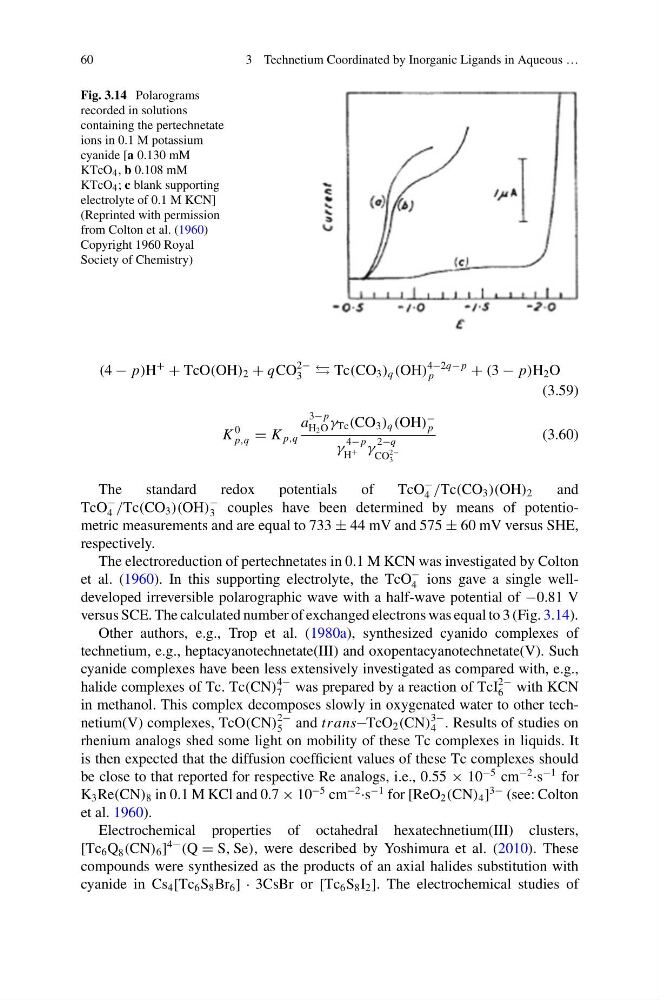
Fig. 3.14 Polarograms
recorded in solutions
containing the pertechnetate
ions in 0.1 M potassium
cyanide [a 0.130 mM
KTcO 4 , b 0.108 mM
KTcO 4 ; c blank supporting
electrolyte of 0.1 M KCN]
(Reprinted with permission
from Colton et al. (1960)
Copyright 1960 Royal
Society of Chemistry)
(4 − p)H
+
+ TcO(OH) 2 + qCO
2−
3 Tc(CO 3 ) q (OH)
4−2q− p
p
+ (3 − p)H 2 O
(3.59)
K
0
p,q = K p,q
a
3− p
H 2 O γ Tc (CO 3 ) q (OH)
−
p
γ
4− p
H
+ γ
2−q
CO
2−
3
(3.60)
The
standard
redox
potentials
of
TcO
−
4 /Tc(CO 3 )(OH) 2
and
TcO
−
4 /Tc(CO 3 )(OH)
−
3 couples have been determined by means of potentiometric measurements and are equal to 733 ± 44 mV and 575 ± 60 mV versus SHE,
respectively.
The electroreduction of pertechnetates in 0.1 M KCN was investigated by Colton
et al. (1960). In this supporting electrolyte, the TcO
−
4 ions gave a single welldeveloped irreversible polarographic wave with a half-wave potential of −0.81 V
versus SCE. The calculated number of exchanged electrons was equal to 3 (Fig. 3.14).
Other authors, e.g., Trop et al. (1980a), synthesized cyanido complexes of
technetium, e.g., heptacyanotechnetate(III) and oxopentacyanotechnetate(V). Such
cyanide complexes have been less extensively investigated as compared with, e.g.,
halide complexes of Tc. Tc(CN)
4−
7 was prepared by a reaction of TcI
2−
6 with KCN
in methanol. This complex decomposes slowly in oxygenated water to other technetium(V) complexes, TcO(CN)
2−
5 and trans−TcO 2 (CN)
3−
4 . Results of studies on
rhenium analogs shed some light on mobility of these Tc complexes in liquids. It
is then expected that the diffusion coefficient values of these Tc complexes should
be close to that reported for respective Re analogs, i.e., 0.55 × 10
−5 cm
−2 ·s
−1 for
K 3 Re(CN) 8 in 0.1 M KCl and 0.7 × 10
−5 cm
−2 ·s
−1 for [ReO 2 (CN) 4 ]
3− (see: Colton
et al. 1960).
Electrochemical properties of octahedral hexatechnetium(III) clusters,
[Tc 6 Q 8 (CN) 6 ]
4−
(Q = S, Se), were described by Yoshimura et al. (2010). These
compounds were synthesized as the products of an axial halides substitution with
cyanide in Cs 4 [Tc 6 S 8 Br 6 ] · 3CsBr or [Tc 6 S 8 I 2 ]. The electrochemical studies of
3 Technetium Coordinated by Inorganic Ligands in Aqueous …
Fig. 3.14 Polarograms
recorded in solutions
containing the pertechnetate
ions in 0.1 M potassium
cyanide [a 0.130 mM
KTcO 4 , b 0.108 mM
KTcO 4 ; c blank supporting
electrolyte of 0.1 M KCN]
(Reprinted with permission
from Colton et al. (1960)
Copyright 1960 Royal
Society of Chemistry)
(4 − p)H
+
+ TcO(OH) 2 + qCO
2−
3 Tc(CO 3 ) q (OH)
4−2q− p
p
+ (3 − p)H 2 O
(3.59)
K
0
p,q = K p,q
a
3− p
H 2 O γ Tc (CO 3 ) q (OH)
−
p
γ
4− p
H
+ γ
2−q
CO
2−
3
(3.60)
The
standard
redox
potentials
of
TcO
−
4 /Tc(CO 3 )(OH) 2
and
TcO
−
4 /Tc(CO 3 )(OH)
−
3 couples have been determined by means of potentiometric measurements and are equal to 733 ± 44 mV and 575 ± 60 mV versus SHE,
respectively.
The electroreduction of pertechnetates in 0.1 M KCN was investigated by Colton
et al. (1960). In this supporting electrolyte, the TcO
−
4 ions gave a single welldeveloped irreversible polarographic wave with a half-wave potential of −0.81 V
versus SCE. The calculated number of exchanged electrons was equal to 3 (Fig. 3.14).
Other authors, e.g., Trop et al. (1980a), synthesized cyanido complexes of
technetium, e.g., heptacyanotechnetate(III) and oxopentacyanotechnetate(V). Such
cyanide complexes have been less extensively investigated as compared with, e.g.,
halide complexes of Tc. Tc(CN)
4−
7 was prepared by a reaction of TcI
2−
6 with KCN
in methanol. This complex decomposes slowly in oxygenated water to other technetium(V) complexes, TcO(CN)
2−
5 and trans−TcO 2 (CN)
3−
4 . Results of studies on
rhenium analogs shed some light on mobility of these Tc complexes in liquids. It
is then expected that the diffusion coefficient values of these Tc complexes should
be close to that reported for respective Re analogs, i.e., 0.55 × 10
−5 cm
−2 ·s
−1 for
K 3 Re(CN) 8 in 0.1 M KCl and 0.7 × 10
−5 cm
−2 ·s
−1 for [ReO 2 (CN) 4 ]
3− (see: Colton
et al. 1960).
Electrochemical properties of octahedral hexatechnetium(III) clusters,
[Tc 6 Q 8 (CN) 6 ]
4−
(Q = S, Se), were described by Yoshimura et al. (2010). These
compounds were synthesized as the products of an axial halides substitution with
cyanide in Cs 4 [Tc 6 S 8 Br 6 ] · 3CsBr or [Tc 6 S 8 I 2 ]. The electrochemical studies of