

3.2 Alkaline solutions
59
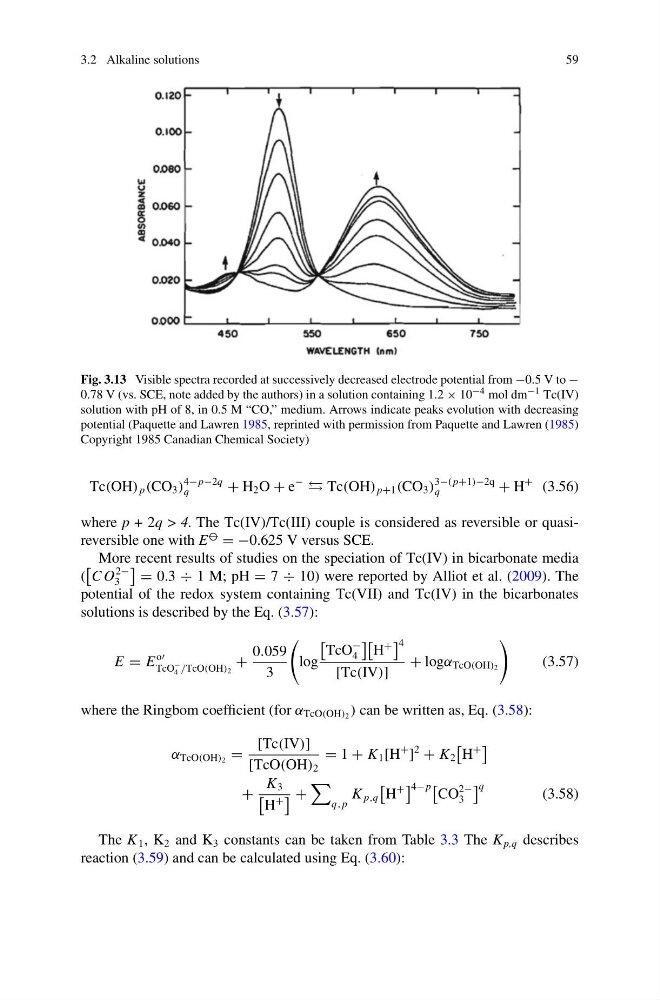
Fig. 3.13 Visible spectra recorded at successively decreased electrode potential from −0.5 V to −
0.78 V (vs. SCE, note added by the authors) in a solution containing 1.2 × 10 −4 mol dm −1 Tc(IV)
solution with pH of 8, in 0.5 M “CO,” medium. Arrows indicate peaks evolution with decreasing
potential (Paquette and Lawren 1985, reprinted with permission from Paquette and Lawren (1985)
Copyright 1985 Canadian Chemical Society)
Tc(OH) p (CO 3 )
4− p−2q
q
+ H 2 O + e
−
Tc(OH) p+1 (CO 3 )
3−( p+1)−2q
q
+ H
+ (3.56)
where p + 2q > 4. The Tc(IV)/Tc(III) couple is considered as reversible or quasireversible one with E
⦵
= −0.625 V versus SCE.
More recent results of studies on the speciation of Tc(IV) in bicarbonate media
(
C O
2−
3
= 0.3 ÷ 1 M; pH = 7 ÷ 10) were reported by Alliot et al. (2009). The
potential of the redox system containing Tc(VII) and Tc(IV) in the bicarbonates
solutions is described by the Eq. (3.57):
E = E
o
TcO
−
4 /TcO(OH) 2
+
0.059
3
log
TcO
−
4
H
+
4
[Tc(IV)]
+ logα TcO(OH) 2
(3.57)
where the Ringbom coefficient (for α TcO(OH) 2 ) can be written as, Eq. (3.58):
α TcO(OH) 2 =
[Tc(IV)]
[TcO(OH) 2
= 1 + K 1 [H
+
]
2
+ K 2
H
+
+
K 3
H
+
+
q, p
K p,q
H
+
4− p
CO
2−
3
q
(3.58)
The K 1 , K 2 and K 3 constants can be taken from Table 3.3 The K p,q describes
reaction (3.59) and can be calculated using Eq. (3.60):
59
Fig. 3.13 Visible spectra recorded at successively decreased electrode potential from −0.5 V to −
0.78 V (vs. SCE, note added by the authors) in a solution containing 1.2 × 10 −4 mol dm −1 Tc(IV)
solution with pH of 8, in 0.5 M “CO,” medium. Arrows indicate peaks evolution with decreasing
potential (Paquette and Lawren 1985, reprinted with permission from Paquette and Lawren (1985)
Copyright 1985 Canadian Chemical Society)
Tc(OH) p (CO 3 )
4− p−2q
q
+ H 2 O + e
−
Tc(OH) p+1 (CO 3 )
3−( p+1)−2q
q
+ H
+ (3.56)
where p + 2q > 4. The Tc(IV)/Tc(III) couple is considered as reversible or quasireversible one with E
⦵
= −0.625 V versus SCE.
More recent results of studies on the speciation of Tc(IV) in bicarbonate media
(
C O
2−
3
= 0.3 ÷ 1 M; pH = 7 ÷ 10) were reported by Alliot et al. (2009). The
potential of the redox system containing Tc(VII) and Tc(IV) in the bicarbonates
solutions is described by the Eq. (3.57):
E = E
o
TcO
−
4 /TcO(OH) 2
+
0.059
3
log
TcO
−
4
H
+
4
[Tc(IV)]
+ logα TcO(OH) 2
(3.57)
where the Ringbom coefficient (for α TcO(OH) 2 ) can be written as, Eq. (3.58):
α TcO(OH) 2 =
[Tc(IV)]
[TcO(OH) 2
= 1 + K 1 [H
+
]
2
+ K 2
H
+
+
K 3
H
+
+
q, p
K p,q
H
+
4− p
CO
2−
3
q
(3.58)
The K 1 , K 2 and K 3 constants can be taken from Table 3.3 The K p,q describes
reaction (3.59) and can be calculated using Eq. (3.60):