

58
3 Technetium Coordinated by Inorganic Ligands in Aqueous …
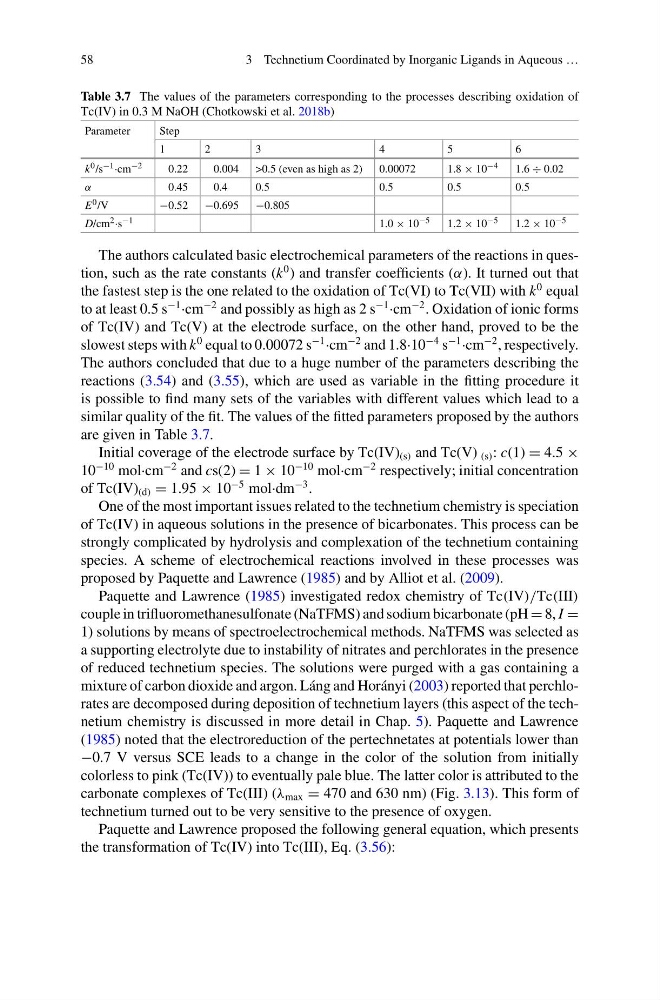
Table 3.7 The values of the parameters corresponding to the processes describing oxidation of
Tc(IV) in 0.3 M NaOH (Chotkowski et al. 2018b)
Parameter
Step
1
2
3
4
5
6
k 0 /s −1 ·cm −2
0.22
0.004 >0.5 (even as high as 2) 0.00072
1.8 × 10 −4
1.6 ÷ 0.02
α
0.45
0.4
0.5
0.5
0.5
0.5
E 0 /V
−0.52 −0.695 −0.805
D/cm 2 ·s −1
1.0 × 10 −5
1.2 × 10 −5
1.2 × 10 −5
The authors calculated basic electrochemical parameters of the reactions in question, such as the rate constants (k
0 ) and transfer coefficients (α). It turned out that
the fastest step is the one related to the oxidation of Tc(VI) to Tc(VII) with k
0 equal
to at least 0.5 s
−1 ·cm
−2 and possibly as high as 2 s
−1 ·cm
−2 . Oxidation of ionic forms
of Tc(IV) and Tc(V) at the electrode surface, on the other hand, proved to be the
slowest steps with k
0 equal to 0.00072 s
−1 ·cm
−2 and 1.8·10
−4 s
−1 ·cm
−2 , respectively.
The authors concluded that due to a huge number of the parameters describing the
reactions (3.54) and (3.55), which are used as variable in the fitting procedure it
is possible to find many sets of the variables with different values which lead to a
similar quality of the fit. The values of the fitted parameters proposed by the authors
are given in Table 3.7.
Initial coverage of the electrode surface by Tc(IV) (s) and Tc(V) (s) : c(1) = 4.5 ×
10
−10 mol·cm
−2 and cs(2) = 1 × 10
−10 mol·cm
−2 respectively; initial concentration
of Tc(IV) (d) = 1.95 × 10
−5 mol·dm
−3 .
One of the most important issues related to the technetium chemistry is speciation
of Tc(IV) in aqueous solutions in the presence of bicarbonates. This process can be
strongly complicated by hydrolysis and complexation of the technetium containing
species. A scheme of electrochemical reactions involved in these processes was
proposed by Paquette and Lawrence (1985) and by Alliot et al. (2009).
Paquette and Lawrence (1985) investigated redox chemistry of Tc(IV)/Tc(III)
couple in trifluoromethanesulfonate (NaTFMS) and sodium bicarbonate (pH = 8, I =
1) solutions by means of spectroelectrochemical methods. NaTFMS was selected as
a supporting electrolyte due to instability of nitrates and perchlorates in the presence
of reduced technetium species. The solutions were purged with a gas containing a
mixture of carbon dioxide and argon. Láng and Horányi (2003) reported that perchlorates are decomposed during deposition of technetium layers (this aspect of the technetium chemistry is discussed in more detail in Chap. 5). Paquette and Lawrence
(1985) noted that the electroreduction of the pertechnetates at potentials lower than
−0.7 V versus SCE leads to a change in the color of the solution from initially
colorless to pink (Tc(IV)) to eventually pale blue. The latter color is attributed to the
carbonate complexes of Tc(III) (λ max = 470 and 630 nm) (Fig. 3.13). This form of
technetium turned out to be very sensitive to the presence of oxygen.
Paquette and Lawrence proposed the following general equation, which presents
the transformation of Tc(IV) into Tc(III), Eq. (3.56):
3 Technetium Coordinated by Inorganic Ligands in Aqueous …
Table 3.7 The values of the parameters corresponding to the processes describing oxidation of
Tc(IV) in 0.3 M NaOH (Chotkowski et al. 2018b)
Parameter
Step
1
2
3
4
5
6
k 0 /s −1 ·cm −2
0.22
0.004 >0.5 (even as high as 2) 0.00072
1.8 × 10 −4
1.6 ÷ 0.02
α
0.45
0.4
0.5
0.5
0.5
0.5
E 0 /V
−0.52 −0.695 −0.805
D/cm 2 ·s −1
1.0 × 10 −5
1.2 × 10 −5
1.2 × 10 −5
The authors calculated basic electrochemical parameters of the reactions in question, such as the rate constants (k
0 ) and transfer coefficients (α). It turned out that
the fastest step is the one related to the oxidation of Tc(VI) to Tc(VII) with k
0 equal
to at least 0.5 s
−1 ·cm
−2 and possibly as high as 2 s
−1 ·cm
−2 . Oxidation of ionic forms
of Tc(IV) and Tc(V) at the electrode surface, on the other hand, proved to be the
slowest steps with k
0 equal to 0.00072 s
−1 ·cm
−2 and 1.8·10
−4 s
−1 ·cm
−2 , respectively.
The authors concluded that due to a huge number of the parameters describing the
reactions (3.54) and (3.55), which are used as variable in the fitting procedure it
is possible to find many sets of the variables with different values which lead to a
similar quality of the fit. The values of the fitted parameters proposed by the authors
are given in Table 3.7.
Initial coverage of the electrode surface by Tc(IV) (s) and Tc(V) (s) : c(1) = 4.5 ×
10
−10 mol·cm
−2 and cs(2) = 1 × 10
−10 mol·cm
−2 respectively; initial concentration
of Tc(IV) (d) = 1.95 × 10
−5 mol·dm
−3 .
One of the most important issues related to the technetium chemistry is speciation
of Tc(IV) in aqueous solutions in the presence of bicarbonates. This process can be
strongly complicated by hydrolysis and complexation of the technetium containing
species. A scheme of electrochemical reactions involved in these processes was
proposed by Paquette and Lawrence (1985) and by Alliot et al. (2009).
Paquette and Lawrence (1985) investigated redox chemistry of Tc(IV)/Tc(III)
couple in trifluoromethanesulfonate (NaTFMS) and sodium bicarbonate (pH = 8, I =
1) solutions by means of spectroelectrochemical methods. NaTFMS was selected as
a supporting electrolyte due to instability of nitrates and perchlorates in the presence
of reduced technetium species. The solutions were purged with a gas containing a
mixture of carbon dioxide and argon. Láng and Horányi (2003) reported that perchlorates are decomposed during deposition of technetium layers (this aspect of the technetium chemistry is discussed in more detail in Chap. 5). Paquette and Lawrence
(1985) noted that the electroreduction of the pertechnetates at potentials lower than
−0.7 V versus SCE leads to a change in the color of the solution from initially
colorless to pink (Tc(IV)) to eventually pale blue. The latter color is attributed to the
carbonate complexes of Tc(III) (λ max = 470 and 630 nm) (Fig. 3.13). This form of
technetium turned out to be very sensitive to the presence of oxygen.
Paquette and Lawrence proposed the following general equation, which presents
the transformation of Tc(IV) into Tc(III), Eq. (3.56):